


Azerbaijan has accused Armenia of attacking large cities overnight in violation of a ceasefire deal brokered by Russia that seeks to end the worst outbreak of hostilities in the separatist Nagorno-Karabakh region.
The Azerbaijani authorities yesterday said that nine civilians have been killed and more than 30 wounded after Armenian forces fired missiles overnight on Ganja, Azerbaijan’s second-largest city, and hit a residential building.
The city of Mingachevir also came under missile attacks early yesterday, the Azerbaijani Prosecutor General’s office said.
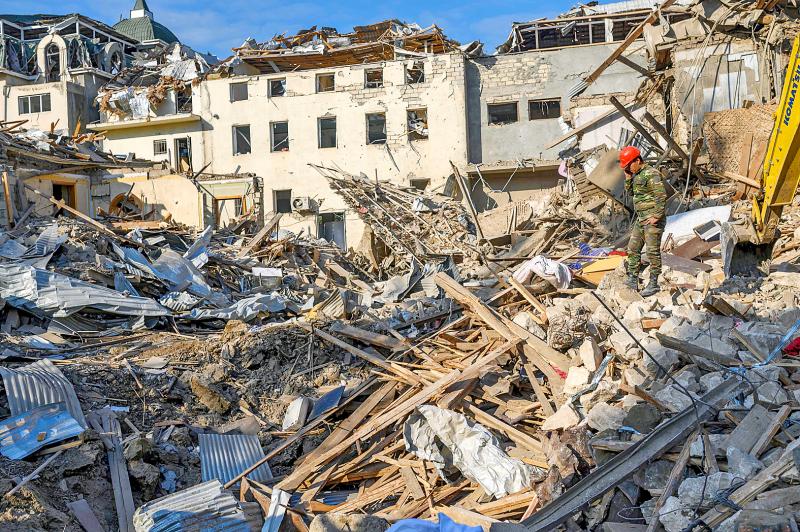
Photo: AFP
Nagorno-Karabakh’s military officials denied attacking Ganja and said the territory’s army is observing the ceasefire.
They added that Azerbaijani forces shelled Stepanakert, the region’s capital, and other towns during the night in violation of the truce.
The recent bout of fighting between Azerbaijani and Armenian forces started on Sept. 27 and left hundreds of people dead in the biggest escalation of the decades-old conflict over Nagorno-Karabakh since a separatist war there ended in 1994.
The region lies in Azerbaijan, but has been under control of ethnic Armenian forces backed by Armenia.
The foreign ministers of Armenia and Azerbaijan signed a truce in Moscow after Russian President Vladimir Putin had brokered it in a series of calls with Azerbaijani President Ilham Aliyev and Armenian Prime Minister Nikol Pashinian.
The ceasefire deal was announced early on Saturday, after 10 hours of talks in the Russian capital sponsored by Russian Minister of Foreign Affairs Sergey Lavrov, and took effect at noon.
The deal stipulated that the ceasefire should pave the way for talks on settling the conflict.
If the truce had held, it would mark a major diplomatic coup for Russia, which has a security pact with Armenia, but also cultivated warm ties with Azerbaijan.
However, minutes after the ceasefire took force, both sides accused each other of continuing attacks in violation of the deal.
The situation in the region was “relatively calm” yesterday morning, Nagorno-Karabakh leader Arayik Harutyunyan said, with only minor hostilities along the front line.
However, it was unclear whether the calm would last, he said.
“There is no shelling of our towns and villages. At the front line, there is some shooting with the use of artillery. There are some skirmishes on the border,” Harutyunyan said. “Since the morning it seems calm, but within minutes the situation can change.”

MAKING WAVES: China’s maritime militia could become a nontraditional threat in war, clogging up shipping lanes to prevent US or Japanese intervention, a report said About 1,900 Chinese ships flying flags of convenience and fishing vessels that participated in China’s military exercises around Taiwan last month and in January have been listed for monitoring, Coast Guard Administration (CGA) Deputy Director-General Hsieh Ching-chin (謝慶欽) said yesterday. Following amendments to the Commercial Port Act (商港法) and the Law of Ships (船舶法) last month, the CGA can designate possible berthing areas or deny ports of call for vessels suspected of loitering around areas where undersea cables can be accessed, Oceans Affairs Council Minister Kuan Bi-ling (管碧玲) said. The list of suspected ships, originally 300, had risen to about 1,900 as

Right-wing political scientist Laura Fernandez on Sunday won Costa Rica’s presidential election by a landslide, after promising to crack down on rising violence linked to the cocaine trade. Fernandez’s nearest rival, economist Alvaro Ramos, conceded defeat as results showed the ruling party far exceeding the threshold of 40 percent needed to avoid a runoff. With 94 percent of polling stations counted, the political heir of outgoing Costa Rican President Rodrigo Chaves had captured 48.3 percent of the vote compared with Ramos’ 33.4 percent, the Supreme Electoral Tribunal said. As soon as the first results were announced, members of Fernandez’s Sovereign People’s Party
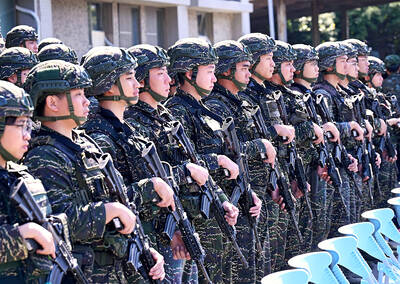
MORE RESPONSIBILITY: Draftees would be expected to fight alongside professional soldiers, likely requiring the transformation of some training brigades into combat units The armed forces are to start incorporating new conscripts into combined arms brigades this year to enhance combat readiness, the Executive Yuan’s latest policy report said. The new policy would affect Taiwanese men entering the military for their compulsory service, which was extended to one year under reforms by then-president Tsai Ing-wen (蔡英文) in 2022. The conscripts would be trained to operate machine guns, uncrewed aerial vehicles, anti-tank guided missile launchers and Stinger air defense systems, the report said, adding that the basic training would be lengthened to eight weeks. After basic training, conscripts would be sorted into infantry battalions that would take
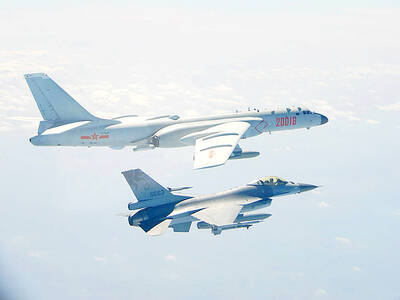
GROWING AMBITIONS: The scale and tempo of the operations show that the Strait has become the core theater for China to expand its security interests, the report said Chinese military aircraft incursions around Taiwan have surged nearly 15-fold over the past five years, according to a report released yesterday by the Democratic Progressive Party’s (DPP) Department of China Affairs. Sorties in the Taiwan Strait were previously irregular, totaling 380 in 2020, but have since evolved into routine operations, the report showed. “This demonstrates that the Taiwan Strait has become both the starting point and testing ground for Beijing’s expansionist ambitions,” it said. Driven by military expansionism, China is systematically pursuing actions aimed at altering the regional “status quo,” the department said, adding that Taiwan represents the most critical link in China’s


 RSS
RSS