

A delegation led by US Undersecretary of State for Economic Growth, Energy and the Environment Keith Krach yesterday ended their visit, with the government saying that Taiwan and the US would continue to bolster economic ties.
After arriving in Taiwan on Thursday afternoon, the delegation yesterday attended a memorial service for former president Lee Teng-hui (李登輝) and exchanged opinions with high-ranking officials and members of different sectors over various issues, the Ministry of Foreign Affairs said.
Krach is the highest-ranking US Department of State official to visit Taiwan since the two nations cut relations in 1979, it said.
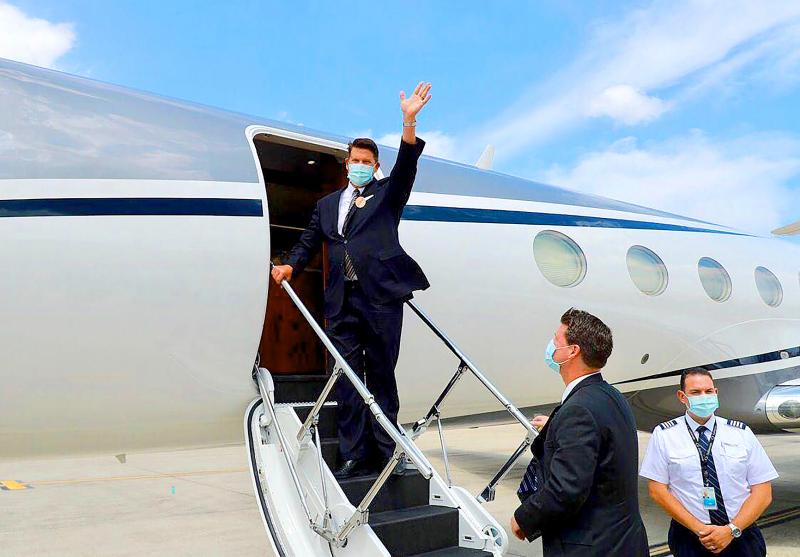
Photo provided by the Ministry of Foreign Affairs via CNA
Based on discussions with the group, the government would continue to work with the US to strengthen economic ties and bilateral partnerships, it added.
After hosting an evening banquet with delegation members at the presidential residence on Friday, President Tsai Ing-wen (蔡英文) posted several photographs of the meeting on Facebook, which showed that Taiwan Semiconductor Manufacturing Co (台積電) founder Morris Chang (張忠謀) also attended the dinner.
They were joined by Vice Premier Shen Jong-chin (沈榮津), Minister of Economic Affairs Wang Mei-hua (王美花), National Security Council Secretary-General Wellington Koo (顧立雄) and Minister Without Portfolio John Deng (鄧振中).
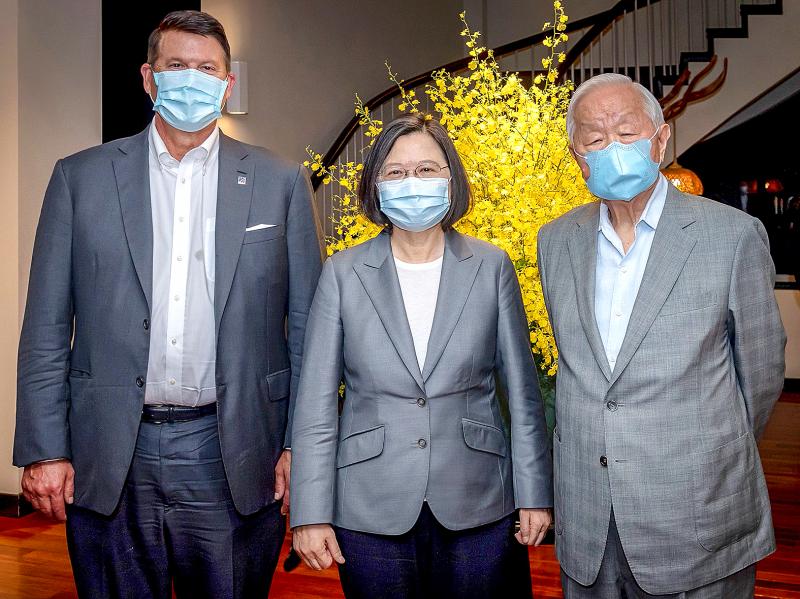
Photo: AFP / Presidential Office
Tsai wrote on Facebook that they had in-depth exchanges, adding that she hopes for additional dialogue.
Most of the US delegation’s meetings were held behind closed doors, unlike last month’s visit from a delegation led by US Secretary of Health and Human Services Alex Azar.
Keeping Krach’s meetings low-profile was not entirely Taiwan’s choice, a source familiar with the matter said, adding that there were some communications between agencies in Washington.
The Office of the US Trade Representative, which manages trade discussions, was viewing the visit closely, and might decide Taiwan has not made enough concessions or be watching how it resolves a disagreement over US pork imports containing ractopamine residues, they said.
The office might also be concerned if Krach’s delegation made too many commitments to Taiwan that create obstacles to future trade negotiations, they added.
Krach’s visit to Taiwan is already a diplomatic breakthrough, showing that Taiwan and the US can have more direct and closer communication, Democratic Progressive Party Legislator Wang Ting-yu (王定宇) said.
Prior to the administration of US President Donald Trump, Taiwan’s affairs were rarely a priority for the US, and Washington often viewed Taiwan through the lens of Beijing, he added.
After Krach commenced “preparatory talks” for the Taiwan-US Economic and Commercial Dialogue, other US officials might visit, he said.
Meanwhile, Chang’s attendance at the banquet showed that Taiwan could play a vital role in the US’ plans to promote its 5G Clean Path initiative and restructuring supply chains related to information technology, Wang added.
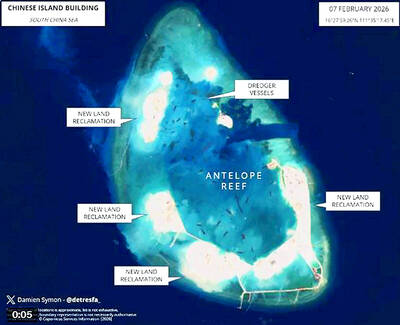
RUNWAY: Analysts said the first aircraft landing is expected by the middle of next year, while Chinese state media said it would serve civilian needs Chinese construction of a runway on Antelope Reef (Lingyang Reef, 羚羊礁) in the Paracel Islands (Xisha Islands, 西沙群島), is well under way with analysts estimating it could be completed by the middle of next year, strengthening Beijing’s military control over the disputed South China Sea. Satellite images reviewed by Reuters show grading work, piles of gravel and concrete, and compaction cranes in operation to build a full-scale runway that military attaches and security analysts say could be one of China’s most important offshore bases in the region. The images, taken on Friday last week by commercial satellite imagery provider Vantor, also show

SHIFTING COOPERATION: With the new arrangement, US representatives would be able to participate directly in defense discussions, including weapons procurement Taiwan-US military cooperation is deepening, with the Pentagon expected to station personnel at the Ministry of National Defense (MND), sources said. The NT$470 million (US$14.77 million) joint program is scheduled to run from this year through 2028, under which the Pentagon would dispatch representatives from the Office of the Under Secretary of Defense for Policy and the Institute for Defense Analyses, a senior military official said on condition of anonymity, adding that one representative from each organization would be stationed at the ministry’s headquarters. The Office of the Under Secretary of Defense for Policy is one of the US’ bodies responsible for

The Presidential Office today condemned China's transnational repression after an alleged Chinese foreign agent was arrested in California yesterday on suspicion of surveilling President William Lai's (賴清德) son, Lai Ting-yu (賴廷與), the FBI said. The 34-year-old woman, named Wanying Heather Zhang (張婉瑩), was arrested on suspicion of acting as an unregistered foreign agent, US news agency CBS reported. She was apprehended at Los Angeles International Airport yesterday attempting to fly to Shanghai, it said. This represents a “typical case” of China’s transnational repression, Presidential Office spokeswoman Karen Kuo (郭雅慧) said today. "Our country expresses the strongest condemnation of such barbaric conduct that
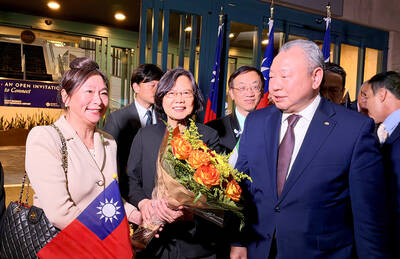
Former president Tsai Ing-wen (蔡英文) on Monday arrived in San Francisco, receiving a warm welcome from hundreds of overseas Taiwanese as she launched a week-long visit. Accompanied by Representative to the US Alexander Yui (俞大?), and head of Taiwan’s San Francisco office Wu Chih-hsiang (伍志翔), Tsai arrived at her hotel, waving, smiling and giving high-fives to Taiwanese compatriots amid cheers of “Taiwan’s democracy involves you and me” to welcome her to the San Francisco Bay Area. It is Tsai’s first visit to the US since she left office in May 2024 after serving two four-year terms as president. Tsai is today to deliver


 RSS
RSS