

At least 18 Chinese military aircraft yesterday flew into the nation’s air defense identification zone (ADIZ) on the second day of a US delegation’s visit, the Ministry of National Defense said, adding that the military responded by deploying an air defense missile system to monitor their activities.
A delegation led by US Undersecretary of State for Economic Growth, Energy and the Environment Keith Krach on Thursday started a three-day visit to Taiwan.
The ministry from Thursday started publicizing the actions of the Chinese People’s Liberation Army (PLA) in Taiwan’s ADIZ on its Web site and Twitter.
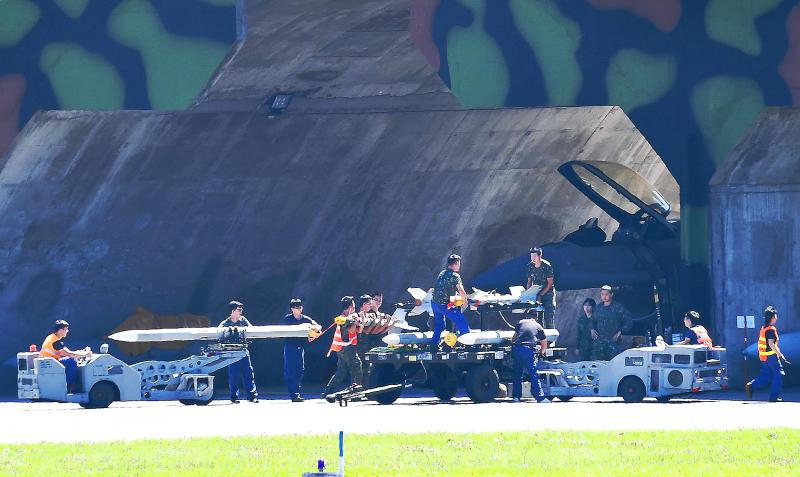
Photo: Yu Tai-lang, Taipei Times
According to ministry reports, 18 PLA aircraft were spotted in the nation’s southwest, west and northwest ADIZ as of yesterday morning, including two H-6 bombers, and eight J-16, four J-11 and four J-10 fighters.
The J-11, J-10 and some of the J-16 fighters were seen crossing the median line of the Taiwan Strait, while the H-6 bombers and other J-16 fighters were spotted flying in the nation’s southwest ADIZ and north of the Pratas Islands (Dongsha Islands, 東沙群島), the ministry said.
The aircraft that crossed the median line were about 68km from Hsinchu, the military said.
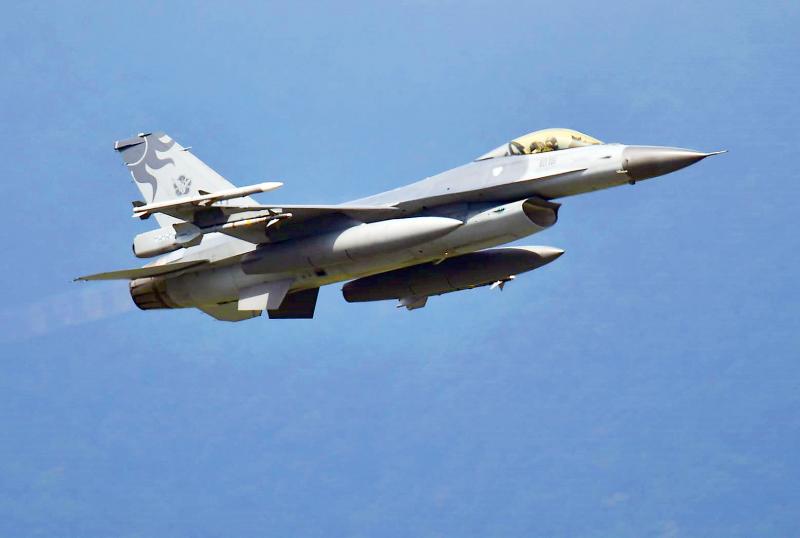
Photo: Yu Tai-lang, Taipei Times
The ministry issued radio warnings, sent fighters and used air defense missile systems to track their movements, it added.
The military issued radio warnings at least 24 times and scrambled fighter jets more than 10 times, according to observations by military enthusiasts.
When asked about the matter at the Legislative Yuan yesterday, Premier Su Tseng-chang (蘇貞昌) said that China should take responsibility as a major world power and quickly contain the COVID-19 pandemic that originated in its country.
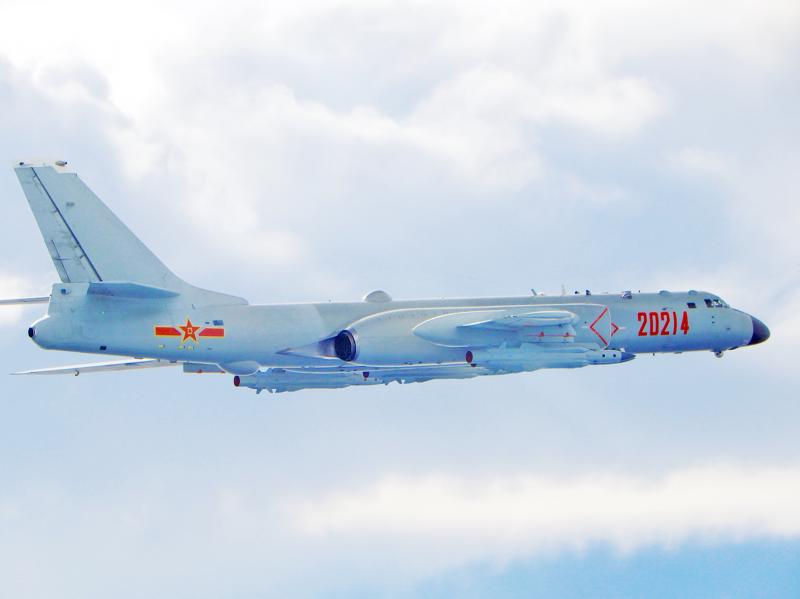
Photo courtesy of Ministry of National Defense
Instead, China frequently threatens Taiwan with military drills or by dispatching aircraft in the Strait, which shows the world who is the real “troublemaker” and lets Taiwanese know who is the real enemy, Su said.
Taiwanese, no matter their political affiliation, should unite in the face of a common enemy, he said.
Presidential Office spokesman Xavier Chang (張惇涵) called on China to restrain itself, adding that as a regional power, Beijing should work to maintain regional peace.
In response to questions about a PLA announcement yesterday morning that the PLA Eastern Theater Command would start combat exercises near the Taiwan Strait, the ministry said in a statement that it would continue to monitor PLA activities and safeguard national security.
The ministry also called on China to restrain its activities in the region and prevent an escalation of cross-strait tensions.
China’s military intimidation has drawn outrage from Taiwanese, and the tactics are condemned by popular public opinion here, the ministry added.
Additional reporting by Chou Hsiang-yun and Lin Chia-nan

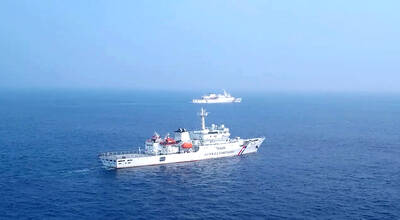
PATROL PARTNERS: The ‘Chiayi’ and the ‘Penghu’ departed for a two-day joint patrol of Palau’s exclusive economic zone, the CGA’s second diplomatic visit to the country The Coast Guard Administration (CGA) set a record for its southernmost deployment of a coast guard vessel as the vessels Chiayi and the Penghu reached Palau’s Pulo Anna Island on Saturday in a cooperative exercise between the two countries. The island, about 217 nautical miles (401km) southwest of Koror in the Palauan state of Sonsorol and 1,220 nautical miles from Taiwan’s southernmost point, Oluanpi (鵝鑾鼻), is the furthest south a CGA vessel has sailed. The two vessels are in Palau for the coast guard’s second diplomatic visit to the country. They docked at Malakal Harbor on Tuesday last week. The coast guard

The government is monitoring online rumors that a pneumonic plague outbreak has spread from Russia into China, and it might enhance quarantine measures, Premier Cho Jung-tai (卓榮泰) said yesterday. During a legislative meeting, Democratic Progressive Party Legislator Wang Ting-yu (王定宇) said that rumors had circulated that the disease had spread across several Chinese provinces. He asked Cho whether the government was prepared to prevent the disease spreading to Taiwan, given the volume of traffic between the two sides, and how concerned the government was about the alleged outbreak. The Ministry of Health and Welfare had implemented border quarantine measures after briefing the Executive
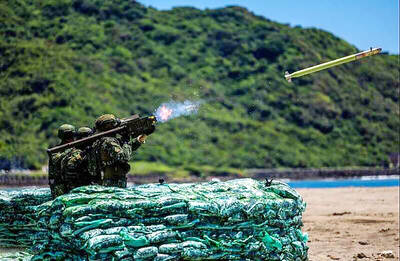
BATCH 1: The military has plans to assign the weapons to the army to defend Taiwan proper, as well as outlying islands and the navy for the Marine Corps, the official said Taiwan is to receive 500 Stinger missiles and 178 launchers from the US by the end of the year, the first batch under a planned two-stage acquisition totaling 2,621 missiles and 763 launchers, a defense official said yesterday on condition of anonymity. The portable missiles would play a vital role in the nation’s air defense capabilities, the source said. The army plans to deploy 2,235 missiles and 657 launchers to defend Taiwan proper and outlying islands, they said, citing military documents. The navy is allotted 295 missiles and 85 launchers to arm the Marine Corps and some surface vessels that lack air defense

The European Parliament on Wednesday adopted a recommendation on EU-China political relations that rejected China’s efforts to restrict Taiwan’s participation in international organizations and exchanges. The recommendation, addressed to the European Council, the European Commission and EU High Representative for Foreign Affairs and Security Policy Kaja Kallas, includes several references to EU-Taiwan relations and expresses support for closer ties, saying they would bring positive benefits and have strategic importance. Describing Taiwan as a valuable partner in trade and technology, the European Parliament said it “rejects China’s attempts to coerce international organizations, third countries and other actors into restricting Taiwan’s international participation and


 RSS
RSS