


Independent Legislator Freddy Lim (林昶佐) yesterday formed the Taiwan Parliamentary Group for Tibet for the current legislative term, while calling on the Democratic Progressive Party administration to go along with the Dalai Lama, who on Sunday during a livestream said that he would like to pay the nation another visit.
The group was joined by 46 lawmakers across party lines, making it larger than the iteration in the previous legislative session, Lim said.
After the Buddhist leader expressed his desire to visit the nation, the Ministry of Foreign Affairs said that a visit would go ahead “when the time is convenient for both sides,” Lim said, asking when it would be a “convenient time” for the nation.
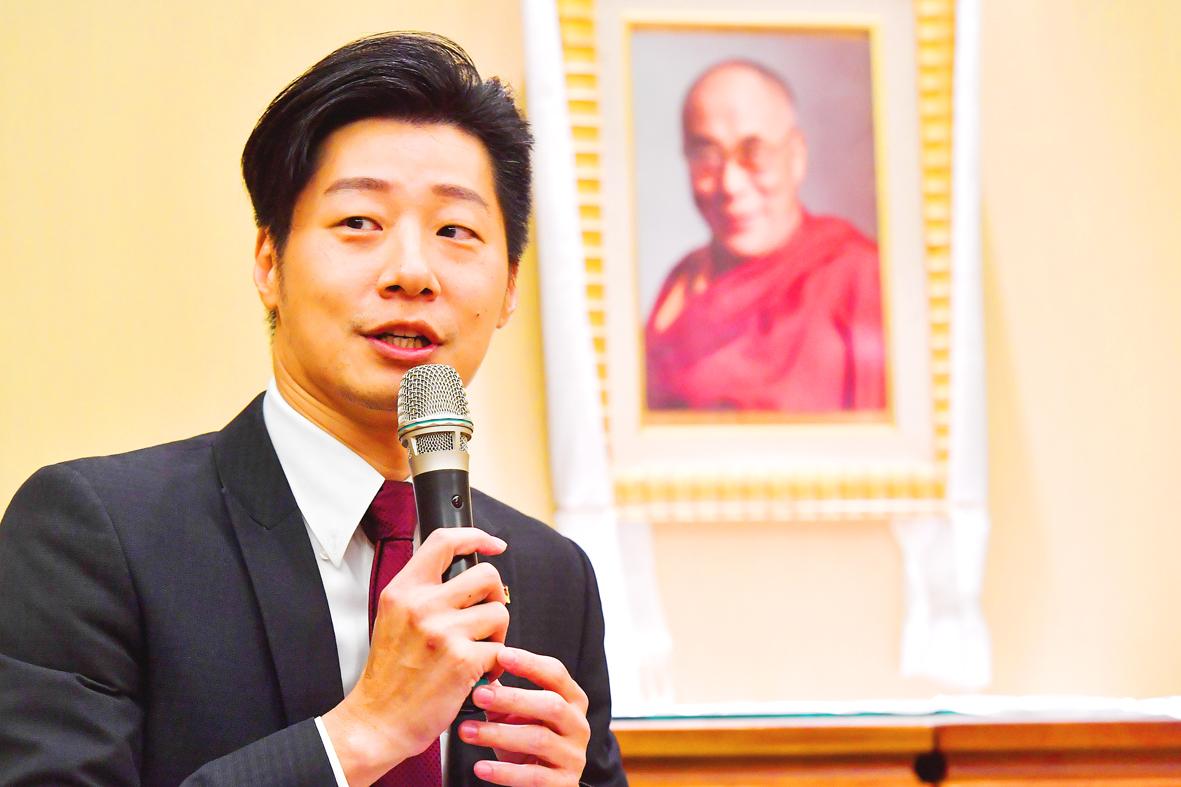
Photo: CNA
The nation should adopt a firmer stance on its support of human rights and say: “Whenever is a convenient time for the Dalai Lama is a convenient time for us,” the lawmaker said.
Thanks to the efforts of the previous group, the Mongolian and Tibetan Affairs Commission was abolished, allowing Tibet a “normalized and equal” channel for exchanges with the nation, he said.
The new group would continue to uphold the rights of Tibetans in the nation, but also concern itself with Beijing’s arbitrary implementation of the Hong Kong national security legislation, its establishment of internment camps in China’s Xinjiang region and its infringement on religious freedom in Tibet, he said.
Hopefully, the group would function as a hub that could rally international support for Tibet and human rights, Lim added.
Tibet signed a peace treaty with China, but within eight years it proved to be a failure, Tibet Religious Foundation of His Holiness the Dalai Lama chairman Dawa Tsering said.
Tibet is a symbol of peace worldwide, yet it cannot live in peace with China, he said.
He said that he hopes to see discussions about Chinese oppression grow in Taiwan, which has managed to keep its sovereignty in the face of daunting threats by Beijing.

SILENCING CRITICS: In addition to blocking Taiwan, China aimed to prevent rights activists from speaking out against authoritarian states, a Cabinet department said The Ministry of Foreign Affairs (MOFA) yesterday condemned transnational repression by Beijing after RightsCon, a major digital human rights conference scheduled to be held in Zambia this week, was abruptly canceled due to Chinese pressure over Taiwanese participation. This year’s RightsCon, the world’s largest conference discussing issues “at the intersection of human rights and technology,” was scheduled to take place from tomorrow to Friday in Lusaka, and expected to draw 2,600 in-person attendees from 150 countries, along with 1,100 online participants. However, organizers were forced to cancel the event due to behind-the-scenes pressure from China, the ministry said, expressing its “strongest condemnation”
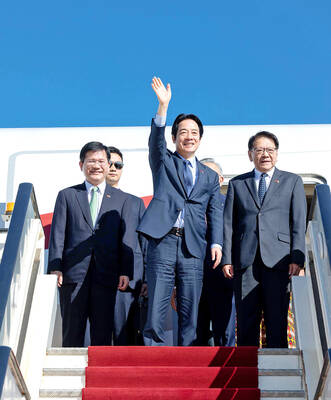
DELAYED BUT DETERMINED: The president’s visit highlights Taiwan’s right to international engagement amid regional pressure from China President Willaim Lai (賴清德) yesterday arrived in Eswatini, more than a week after his planned visit to Taiwan’s sole African ally was suspended because of revoked overflight permits. “The visit, originally scheduled for April 22, was postponed due to unforeseen external factors,” Lai wrote on social media. “After several days of careful arrangements by our diplomatic and national security teams, we successfully arrived today.” Lai said he looked forward to further deepening Taiwan-Eswatini relations through closer cooperation in the economy, agriculture, culture and education, as well as advancing the nation’s international partnerships. The president was initially scheduled to arrive in time to celebrate

Iran’s Islamic Revolutionary Guard Corp (IRGC) yesterday said the US faced a choice between an “impossible” military operation or a “bad deal” with Tehran, after US President Donald Trump disparaged Iran’s latest peace proposal. Negotiations between the two countries have been deadlocked since a ceasefire came into effect on April 8, with only one round of direct peace talks held so far. Iran’s Tasnim and Fars news agencies reported that Tehran had submitted a 14-point proposal to mediator Pakistan, but Trump was quick to cast doubt on it. “I will soon be reviewing the plan that Iran has just sent to us, but

A group affiliated with indicted Chinese immigrant Xu Chunying (徐春鶯) is to be dissolved for monitoring Chinese immigrants in Taiwan, a source said yesterday. Xu, the secretary-general of the Cross-Strait Marriage and Family Service Alliance, was indicted on March 24 on charges of violating the Anti-Infiltration Act (反滲透法). The alliance “illegally monitored" Chinese immigrants living in Taiwan on behalf of the Chinese Communist Party (CCP) and the Ministry of the Interior is expected to dissolve the organization in the coming days under provisions of the Civil Associations Act (人民團體法), the source said. Xu, who married a Taiwanese in 1993 and became a Republic


 RSS
RSS