


Taiwan yesterday protested a Japanese city’s decision to change the name of an administrative area that covers the Diaoyutai Islands (釣魚台).
Known as the Senkaku Islands in Japan, the group of uninhabited islands in the East China Sea is claimed by Taiwan, Japan and China.
The Ishigaki Municipal Assembly yesterday passed a bill to change the islands’ administrative name from “Tonoshiro” to “Tonoshiro Senkaku,” despite the Ministry of Foreign Affairs’ assertion of Taiwanese sovereignty over the islands on multiple occasions following media reports about the Japanese proposal earlier this month.
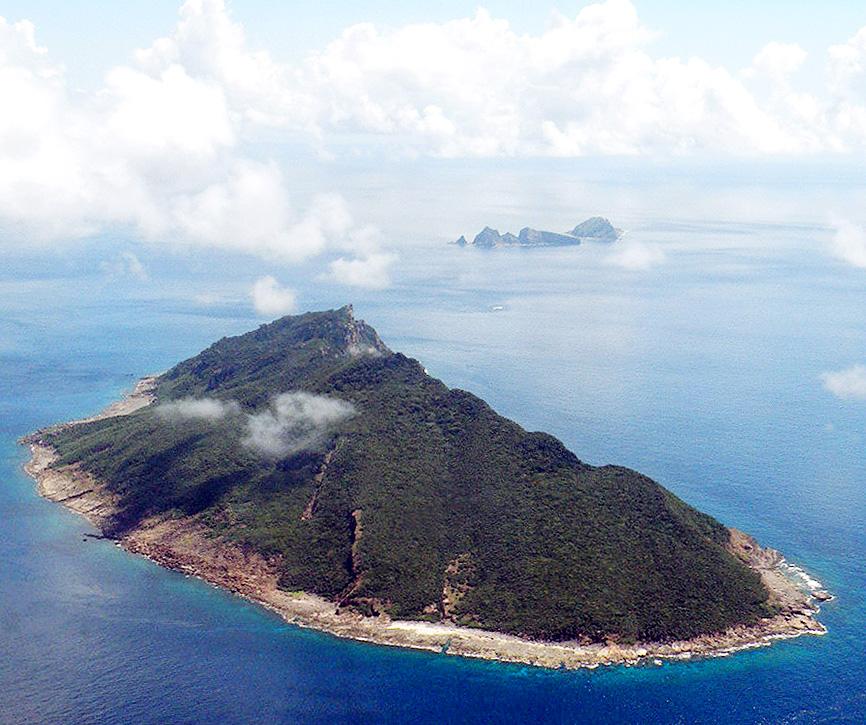
Photo: AFP
Ishigaki Mayor Yoshitaka Nakayama said at the time that Japan hoped to rename the islands because China frequently dispatched vessels to waters around the islands, and even expelled Japanese fishing vessels in the area.
The Presidential Office said that any unilateral move would not change the fact that the Diaoyutais belongs to the Republic of China (ROC), adding that any unilateral action was unhelpful to resolving the matter.
The Taiwanese government, which has long asserted sovereignty over the islands, would continue to resort to peaceful and rational means when it comes to sovereignty disputes, the ministry said in a statement.
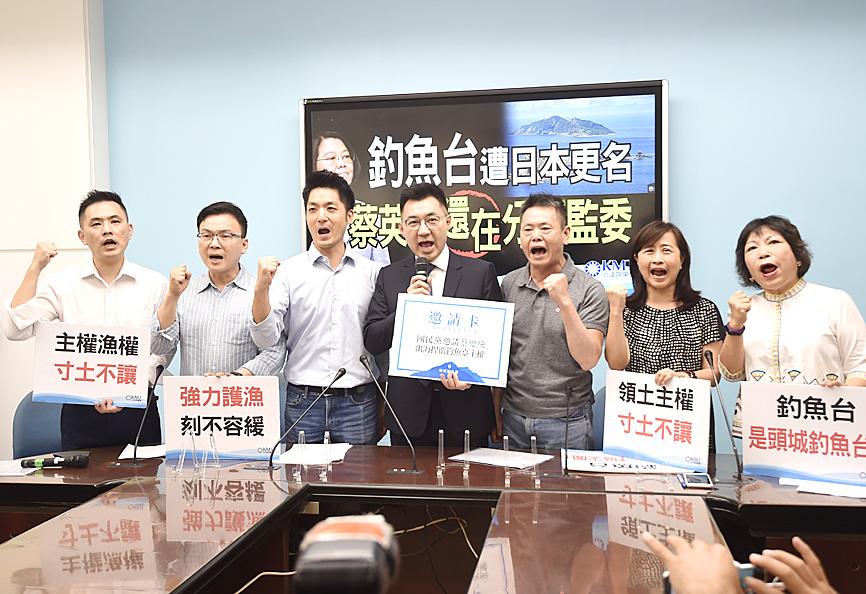
Photo: Chien Jung-fong, Taipei Times
Japan should exercise rationality and restrain itself from interfering with Taiwan’s sovereignty over the islands, otherwise friendship between the two nations, as well as regional stability in the East China Sea, could be affected, it said.
The Chinese Nationalist Party (KMT) also condemned the council’s move, saying the Diaoyutais are ROC territory and the nation would not give up even “an inch” of its sovereignty.
Japan’s move infringes on the nation’s territory, sovereignty and fishing rights, the KMT said, calling on President Tsai Ing-wen (蔡英文) not to overlook Japan’s action.
Protection of the nation’s sovereignty and fishing rights are the will and consensus of Taiwanese, it said, adding that Taiwan must not allow its sovereignty to be “eroded little by little.”
KMT headquarters urged the Tsai administration to immediately summon Japan’s representative to Taiwan to express its solemn protest, and to propose a counterplan to “maintain the integrity of the nation’s territory, sovereignty and fishing rights.”
The KMT caucus also urged Tsai to visit the Diaoyutais to assert the nation’s sovereign claim to the islands.
In Taiwan, the Diaoyutais fall under the jurisdiction of Toucheng Township (頭城) in Yilan County, which earlier this month passed a resolution to submit a proposal to the Ministry of the Interior to change the name of the islands to Toucheng Township Diaoyutai (頭城釣魚台).”
Yilan County Commissioner Lin Zi-miao (林姿妙) expressed regret over Japan’s decision to change the islands’ name.
Asked whether she would visit the islands and put up house number plates there, as she had proposed before as a way to assert Taiwan’s sovereignty, Lin said: “As it is a matter of great importance, more discussion is needed.”
The county government said it has sent an official letter to the Ministry of the Interior, urging it to respect regional opinions by officially renaming the Diaoyutais “Toucheng Township Diaoyutai.”
Suao Fishermen’s Association head Chen Chun-sheng (陳春生) said that fishers from Yilan’s Suao Township (蘇澳) had voiced concern about their fishing rights in waters near the islands, as the area is an important fishing ground.
The area has plenty of fishing resources, including black tuna, sharks, marlin and mahi-mahi, making it a hotly contested asset by countries surrounding it, he said.
Saying he advocates “setting disputes aside, jointly developing the area and sharing the resources,” Chen urged the Tsai administration to mediate the sovereignty dispute.
Asked if he would form a protest flotilla to the islands, Chen said he would invite fishers for further discussions.
Additional reporting by Sherry Hsiao,Su Yung-yao,Chang Yi-chen,Chiang Chih-hsiung and CNA

‘NO SECURITY RISK’: The Railway Bureau reassured the public that the technicians’ activities were limited to technical guidance and did not involve sensitive systems The Railway Bureau yesterday said it had invited eight Chinese technicians to assist with an airport MRT construction project. The bureau issued the confirmation after an Internet user said Chinese nationals had entered the construction zone of Taiwan Taoyuan International Airport’s Terminal 3 project. They asked why “individuals from an enemy state” were allowed access to such a major national infrastructure project, which raised serious concerns over Taiwan’s industrial safety, sensitive systems and information security. The bureau’s Northern Region Engineering Branch Office said subcontractor Taiwan Handle Industrial Co (台灣手把工業) of the Taoyuan airport MRT’s “Contract No. CU05 Project A14 Station Civil, MEP &

A signaling system malfunction disrupted high-speed rail (HSR) services beginning at 8am today, with trains temporarily reduced to three northbound and three southbound trains per hour as authorities conduct inspections. The malfunction occurred on a section of track in Miaoli County during pre-operation checks early this morning, forcing northbound and southbound trains to use a single track, the HSR operator said. The regular schedule has been replaced with three hourly trains offering only nonreserved seating in each direction, stopping at every station, it said, adding that business class cars would still have reserved seating. Departures from terminal stations are scheduled at the top

Taiwan is still in the process of assessing the possibility of recruiting workers from Eswatini, the Ministry of Foreign Affairs said yesterday, adding that its goal is to help Eswatini upgrade its vocational training centers. If there are plans to recruit workers from Eswatini, safeguarding national security, protecting public health and ensuring the employment rights of Taiwanese would be prerequisites, Department of West Asian and African Affairs Director-General Yen Chia-liang (顏嘉良) told a news conference. Key considerations would also include filling labor shortages in specific industries, and fostering bilateral professional and technical exchanges, he said. Yen was asked about the progress of labor

A US uncrewed surface vessel (USV) encountered multiple Chinese warships during an autonomous transit of the Taiwan Strait, US defense company Seasats said in a statement on Wednesday. Seasats announced that a Lightfish USV had completed the first autonomous transit of the Taiwan Strait. Over five days, the USV traversed the entire length of the Strait while constantly monitoring surface vessel traffic, the company said. The Lightfish encountered multiple Chinese warships, one of which was a Chinese People’s Liberation Army Navy (PLAN) Type 056 corvette, it said. The Chinese vessels were operating “well within Taiwan’s exclusive economic zone without transmitting their identity via the


 RSS
RSS