

Human rights advocates yesterday cautioned the global community against China’s expanding totalitarianism in Hong Kong and elsewhere, as they marked the 31st anniversary of the Tiananmen Square Massacre.
The New School for Democracy held a forum attended by lawmakers, academics and human rights advocates.
The school had invited Chinese Nationalist Party (KMT) members to the forum, but they said they could not comply with the schedule, school chairman Tseng Chien-yuan (曾建元) said.

Photo: Liao Chen-huei, Taipei Times
For the first time, Hong Kongers are this year banned from holding the annual June 4 Tiananmen vigil in Victoria Park, Democratic Progressive Party Legislator Fan Yun (范雲) said, adding that it used to be the most significant event marking the massacre’s anniversary among ethnic Chinese.
Whether the Hong Kong government banned the event to prevent mass gatherings amid the COVID-19 pandemic or for political reasons, “refusing to forget” and letting the perpetrators know “we remember” is important, she said.
As a “global citizen” that hopes to rejoin the global community, Taiwan should demonstrate its democratic values by expressing support for Hong Kongers and remembering the massacre, as Taiwan might not maintain its democracy and freedoms if Chinese totalitarianism continues to expand, she said.
Remembering the massacre and its victims is “a war between remembrance and oblivion,” said National Tsing Hua University associate professor of sociology Chen Ming-chi (陳明祺), who resigned as deputy minister of the Mainland Affairs Council on May 20.
Remembering the massacre in Taiwan is meaningful, as it protects Taiwan’s democracy and resists China’s expanding totalitarianism, he said.
While Beijing hopes that people will forget the atrocity, Taiwanese should continue to remind people that tanks ran over democracy activists, students and citizens in the massacre, Chen said.
The Chinese Communist Party is now extending its violence to Hong Kong, he said, adding that this could also happen in other parts of the world.
Taiwan should act as “an ark of democracy” to connect like-minded partners, Chen said.
“We respect Chinese people who aspire for democracy and freedom. We have not forgotten them,” he said.
As seen during the COVID-19 pandemic, countries that have chosen to side with China to gain benefits would get their just deserts, Taiwan Association for Human Rights secretary-general Shih Yi-hsiang (施逸翔) said, urging other countries to be vigilant regarding the uncontrollable risk of China’s expanding influence.
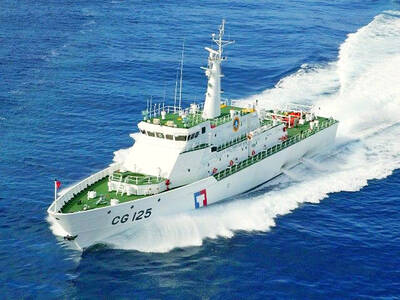
GEOPOLITICAL SIGNIFICANCE: The CGA’s nonmilitary role makes it a tool to avert diplomatic issues, an official said, while confirming the donation of a ship to Manila Coast Guard Administration (CGA) ships are scheduled to sail to the Philippines bearing the words “Taiwan Coast Guard” in a high-profile visit in October next year, the first such visit by a Taiwanese maritime law enforcement vessel to the Southeast Asian nation, the agency said yesterday. The CGA also confirmed that it had donated one of its decommissioned patrol vessels to the Philippines in a rare transfer of a retired ship to a nondiplomatic ally. The Republic of China (ROC) Navy last made such a visit in 1974, shortly before the Philippines switched diplomatic recognition to the People’s Republic of China in

‘GLOBAL WARNING’: The infiltration is not just a local problem, as Beijing has been deploying the same tactics worldwide against Western democracies, a report said Between 50,000 and 100,000 Chinese spies are operating in Taiwan, far more than the National Security Bureau’s previous estimate of 5,000, German journalist and author Jurgen Kremb said on Monday. Kremb presented his research, titled “The War of Spies: How China’s Intelligence Services Are Infiltrating Taiwan — and What Europe Must Learn from It,” at a joint event held by the Taiwan offices of the Friedrich Naumann Foundation and the European Values Center for Security Policy. The report was published in June in the Ministry of Justice Investigation Bureau’s Prospect & Exploration Monthly (展望與探索月刊). By spies, he said he was referring to informants,
CALL FOR CHANGE: They urged the UN to facilitate Taiwan’s involvement in the body, recognize its peace efforts and to work with members in preventing military conflict Representatives to the UN from five of Taiwan’s diplomatic allies sent a joint letter to UN Secretary-General Antonio Guterres on Friday, calling for the country’s inclusion in the body. Allies in the letter sent ahead of the 81st session of the UN General Assembly General Debate made three demands in support of Taiwan: inclusion, recognition and camaraderie. They implored the UN to seek an appropriate way to facilitate Taiwan’s meaningful involvement in the world governing body, saying that UN Resolution 2758, which accepted the People’s Republic of China (PRC) as a member of the UN, does not exclude Taiwan. Beijing claims that the

PRICE STABILIZATION: The Ministry of Economic Affairs has urged the legislature to support the Cabinet’s supplementary budget for state-owned energy companies State-owned oil supplier CPC Corp, Taiwan (CPC, 台灣中油) on Saturday announced that it would raise domestic gasoline prices by NT$0.7 (US$0.02) per liter and diesel prices by NT$0.6 per liter this week after international crude oil prices rose above US$100 per barrel last week. Formosa Petrochemical Corp (台塑石化) yesterday said that it matched CPC’s price adjustments for this week. The decisions end a six-week period during which CPC and Formosa kept fuel prices in Taiwan unchanged. Retail gasoline prices this week would rise to NT$31.2, NT$32.7 and NT$34.7 per liter for 92, 95 and 98-octane unleaded gasoline respectively at CPC


 RSS
RSS