


YouTube on Tuesday said that it was investigating the removal of comments critical of the Chinese Communist Party (CCP) from the video-sharing platform, saying the filtering appeared to be “an error.”
The statement from the Google-owned video service came after a media report in The Verge prompted by complaints from technology entrepreneur Palmer Luckey.
Luckey, a founder of the virtual reality group Oculus, who is now with a defense technology firm, on Monday wrote on Twitter: “YouTube has deleted every comment I ever made about the Wumao, an internet propaganda division of the Chinese Communist Party.”

Photo: AFP
He suggested that the filtering appeared to be a new policy of censorship.
Other Twitter users responded to Luckey, saying that they, too, believed comments about the CCP had been removed.
The comments attracted the attention of US Senator Ted Cruz, who called the matter “very disturbing.”
“Why is Google/YouTube censoring Americans on behalf of the CCP? This is WRONG,” Cruz wrote on Twitter. “Big Tech is drunk with power. The Sherman Act prohibits abusing monopoly power. DOJ [the US Department of Justice] needs to stop this NOW.”
Cruz appeared to be referencing unsubstantiated comments from the White House that large technology firms are biased against conservatives and should be censured for antitrust breaches.
YouTube said in a statement that it had made no policy changes and that its filters are designed to remove only “spammy, hateful or harassing comments” from the platform.
“This appears to be an error in our enforcement systems and we are investigating,” a YouTube spokesperson said of the complaints. “Users can report suspected issues to troubleshoot errors and help us make product improvements.”
The Internet platform said that it has been relying more on automated systems during the COVID-19 pandemic as its human reviewers have been sent home.
YouTube in March said that it expected to see more content removal as a result of its reliance on machine learning instead of human moderators.

LEVERAGE: China did not ‘need to fire a shot’ to deny Taiwan airspace over Africa when it owns ‘half the continent’s debt,’ a US official said, calling it economic warfare The EU has raised concerns about overflight rights following the delay of President William Lai’s (賴清德) planned state visit to the Kingdom of Eswatini after three African nations denied overflight clearance for his charter at the last minute. Taiwanese allies Paraguay and Saint Kitts and Nevis, as well as several US lawmakers and the Inter-Parliamentary Alliance on China (IPAC) condemned China for allegedly pressuring the countries. Lai was scheduled to fly directly to Taiwan’s only African ally from yesterday to Sunday to celebrate the 40th anniversary of King Mswati III’s accession and his 58th birthday, but Seychelles, Mauritius and Madagascar suddenly revoked

The number of pet cats in Taiwan surpassed that of pet dogs for the first time last year, reaching 1,742,033, a 32.8 percent increase from 2023, the Ministry of Agriculture said yesterday, citing a survey. By contrast, the number of pet dogs declined slightly by 1.2 percent over the same period to 1,462,528, the ministry said. Despite the shift, households with dogs still slightly outnumber those with cats by 1.2 percent. However, while the number of households with multiple dogs has remained relatively stable, households keeping more than two cats have increased, contributing to the overall rise in the feline population. The trend

China on Wednesday teased in a video an aircraft carrier that could be its fourth, and the first using nuclear power, while making an allusion to Taiwan and vowing to further build up its islands, as it looks to boost maritime power, secure resources and bolster territorial claims. The video, issued on the eve of the 77th founding anniversary of the Chinese People’s Liberation Army Navy, featured fictional officers with names that are homophones of three commissioned aircraft carriers, the Liaoning (遼寧), Shandong (山東) and Fujian (福建). Titled Into the Deep, it showed a 19-year-old named “Hejian” (何劍) joining the group, sparking
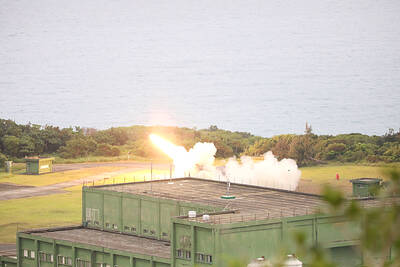
Taiwan has signed six arms procurement offers from the US totaling more than NT$208 billion (US$6.59 billion) covering long-range precision strike systems, missile stockpile replenishment and joint production of large-caliber ammunition, the Ministry of National Defense said yesterday. The government’s proposed NT$1.25 trillion special defense budget has been stalled in the Legislative Yuan as opposition lawmakers question the amount and procurement items, while the Presidential Office and defense ministry say that the full amount is necessary to safeguard Taiwan. Minister of National Defense Wellington Koo (顧立雄) on Monday briefed the legislature’s Foreign Affairs and National Defense Committee on the defense budget for


 RSS
RSS