


Taiwan is stepping up military cooperation with long-standing partners and forging new ties as it bolsters training exercises with the US Army Special Forces and trains officers and soldiers from an undisclosed Middle Eastern country, a high-ranking military official said yesterday.
The Republic of China Military Police Special Services Company, commonly called the Night Hawks, has standing collaborations with the US Army Special Forces, commonly known as the Green Berets, for regular joint exercises, said the official, who spoke on condition of anonymity.
Taiwan and the US have increased the frequency of training and adapted course materials to meet the needs of the security situation in East Asia, the official added.
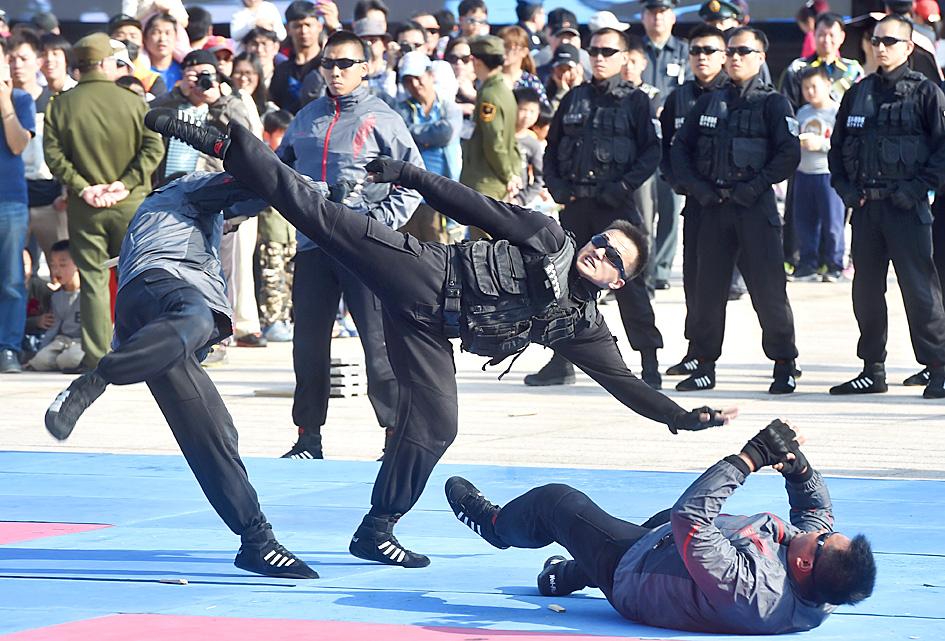
Photo: Chien Jung-fong, Taipei Times
One of the joint exercises added to the program last year involved observing Green Berets training in a simulated battle zone in Washington state, they said.
Through the training, the Night Hawk unit aimed to sharpen its knowledge of wartime military operations and boost the special operations capabilities of the Military Police Command.
The Night Hawks’ standing invitation to participate in the annual Pacific Area Special Operations Conference would expand its network, and help it look beyond Taiwan and regional concerns, the official added.
The source also said that Taiwan has reached an agreement with a Middle Eastern country to provide counterterrorism training to that nation’s officers and soldiers in Taiwan, without disclosing the country’s name.
The first group of trainees has completed their training and returned to their home country, but the second group’s arrival has been delayed due to the COVID-19 pandemic, the source said.
The deal is a breakthrough for the command, they said, adding that high-ranking officers from both sides visited each nation last year.
The Ministry of National Defense is to schedule a visit to the Middle Eastern country and send a platoon of Night Hawks for training exercises once the pandemic eases, the source said.
Visits by high-ranking officers to Taiwan and the Middle Eastern country would likely be normalized in the future, the source added.
Taiwan’s special forces are respected internationally and are one of the few units in Asia that can train themselves and provide counterterrorism training to other nations, the source said.
Separately on Friday, the ministry said that a Chinese Y-8 military transport aircraft entered Taiwan’s air defense identification zone while flying over waters southwest of the nation.
The intrusion occurred at about noon, the ministry said, adding that the aircraft left the area after being warned over radio by Taiwanese fighter jets.
It was the seventh time this year that Chinese military aircraft have been spotted flying near Taiwan.
Air activity over the waters surrounding Taiwan are being closely monitored by the military, the ministry said.
“At present, there is no cause for alarm,” it added.
Additional reporting by CNA
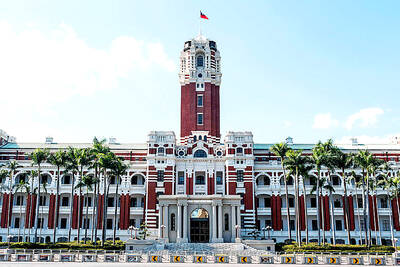
SECURITY: Taipei presses the US for arms supplies, saying the arms sales are not only a reflection of the US security commitment to Taiwan but also serve as a mutual deterrent against regional threats Taiwan is committed to preserving the cross-strait “status quo” and contributing to regional peace and stability, the Presidential Office said yesterday. “It is an undeniable fact that the Republic of China is a sovereign and independent democratic nation,” Presidential Office spokeswoman Karen Kuo (郭雅慧) reiterated, adding that Beijing has no right to claim sovereignty over Taiwan. The statements came after US President Donald Trump warned against Taiwanese independence. Trump wrapped up a state visit to Beijing on Friday, during which Chinese President Xi Jinping (習近平) had pressed him not to support Taiwan. Taiwan depends heavily on US security backing to deter China from carrying
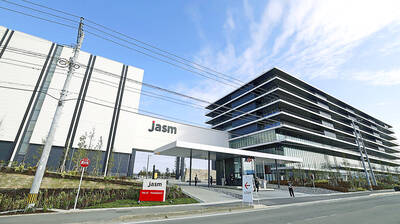
The subsidiary of Taiwan Semiconductor Manufacturing Co (TSMC, 台積電) in Kumamoto, Japan, turned a profit in the first quarter of this year, marking the first time the first fab of the unit has become profitable since mass production started at the end of 2024. According to the contract chipmaker’s financial statement released on Friday, Japan Advanced Semiconductor Manufacturing Inc (JASM), a joint venture running the fab in Kumamoto, posted NT$951 million (US$30.19 million) in profit in the January-to-March period, compared with a loss of NT$1.39 billion in the previous quarter, and a loss of NT$3.25 billion in the first quarter of
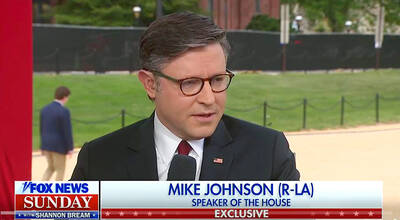
RESOLUTE BACKING: Two Republican senators are planning to introduce legislation that would impose immediate sanctions on China if it attempts to invade Taiwan US House of Representatives Speaker Mike Johnson on Sunday reaffirmed US congressional support for Taiwan, saying the US and “all freedom-loving people” have a stake in preventing China from seizing Taiwan by force. Johnson made the remarks in an interview with Fox News Sunday on US President Donald Trump’s summit with Chinese President Xi Jinping (習近平) last week. In an interview that aired on Friday on Fox News, just as Trump wrapped up a high-stakes visit to China, he said he has yet to green-light a new US$14 billion arms package to Taiwan and that it “depends on China.” “It’s a very good
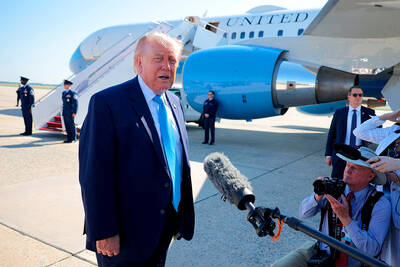
US President Donald Trump yesterday said he would speak to President William Lai (賴清德) as his administration considers whether to move ahead with a US$14 billion weapons sale to Taiwan — a potential arms deal that has drawn criticism from China. “Well, I’ll speak to him. I speak to everybody,” Trump told reporters yesterday when asked if he had any plans to call his counterpart, although he did not offer a time frame for when such a conversation could take place. Trump previously said he would speak to the person “that’s running Taiwan,” without specifying who he meant. “We have that situation very


 RSS
RSS