


The man charged in the slaying of a railway police officer last year was acquitted of murder by the Chiayi District Court yesterday, with judges saying that the suspect, surnamed Cheng (鄭), had a mental disorder.
However, Cheng was ordered to undergo five years of psychiatric treatment.
The parents of Lee Cheng-han (李承翰), the 25-year-old railway officer killed in July last year, were at the court. Lee Tseng-wen (李增文), Lee Cheng-han’s father, told reporters after the verdict was announced: “This is outrageous.”
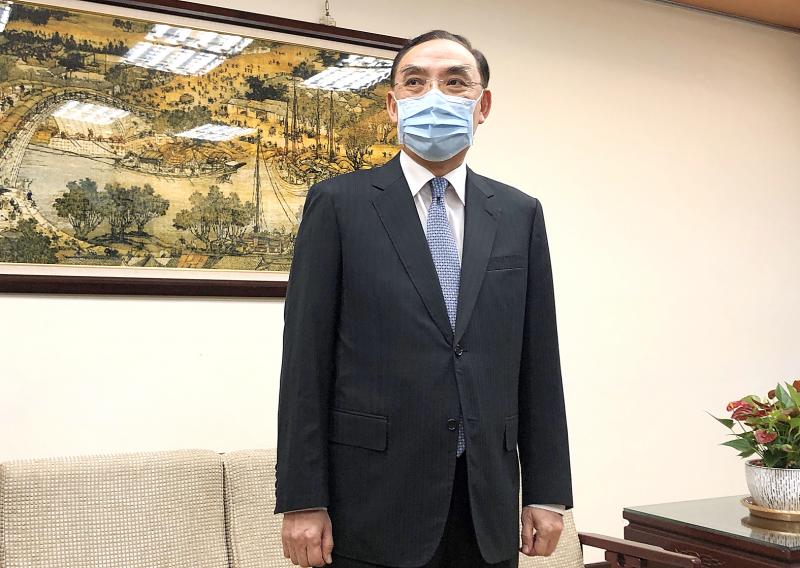
Photo: CNA
“My son was killed in the line of his duty as a police officer and the court gave a not guilty ruling,” he said. “It is painful for me right now. The judges have lost their senses and reason.”
“He was our only son. He worked diligently and was devoted to his family. We have to suffer the pain and sorrow of his death to this day,” he said. “If we could turn back the clock, we would never allow him to work as a police officer.”
Cheng, 55, was examined by psychiatrists, who said that he was suffering from schizophrenia when he stabbed Lee Cheng-han.
“He was under a delusion that affected his behavior at the time,” the psychiatrists said in a report. “His actions resulted from his mental condition.”
“Psychiatrists say that people with schizophrenia must take medication their whole lives. If they do not, they will relapse,” the report said. “Cheng’s mental capacity had deteriorated and he had lost awareness of his action at the time.”
The judges cited Article 19 of the Criminal Code: “An offense is not punishable if it is committed by a person who is mentally disordered.”
Cheng was granted release on NT$500,000 bail, but his family reportedly could not pay the amount, so he remained in detention yesterday.
The stabbing was captured on video.
Cheng had refused to pay his fare and became violent. When the train arrived at Chiayi Station, Lee Cheng-han boarded the car to try and remove him.
In the struggle, Cheng stabbed the officer.
Despite the severe wound, Lee continued to hold Cheng as passengers disarmed him.
Minister of Justice Tsai Ching-hsiang (蔡清祥) said that killing a police officer is a very serious crime and criminals must not be permitted to evade prosecution by using mental disorders as an excuse.
Tsai joined calls from prosecutors and police officials to appeal the ruling.
“The Railway Police Bureau has been one of the Taiwan Railways Administration’s [TRA] important partners, with the two agencies working together over the years to keep passengers safe and rail operations secure,” the TRA said in a statement.
“Railway police officers have helped resolve ticketing disputes. Lee sacrificed his life to protect passengers, but the Chiayi District Court ruled that the perpetrator is not guilty and granted bail of NT$500,000,” it said.
“It is regrettable that the court made this decision and we would support prosecutors should they appeal the verdict,” the TRA said.
“It is our sincere hope that our law enforcement officers have the backing of the judicial system.”
Netizens condemned the ruling, writing that it was another situation where “dinosaur judges” had let a killer get away with his crime.
People also flooded the Judicial Yuan’s Web site with messages criticizing the judges.
Additional reporting by Shelley Shan

Right-wing political scientist Laura Fernandez on Sunday won Costa Rica’s presidential election by a landslide, after promising to crack down on rising violence linked to the cocaine trade. Fernandez’s nearest rival, economist Alvaro Ramos, conceded defeat as results showed the ruling party far exceeding the threshold of 40 percent needed to avoid a runoff. With 94 percent of polling stations counted, the political heir of outgoing Costa Rican President Rodrigo Chaves had captured 48.3 percent of the vote compared with Ramos’ 33.4 percent, the Supreme Electoral Tribunal said. As soon as the first results were announced, members of Fernandez’s Sovereign People’s Party
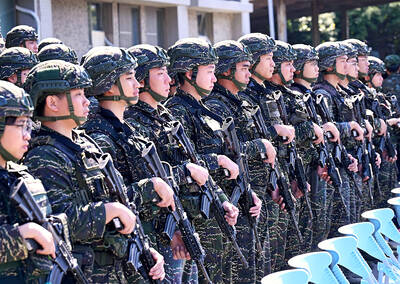
MORE RESPONSIBILITY: Draftees would be expected to fight alongside professional soldiers, likely requiring the transformation of some training brigades into combat units The armed forces are to start incorporating new conscripts into combined arms brigades this year to enhance combat readiness, the Executive Yuan’s latest policy report said. The new policy would affect Taiwanese men entering the military for their compulsory service, which was extended to one year under reforms by then-president Tsai Ing-wen (蔡英文) in 2022. The conscripts would be trained to operate machine guns, uncrewed aerial vehicles, anti-tank guided missile launchers and Stinger air defense systems, the report said, adding that the basic training would be lengthened to eight weeks. After basic training, conscripts would be sorted into infantry battalions that would take

GROWING AMBITIONS: The scale and tempo of the operations show that the Strait has become the core theater for China to expand its security interests, the report said Chinese military aircraft incursions around Taiwan have surged nearly 15-fold over the past five years, according to a report released yesterday by the Democratic Progressive Party’s (DPP) Department of China Affairs. Sorties in the Taiwan Strait were previously irregular, totaling 380 in 2020, but have since evolved into routine operations, the report showed. “This demonstrates that the Taiwan Strait has become both the starting point and testing ground for Beijing’s expansionist ambitions,” it said. Driven by military expansionism, China is systematically pursuing actions aimed at altering the regional “status quo,” the department said, adding that Taiwan represents the most critical link in China’s
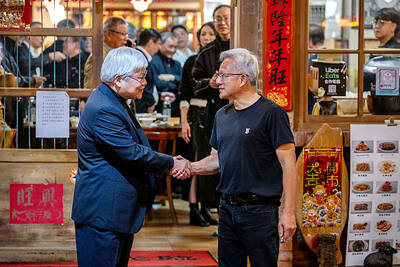
‘REALLY PROUD’: Nvidia would not be possible without Taiwan, Huang said, adding that TSMC would be increasing its capacity by 100 percent Nvidia Corp CEO Jensen Huang (黃仁勳) on Saturday praised and lightly cajoled his major Taiwanese suppliers to produce more to help power strong demand for artificial intelligence (AI), capping a visit to the country of his birth, where he has been mobbed by adoring fans at every step. Speaking at an impromptu press conference in the rain outside a Taipei restaurant, where he had hosted suppliers for a “trillion-dollar dinner,” named after the market capitalization of those firms attending, Huang said this would be another good year for business. “TSMC needs to work very hard this year because I need a lot


 RSS
RSS