


Twenty-six new COVID-19 cases were confirmed yesterday, including five clusters, and all but one were imported, bringing Taiwan’s total number to 195, as border controls and home quarantine measures prove their effectiveness, the head of the Central Epidemic Command Center (CECC) said.
Twelve of the new cases were in people tested at airports upon their return, 11 were in people under home quarantine and two were people who tested positive after seeking medical treatment, Minister of Health and Welfare Chen Shih-chung (陳時中), who heads the center, said at its daily news conference.
“The new domestic case is a woman who lives with a Germen researcher at a national research institute who was one of three cases confirmed from the same institute on Sunday, he said.
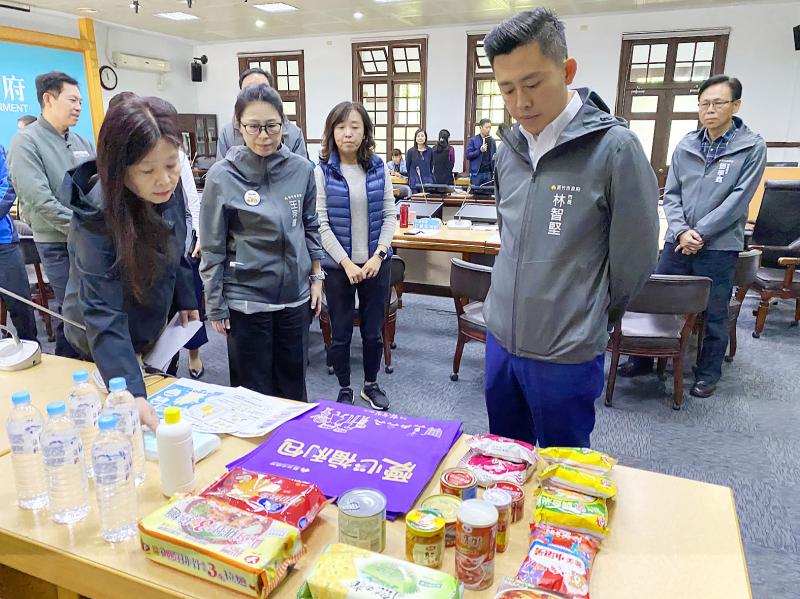
Photo: Hung Mei-hsiu, Taipei Times
The daily numbers of imported cases have continued to increase since mid-March, and the growth curve is expected to be maintained over the next two weeks,” he said.
Asked why, Chen said the number of travelers returning to Taiwan dropped from about 8,000 people in the middle of this month to more than 3,000 yesterday, but it is likely that more Taiwanese students would return in the coming days, as schools in many nations have been closed, Chen said.
“We are not afraid of an increase in imported cases, as long as we properly conduct airport and home quarantine measures,” he said.
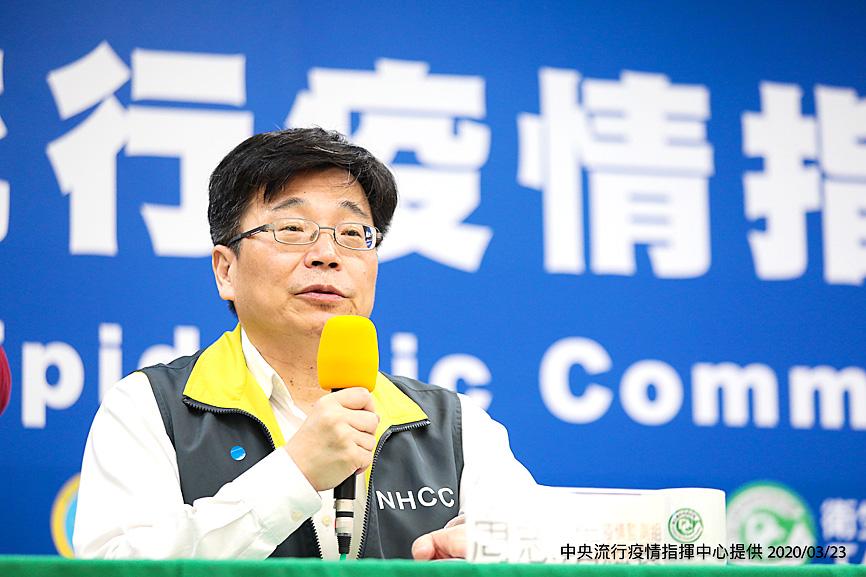
Photo courtesy of the Central Epidemic Command Center
Taiwanese who are overseas should evaluate three factors before deciding to return home — the number of infections where they are, social unrest in that area and the risk of infection during flights — and they should take protective measures if they decide to return, he said.
“They should also be honest in filling in the COVID-19 Health Declaration Form or reporting their travel history and health condition at airport quarantine stations,” he said.
Travelers should report any symptoms they experienced in the previous 14 days, even if they feel better or if they took medicine to alleviate the symptoms, he said.
“We are not punishing people because they took medicine to reduce symptoms, but we will punish people for making false statements on the health declaration form,” he said.
Meanwhile, the number of locally acquired cases remains relatively low, with the sources of infection unclear in only three recent cases, which are under investigation, he said.
The five clusters confirmed yesterday are a married couple who traveled to Spain; two colleagues who traveled to the Netherlands and two family members who traveled with them; a married couple who worked and studied in France; two colleagues who traveled to the US; and a person who traveled to the US with two friends, who were confirmed as being infected on Saturday, he said.
A four-year-old boy who accompanied his parents to the Netherlands is the youngest confirmed case in Taiwan so far, Chen said.
The people among the new imported cases had taken proper self-isolation measures, staying away from those they live with, and so far they had not spread virus into local communities, he said.
Most people have been cooperating with the two lines of defense — airport testing and home quarantines — with just a few exceptions, he added.
Deputy Minister of the Interior Chen Tsung-yen (陳宗彥) said a man under home quarantine after returning from abroad was discovered at a nightclub on Saturday night by police, so the local government fined him the maximum NT$1 million (US$32,889), and he has been placed in a quarantine center.
Police are being deployed at nightclub entrances to check the identity of all those entering, and maximum punishments would be imposed on those who violate home quarantine orders, he said.

A signaling system malfunction disrupted high-speed rail (HSR) services beginning at 8am today, with trains temporarily reduced to three northbound and three southbound trains per hour as authorities conduct inspections. The malfunction occurred on a section of track in Miaoli County during pre-operation checks early this morning, forcing northbound and southbound trains to use a single track, the HSR operator said. The regular schedule has been replaced with three hourly trains offering only nonreserved seating in each direction, stopping at every station, it said, adding that business class cars would still have reserved seating. Departures from terminal stations are scheduled at the top

DRONE CENTRAL: Taiwan aims to become Asia’s democratic hub for drones, with most exports focused on high-quality military-grade models, an official said Taiwan’s drone industry is expected to expand significantly by 2030, producing 100,000 units per month and exporting half of them, the Ministry of Economic Affairs said yesterday. Current drone production capacity is about 15,000 units per month, but the industry can quickly scale up as demand increases, Industrial Development Administration Director-General Chiou Chyou-huey (邱求慧) told a news conference in Taipei. Taiwan’s drone output grew 2.5-fold last year to NT$12.9 billion (US$408.3 million) under a government program to develop the uncrewed vehicle sector, he said. The Executive Yuan in October last year approved plans to invest NT$44.2 billion into domestic production of uncrewed aerial

VERBOSE VESSELS: A CGA cutter and a China Coast Guard exchanged verbal barbs for more than a day in Taiwanese-controlled waters before the Chinese vessel left The Taiwanese and Chinese coast guards had a standoff near the strategically located Pratas Islands (Dongsha Islands, 東沙群島) in the north of the South China Sea, the Coast Guard Administration (CGA) said yesterday. The two sides engaged in intense radio exchanges over sovereignty claims during the 33-hour standoff. China Coast Guard vessel 3501 eventually left the restricted waters, 26.6 nautical miles (49.2km) west of the Pratas Islands, at 5pm yesterday, the CGA said. Lying approximately between southern Taiwan and Hong Kong, the Taiwan-controlled Pratas are seen by some security experts as vulnerable to Chinese attack due to their distance — more than
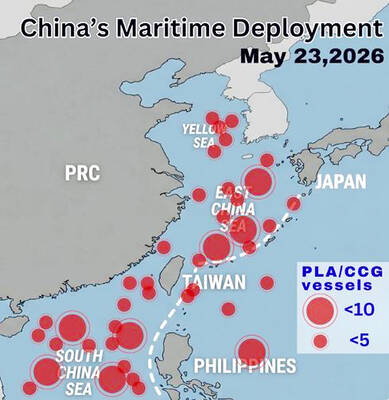
WARNING: China should stop engaging in actions that undermine regional peace and stability, as it would only build resentment among people across the Strait, the CGA said China has deployed more than 100 navy, coast guard and other vessels in waters from the Yellow Sea to the South China Sea and the western Pacific since US President Donald Trump and Chinese President Xi Jinping (習近平) met in Beijing, National Security Council Secretary-General Joseph Wu (吳釗燮) said yesterday. “In this part of the world, #China is the one & only PROBLEM wrecking the #StatusQuo & threatening regional peace & stability,” Wu wrote on X. In a separate post, he said Beijing was coercing Taiwan’s maritime domain, calling it illegal and provocative, after the Coast Guard Administration (CGA) expelled a


 RSS
RSS