


The Central Epidemic Command Center (CECC) yesterday issued a level 2 “alert” travel notice for eight European and two Middle Eastern countries, as well as a level 1 “watch” notice for 16 other European countries as it confirmed a new case of COVID-19 infection in a Taiwanese woman who on Sunday returned from the UK.
The coronavirus outbreak in Europe is getting worse, said Minister of Health and Welfare Chen Shih-chung (陳時中), who heads the center.
The CECC had already issued a level 3 “warning” travel notice — avoid all nonessential travel — for Italy and a level 2 “alert” notice — practice enhanced precautions — for France, Germany and Spain, he said.
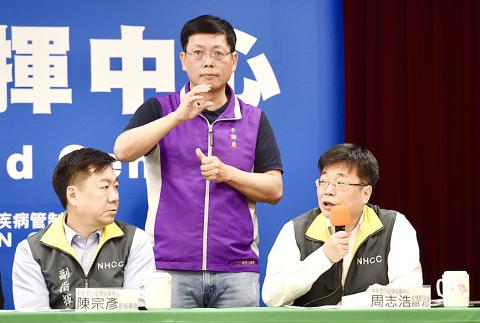
Photo: Peter Lo, Taipei Times
“We are issuing a level 2 ‘alert’ travel notice for Iceland, Switzerland, Norway, Sweden, Belgium, the Netherlands, Denmark and Austria, effective as of today,” he added.
“Also, a level 2 travel notice has been issued for Bahrain and Kuwait in the Middle East, as they have the same level of risk,” he said.
“We are also issuing a level 1 ‘watch’ travel notice for Greece, the Czech Republic, Portugal, Finland, Slovenia, Poland, Estonia, Hungary, Luxemburg, Malta, Slovakia, Latvia, Lithuania, Liechtenstein, the UK and Ireland,” whose citizens can move freely within the Schengen area, Chen said
People arriving in Taiwan from these countries are required to practice self-health management for 14 days, the center said.
Chen said that the latest confirmed case — the nation’s 48th — is woman in her 30s living in northern Taiwan.
The woman visited a friend in the UK from Feb. 28 to Sunday, Chen said.
She sought medical treatment at a clinic for dizziness and a headache on Monday, went to hospital the next day after she developed a mild fever and a cough, and was reported for testing, he said, adding that the results came out positive yesterday.
The woman mainly stayed at home after returning from the trip, Centers for Disease Control Director-General Chou Jih-haw (周志浩) said.
Nine people who have had close contact with her in Taiwan have shown no symptoms, Chou said, adding that a contact investigation is being carried out.
In related news, the Regulations Governing the Compensation for Periods of Isolation and Quarantine for Severe Pneumonia with Novel Pathogens (嚴重特殊傳染性肺炎隔離及檢疫期間防疫補償辦法) was promulgated on Tuesday.
Under the regulations, people who are placed under mandatory 14-day home isolation, home quarantine or have asked for disease-prevention family care leave due to COVID-19-related policies can apply for compensation of NT$1,000 per day up to a maximum of NT$14,000 for 14 days.
The budget allocated for the compensation is expected to cover about 130,000 people.
Chou said that the number is only an estimate, adding that an actual epidemic situation is difficult to predict accurately.
The quarantine orders would not stop if the number exceeds 130,000 people, he added.
Asked about concerns that some people might travel abroad with the aim of being placed under home quarantine to receive compensation, Chen said such offenses would be punished in accordance with the law.
As for the center’s online mask purchase program, Chen said that people can start ordering masks from 9am today at the Web site emask.taiwan.gov.tw.

PROVOCATIVE: Chinese Deputy Ambassador to the UN Sun Lei accused Japan of sending military vessels to deliberately provoke tensions in the Taiwan Strait China denounced remarks by Japan and the EU about the South China Sea at a UN Security Council meeting on Monday, and accused Tokyo of provocative behavior in the Taiwan Strait and planning military expansion. Ayano Kunimitsu, a Japanese vice foreign minister, told the Council meeting on maritime security that Tokyo was seriously concerned about the situation in the East China and South China seas, and reiterated Japan’s opposition to any attempt to change the “status quo” by force, and obstruction of freedom of navigation and overflight. Stavros Lambrinidis, head of the EU delegation to the UN, also highlighted South China Sea
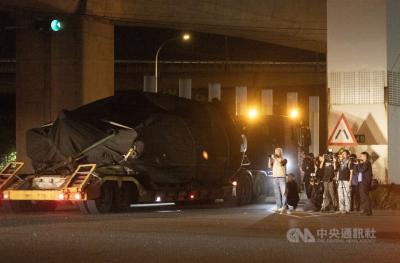
The final batch of 28 M1A2T Abrams tanks purchased from the US arrived at Taipei Port last night and were transported to the Armor Training Command in Hsinchu County’s Hukou Township (湖口), completing the military’s multi-year procurement of 108 of the tanks. Starting at 12:10am today, reporters observed more than a dozen civilian flatbed trailers departing from Taipei Port, each carrying an M1A2T tank covered with black waterproof tarps. Escorted by military vehicles, the convoy traveled via the West Coast Expressway to the Armor Training Command, with police implementing traffic control. The army operates about 1,000 tanks, including CM-11 Brave Tiger
Taiwan Semiconductor Manufacturing Co (TSMC, 台積電), the world’s largest contract chipmaker, said it expects its 2-nanometer (2nm) chip capacity to grow at a compound annual rate of 70 percent from this year to 2028. The projection comes as five fabs begin volume production of 2-nanometer chips this year — two in Hsinchu and three in Kaohsiung — TSMC senior vice president and deputy cochief operating officer Cliff Hou (侯永清) said at the company’s annual technology symposium in Silicon Valley, California, last week. Output in the first year of 2-nanometer production, which began in the fourth quarter of last year, is expected to

Taiwan’s drone exports surged past US$100 million in the first quarter, exceeding last year’s full-year total, with the Czech Republic emerging as the largest buyer, the Ministry of Economic Affairs said. Exports of complete drones reached US$115.85 million in the period, about 1.2 times the total recorded for all of last year, the ministry said in a report. Exports to the Czech Republic accounted for about US$100 million, far outpacing other markets. Poland, last year’s top destination, recorded about US$11.75 million in the first quarter. Taiwan’s drone exports have expanded rapidly in the past few years, with last year’s total


 RSS
RSS