


The Administrative Enforcement Agency’s Changhua County branch yesterday oversaw the handover of a former Buddhist temple from a family that had turned it into a Chinese communist shrine to a former nun of the temple.
Biyun Chan Temple in Changhua’s Ershuei Township (二水) was in 2011 acquired by Wei Ming-jen (魏明仁), a contractor and former military officer.
The nearly 100-year-old temple had served as a place of worship for local Buddhists. The temple hired Wei to build an expansion, but later lost the building to him due to a property rights dispute.
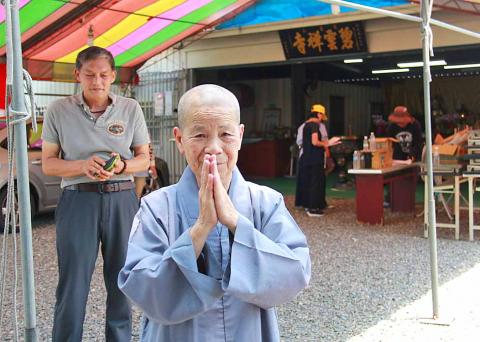
Photo: Chen Kuan-pei, Taipei Times
Wei kicked out the nuns residing at the temple, adding on to the structure and replacing Buddhist statues with images of Mao Zedong (毛澤東) and other Chinese Communist Party icons.
The Changhua County Government in September last year ordered that illegal additions on the property be demolished.
The contractor’s sister, Wei Su-tan (魏素丹), who had the rights to the property, failed to pay a NT$4.9 million (US$156,101 at the current exchange rate) demolition fee, so the government auctioned the property in April.
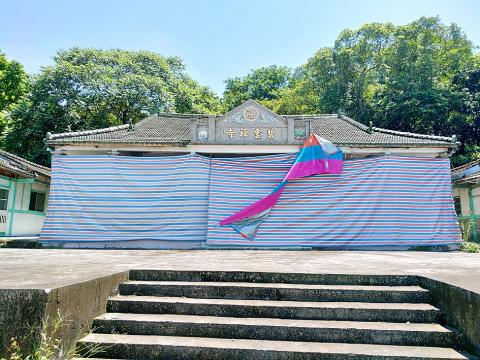
Photo: Chen Kuan-pei, Taipei Times
As a result, Shih Huai-tsung (釋懷宗), a former nun of the temple, regained ownership of the property under her legal name, Chen Fu-mei (陳富美).
Agency officials arrived at about 10:30am for the handover. They were accompanied by Changhua County Councilor Hsu Shu-wei (許書維) and officials from the county’s Cultural Affairs Bureau.
Former Changhua County commissioner Wei Ming-ku (魏明谷), who was in office when the demolition was carried out, was also there and livestreamed the handover so that the public could witness the event.
As the doors to Biyun Chan Temple had not been opened in nearly a decade, it took a locksmith considerable effort to open them, sources said.
Shih, 80, who became a nun at the temple at age 20, said she felt as though a heavy weight had been lifted from her.
With others’ help, she finally regained the property rights to the temple after a lawsuit that lasted more than a decade, she said.
Shih said she was not sure when statues of the main deities, bodhisattvas Avalokitesvara and Ksitigarbha, would be reinstalled, as much renovation is needed.
The contractor’s wife was at the temple with two of her friends to sign the paperwork for the handover, during which they accused the government of illegally demolishing parts of the temple.
The temple was acquired legally, but “illegal structures” are used for “political tactics,” she said, adding that plans were in place when asked whether her husband would “seek justice.”
The Changhua County Police Department deployed nearly 30 officers to the site to maintain order, but there was no physical violence, sources said.

‘NO SECURITY RISK’: The Railway Bureau reassured the public that the technicians’ activities were limited to technical guidance and did not involve sensitive systems The Railway Bureau yesterday said it had invited eight Chinese technicians to assist with an airport MRT construction project. The bureau issued the confirmation after an Internet user said Chinese nationals had entered the construction zone of Taiwan Taoyuan International Airport’s Terminal 3 project. They asked why “individuals from an enemy state” were allowed access to such a major national infrastructure project, which raised serious concerns over Taiwan’s industrial safety, sensitive systems and information security. The bureau’s Northern Region Engineering Branch Office said subcontractor Taiwan Handle Industrial Co (台灣手把工業) of the Taoyuan airport MRT’s “Contract No. CU05 Project A14 Station Civil, MEP &

A US uncrewed surface vessel (USV) encountered multiple Chinese warships during an autonomous transit of the Taiwan Strait, US defense company Seasats said in a statement on Wednesday. Seasats announced that a Lightfish USV had completed the first autonomous transit of the Taiwan Strait. Over five days, the USV traversed the entire length of the Strait while constantly monitoring surface vessel traffic, the company said. The Lightfish encountered multiple Chinese warships, one of which was a Chinese People’s Liberation Army Navy (PLAN) Type 056 corvette, it said. The Chinese vessels were operating “well within Taiwan’s exclusive economic zone without transmitting their identity via the
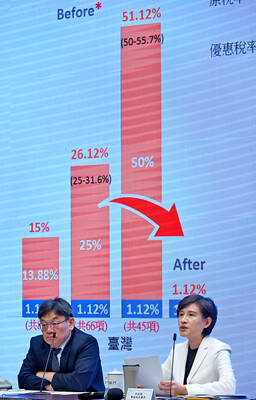
GREATER REACH? Auto parts and wood products would face tariffs of up to 15%, matching those targeting the EU, Japan and South Korea, Vice Premier said The US has announced that preferential tariff treatment for Taiwan’s non-semiconductor Section 232 goods would take effect retroactively from May 1, the Executive Yuan said yesterday. The US government yesterday posted a notice on the Federal Register’s public inspection Web site previewing tariff concessions for Taiwan under a memorandum of understanding (MOU) on Taiwan-US investment after two months of negotiations. The MOU signed on Jan. 15 stipulated three major preferential tariff arrangements: a 15 percent “reciprocal” tariff rate for Taiwan without stacking most-favored nation (MFN) rates; preferential Section 232 treatment for semiconductors and related products; and preferential Section 232 treatment for non-semiconductor

The National Chungshan Institute of Science and Technology yesterday showcased its locally developed variants of the Vision 60 robotic patrol dog, which it plans to deploy on the nation’s outlying territories in the South China Sea. The variants were produced under the Joint Lab project — created by the institute and domestic companies — and assembled with domestically produced motors, lenses and artificial intelligence (AI) systems alongside licensed tech from the US, Missile and Rocket Systems Research Division deputy director Jen Kuo-kang (任國光) told the media event at a military base in Taipei’s Dazhi (大直) area. Taiwan has built up its strengths


 RSS
RSS