


The struggle between the heirs to Evergreen Group (長榮集團) yesterday escalated as the three older brothers reportedly took drastic measures to undermine their younger brother’s accession to the helm of the family-run shipping and transportation empire.
The dramatic shift came two months after Evergreen Group founder Chang Yung-fa (張榮發) died on Jan. 20 and left a December 2014 will that named his youngest son, Chang Kuo-wei, (張國煒), chairman of Eva Airways (長榮航空) and the only son of his second wife, as his successor and the sole inheritor of his estate worth billions of New Taiwan dollars.
Chang Yung-fa’s eldest son, Chang Kuo-hua (張國華), led his two brothers by his father’s first wife in moving to dissolve the group’s top management team during an extraordinary board meeting, effectively stripping Chang Kuo-wei of the chairmanship, local media said, without naming sources.
In the absence of a chairman or management team, senior executives are to be dispatched to oversee the conglomerate’s subsidiaries, reports said.
The move reportedly aimed to deny Chang Kuo-wei leadership of the group after he allegedly disclosed their father’s will before the family agreed on the succession issue, the media said.
As the chairmanship is not protected by the law, disputes might boil down to the size of stakes held by rival heirs, reports said.
An Evergreen Group filing with the Taiwan Stock Exchange showed that the three older brothers hold stakes of 34.7 percent and 54.56 percent respectively in the group’s main subsidiaries, Evergreen Marine Corp (長榮海運) and Evergreen International Storage & Transportation Corp (榮運), compared with 6.83 percent and 2.3 percent held by Chang Kuo-wei.
Chang Kuo-wei might even lose the chairmanship of EVA Airways, reports said.
He holds a 14.67 percent stake in the airline, compared with 31.65 percent held by his stepbrothers, who might seek to oust him during the company’s board meeting next month, or during a board of directors election scheduled for June, reports said.
A move to oust Chang Kuo-wei from the airline would require support from independent board members, who were installed under his watch, reports said.
Chang Kuo-wei could also seek endorsement from foreign institutional investors, who hold a 26.38 percent stake in EVA Airways and can forge alliances with others to bolster his stake in the airline by NT$4 billion (US$119.16 million), reports said.

A signaling system malfunction disrupted high-speed rail (HSR) services beginning at 8am today, with trains temporarily reduced to three northbound and three southbound trains per hour as authorities conduct inspections. The malfunction occurred on a section of track in Miaoli County during pre-operation checks early this morning, forcing northbound and southbound trains to use a single track, the HSR operator said. The regular schedule has been replaced with three hourly trains offering only nonreserved seating in each direction, stopping at every station, it said, adding that business class cars would still have reserved seating. Departures from terminal stations are scheduled at the top
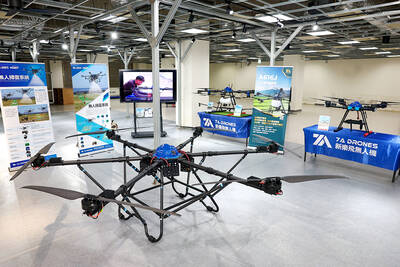
DRONE CENTRAL: Taiwan aims to become Asia’s democratic hub for drones, with most exports focused on high-quality military-grade models, an official said Taiwan’s drone industry is expected to expand significantly by 2030, producing 100,000 units per month and exporting half of them, the Ministry of Economic Affairs said yesterday. Current drone production capacity is about 15,000 units per month, but the industry can quickly scale up as demand increases, Industrial Development Administration Director-General Chiou Chyou-huey (邱求慧) told a news conference in Taipei. Taiwan’s drone output grew 2.5-fold last year to NT$12.9 billion (US$408.3 million) under a government program to develop the uncrewed vehicle sector, he said. The Executive Yuan in October last year approved plans to invest NT$44.2 billion into domestic production of uncrewed aerial

VERBOSE VESSELS: A CGA cutter and a China Coast Guard exchanged verbal barbs for more than a day in Taiwanese-controlled waters before the Chinese vessel left The Taiwanese and Chinese coast guards had a standoff near the strategically located Pratas Islands (Dongsha Islands, 東沙群島) in the north of the South China Sea, the Coast Guard Administration (CGA) said yesterday. The two sides engaged in intense radio exchanges over sovereignty claims during the 33-hour standoff. China Coast Guard vessel 3501 eventually left the restricted waters, 26.6 nautical miles (49.2km) west of the Pratas Islands, at 5pm yesterday, the CGA said. Lying approximately between southern Taiwan and Hong Kong, the Taiwan-controlled Pratas are seen by some security experts as vulnerable to Chinese attack due to their distance — more than
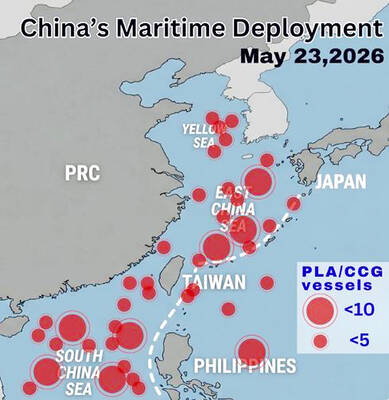
WARNING: China should stop engaging in actions that undermine regional peace and stability, as it would only build resentment among people across the Strait, the CGA said China has deployed more than 100 navy, coast guard and other vessels in waters from the Yellow Sea to the South China Sea and the western Pacific since US President Donald Trump and Chinese President Xi Jinping (習近平) met in Beijing, National Security Council Secretary-General Joseph Wu (吳釗燮) said yesterday. “In this part of the world, #China is the one & only PROBLEM wrecking the #StatusQuo & threatening regional peace & stability,” Wu wrote on X. In a separate post, he said Beijing was coercing Taiwan’s maritime domain, calling it illegal and provocative, after the Coast Guard Administration (CGA) expelled a


 RSS
RSS