


An international study has found that the Chinese people originated not from "Peking Man" in northern China, but from early humans in East Africa who moved through South Asia to China some 100,000 years ago, Hong Kong's Ming Pao daily reported yesterday in a finding that confirms the "single origin" theory in anthropology.
According to the newspaper, a research team led by Jin Li (
In China, school textbooks teach that the Chinese race evolved from "Peking Man," based on a theory that humans in Europe and Asia evolved from local species.
But Jin and his fellow researchers found that early humans belonged to different species, of which only the East African species developed into modern humans.
This new finding nullifies the theory that the ancestors of the Chinese people were "Peking Man" who lived in northern China 400,000 years ago.
Based on DNA analyses of 100,000 samples gathered from around the world, a number of human families evolved in East Africa some 150,000 years ago, said Li Hui (
About 100,000 years ago, some of those humans began to leave Africa, with some people moving to China via South and Southeast Asia, Li said.
According to the newspaper article, it has been proven that the "65 branches of the Chinese race" share similar DNA mutations with the peoples of East and Southeast Asia.
It said that the Shanghai scientists were part of an international team comprised of researchers from Russia, India, Brazil and other nations in a five-year project studying the geographic and genealogical routes related to the spread and settlement of modern humans.
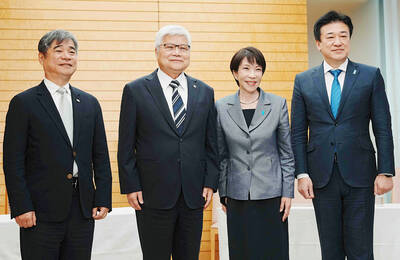
Taiwan Semiconductor Manufacturing Co (TSMC, 台積電) plans to make advanced 3-nanometer chips in Japan, stepping up its semiconductor manufacturing roadmap in the country in a triumph for Japanese Prime Minister Sanae Takaichi’s technology ambitions. TSMC is to adopt cutting-edge technology for its second wafer fab in Kumamoto, company chairman C.C. Wei (魏哲家) said yesterday. That is an upgrade from an original blueprint to produce 7-nanometer chips by late next year, people familiar with the matter said. TSMC began mass production at its first plant in Japan’s Kumamoto in late 2024. Its second fab, which is still under construction, was originally focused on
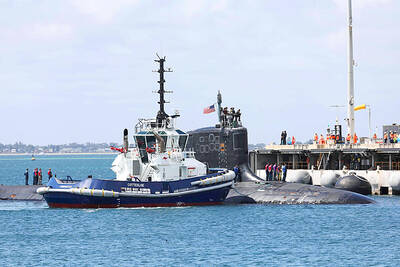
DETERRENCE EFFORTS: Washington and partners hope demonstrations of force would convince Beijing that military action against Taiwan would carry high costs The US is considering using HMAS Stirling in Western Australia as a forward base to strengthen its naval posture in a potential conflict with China, particularly over Taiwan, the Wall Street Journal reported on Saturday. As part of its Indo-Pacific strategy, Washington plans to deploy up to four nuclear-powered submarines at Stirling starting in 2027, providing a base near potential hot spots such as Taiwan and the South China Sea. The move also aims to enhance military integration with Pacific allies under the Australia-UK-US trilateral security partnership, the report said. Currently, US submarines operate from Guam, but the island could
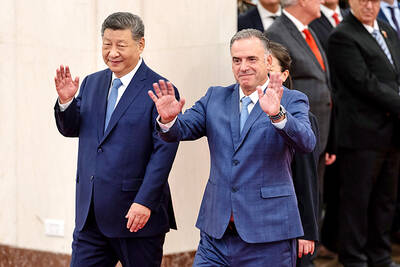
EMERGING FIELDS: The Chinese president said that the two countries would explore cooperation in green technology, the digital economy and artificial intelligence Chinese President Xi Jinping (習近平) yesterday called for an “equal and orderly multipolar world” in the face of “unilateral bullying,” in an apparent jab at the US. Xi was speaking during talks in Beijing with Uruguayan President Yamandu Orsi, the first South American leader to visit China since US special forces captured then-Venezuelan president Nicolas Maduro last month — an operation that Beijing condemned as a violation of sovereignty. Orsi follows a slew of leaders to have visited China seeking to boost ties with the world’s second-largest economy to hedge against US President Donald Trump’s increasingly unpredictable administration. “The international situation is fraught
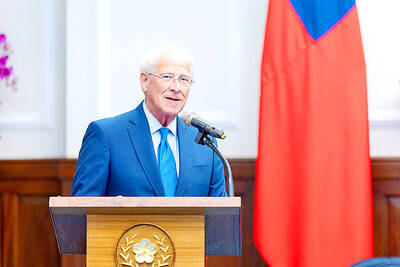
Opposition parties not passing defense funding harms Taiwan’s national security, two US senators said separately in rare public criticism. “I am disappointed to see Taiwan’s opposition parties in parliament [the legislature] slash President [William] Lai’s (賴清德) defense budget so dramatically,” Roger Wicker, a Republican who chairs the US Senate Armed Forces Committee, said on social media. “The original proposal funded urgently needed weapons systems. Taiwan’s parliament should reconsider — especially with rising Chinese threats,” he added. Wicker’s post linked to an article published by Bloomberg that said that the two opposition parties’ move was “potentially jeopardizing the purchases of billions of dollars of


 RSS
RSS