


Frank Hsieh (
The meeting was notable for being the first time that a KMT leader has ever called upon the DPP, something that Lien pointed out while expressing his congratulations to Hsieh on the latter's inauguration as the DPP's ninth chairman.
At their meeting the two party leaders agreed to open more dialogue between the DPP and KMT and to accelerate the attainment of better interaction between parties in accordance with the principles of party politics.

PHOTO: CHIANG YING-YING, TAIPEI TIMES
There was, however, no resolution of the issue that the meeting had actually been called to address, namely the KMT's participation in a round-table meeting of the heads of Taiwan's major political parties called by President Chen Shui-bian
Hsieh urged Lien to attend the meeting but the KMT chairman said that his attendance was dependent upon what issues were on the agenda. Lien, however, did say that KMT Secretary-General Lin Feng-cheng
Lien is scheduled to depart for the US today for a month-long trip.
"It is possible that the KMT is still hesitant about attending the round-table meeting," said Wu, speaking to the media after the Hsieh-Lien meeting.
"On the basis of Lien's remarks today, however, the presidential round-table meeting will probably proceed," he said.
During the 30-minute meeting, Lien also said that parties should have mutual respect and interact in a mature fashion, while Hsieh agreed that interaction carried out in good faith would be conducive to the eradication of emotional and ideological conflicts between rival parties.
"Dialogue and exchange has been undertaken by both parties on either side of the Taiwan Strait. So why not between political parties [in Taiwan]?" Hsieh said.
Others taking part in the Hsieh-Lien meeting from the KMT included party spokesman Jason Hu (
Participants from the DPP included central standing committee member Chiu Yi-ying (邱議瑩), social promotion department director Lee Wen-ying (李文英) and spokeswoman Phoenix Cheng (鄭運鵬).
Some political analysts saw yesterday's meeting as an attempt to highlight the importance of party politics over the "government for all the people" (
"Political interaction is very important. The concept of `government for all the people' is based on the concept of party politics," the KMT's Chen said, hinting that the new government still needed the KMT's support.
Following his meeting with Lien, Hsieh visited the Presidential Office for his weekly Wednesday meeting with President Chen. He then returned to DPP headquarters and addressed reporters again.
"The concepts of party politics and `government for all the people' are not mutually exclusive," said Hsieh, quoting remarks reportedly just made to him by the president.
Hsieh said that the president was pleased to see that the DPP and KMT had met and he hoped that there would be more harmonious political interaction. Hsieh added that the president would assign acting Secretary-General to the President Chen Che-nan (
Hsieh met with New Party leader Hau Lung-bin (
On Monday Hsieh proposed a meeting with the PFP's Chairman James Soong
Soong has said he would welcome such dialogue.
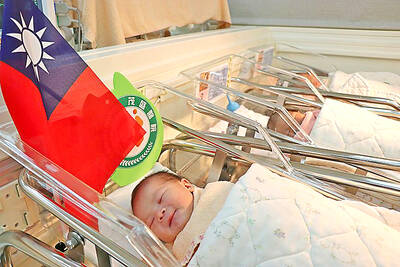
AGING: As of last month, people aged 65 or older accounted for 20.06 percent of the total population and the number of couples who got married fell by 18,685 from 2024 Taiwan has surpassed South Korea as the country least willing to have children, with an annual crude birthrate of 4.62 per 1,000 people, Ministry of the Interior data showed yesterday. The nation was previously ranked the second-lowest country in terms of total fertility rate, or the average number of children a woman has in her lifetime. However, South Korea’s fertility rate began to recover from 2023, with total fertility rate rising from 0.72 and estimated to reach 0.82 to 0.85 by last year, and the crude birthrate projected at 6.7 per 1,000 people. Japan’s crude birthrate was projected to fall below six,
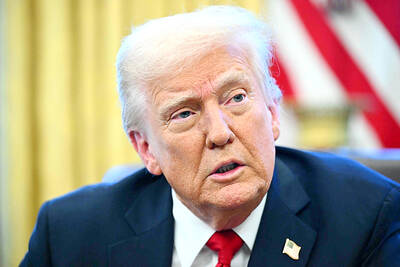
US President Donald Trump in an interview with the New York Times published on Thursday said that “it’s up to” Chinese President Xi Jinping (習近平) what China does on Taiwan, but that he would be “very unhappy” with a change in the “status quo.” “He [Xi] considers it to be a part of China, and that’s up to him what he’s going to be doing, but I’ve expressed to him that I would be very unhappy if he did that, and I don’t think he’ll do that. I hope he doesn’t do that,” Trump said. Trump made the comments in the context
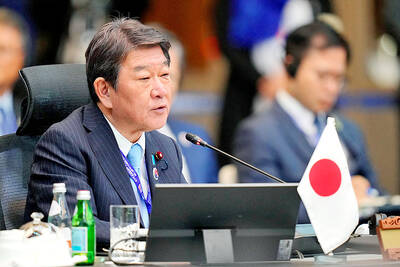
SELF-DEFENSE: Tokyo has accelerated its spending goal and its defense minister said the nation needs to discuss whether it should develop nuclear-powered submarines China is ramping up objections to what it sees as Japan’s desire to acquire nuclear weapons, despite Tokyo’s longstanding renunciation of such arms, deepening another fissure in the two neighbors’ increasingly tense ties. In what appears to be a concerted effort, China’s foreign and defense ministries issued statements on Thursday condemning alleged remilitarism efforts by Tokyo. The remarks came as two of the country’s top think tanks jointly issued a 29-page report framing actions by “right-wing forces” in Japan as posing a “serious threat” to world peace. While that report did not define “right-wing forces,” the Chinese Ministry of Foreign Affairs was

PREPAREDNESS: Given the difficulty of importing ammunition during wartime, the Ministry of National Defense said it would prioritize ‘coproduction’ partnerships A newly formed unit of the Marine Corps tasked with land-based security operations has recently replaced its aging, domestically produced rifles with more advanced, US-made M4A1 rifles, a source said yesterday. The unnamed source familiar with the matter said the First Security Battalion of the Marine Corps’ Air Defense and Base Guard Group has replaced its older T65K2 rifles, which have been in service since the late 1980s, with the newly received M4A1s. The source did not say exactly when the upgrade took place or how many M4A1s were issued to the battalion. The confirmation came after Chinese-language media reported


 RSS
RSS