

These few weeks will decide who ends up on the ballot, and who does not, in this year’s elections. Registration closes on Sep. 4, but until then, politicians may drop in or drop out of the race.
Both the pan-green Democratic Progressive Party and the its supporters (DPP) and the pan-blue Chinese Nationalist Party (KMT) have nominated 19 candidates for 22 of the top-level mayor and county commissioner posts. The KMT is also promoting a “great opposition alliance” in the remaining three, backing two independents and one candidate from the KMT-aligned Taiwan People’s Party (TPP).
For more context and a look at the races in northern Taiwan, see “Donovan’s Deep Dives: Northern Taiwan’s races come into focus” (Aug. 8, page 12) and for central Taiwan “Donovan’s Deep Dives: Splinters, snubs and the ‘one-term curse’: The chaotic fight for central Taiwan” (Aug. 13, page 12).
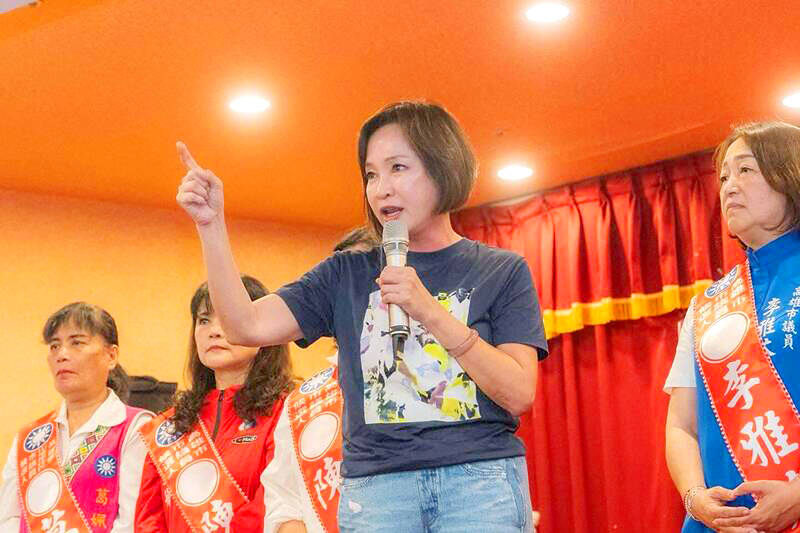
Photo: Wang Jung-hsiang, Taipei Times
CHIAYI CITY
For space reasons, Chiayi County was included in the previous column. The county has stuck with the DPP through thick and thin.
Chiayi City is pan-green in national elections. Locally, the city rejected the KMT for decades, with independents dominating the mayoral races from the early 1980s to the early 2000s.
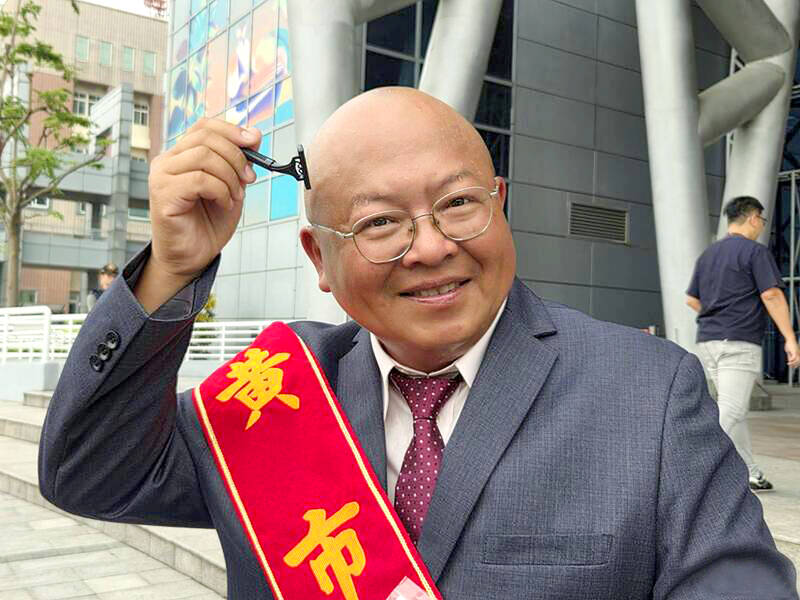
Photo: Wang Shan-yen, Taipei Times
Then, in 2005, the city elected the KMT’s Huang Min-hui (黃敏惠) as mayor, and re-elected her in 2009. Term-limited out, the DPP won in 2014, but it seems the city could not get enough of Huang, and re-elected her for two terms starting in 2018. She also served as the KMT’s first-ever female party chair.
Term-limited out again, the slate is clean. Huang has a good relationship with the DPP’s candidate, lawmaker Wang Mei-hui (王美惠), and it is widely rumored they have a pact not to attack each other personally.
As part of their alliance agreement, the KMT and TPP held public opinion polling primaries to determine which of their candidates would represent them in New Taipei City, Yilan and Chiayi City. The TPP lost two of those, but won this one.
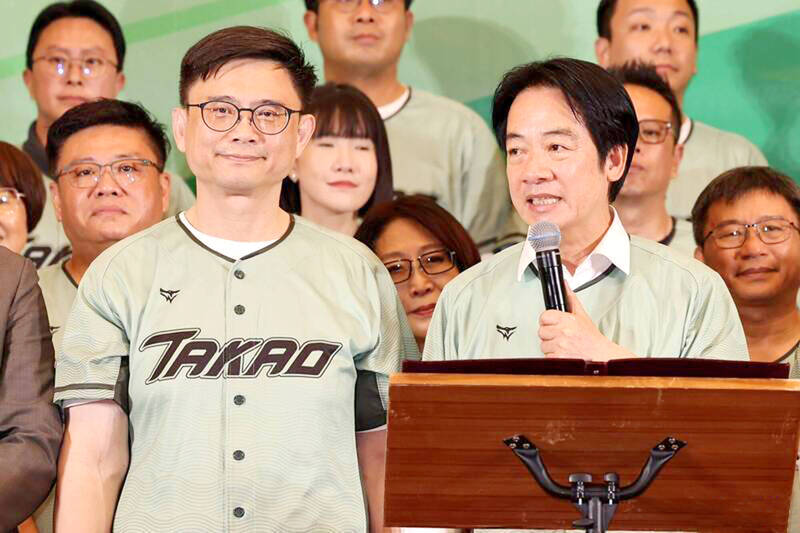
Photo: Ge Yu-hao, Taipei Times
The TPP candidate is Chang Chi-kai (張?楷). On social media he uses Chinese Hanyu Pinyin to spell his name as Zhang Qikai, a pro-China signal; his background is as a television personality and journalist for deep blue media outlets, including Want Want China Times and CTiTV News.
Both are being challenged by independents Chen Kai Huang (陳愷璜) and Huang Hong-cheng Rich God President (黃宏成台灣阿成世界偉人財神總統). Yes, that really is his name, and he has run several times but never gains traction.
The DPP is optimistic about winning this race. KMT Chair Cheng Li-wun (鄭麗文) says they haven’t given up on this race.
TAINAN
Tainan politics are brutal, with a history of corruption and violence on both sides of the aisle.
After a fiercely contested DPP primary, legislator Fifi Chen (陳亭妃) came out on top, beating her New Tide faction rival. Chen is formidable, with an iron will and fierce determination.
She will need those skills, as the KMT’s Hsieh Lung-chieh (謝龍介) is also formidable, with a knack for getting press attention. The lawmaker lost by only five points in 2022, an impressive result in this deep-green city, running against an incumbent.
Before they merged in 2010, Tainan County was solidly DPP from 1993, Tainan City from 1997 and the merged Tainan City has remained in DPP hands.
Like Chiayi City, KMT Chair Cheng says Tainan is still in play. The DPP is publicly optimistic, but it appears that they had to work hard to put the acrimony of the primary behind them, hinting that they are concerned about Hsieh’s prospects.
A Big Media poll released in early March found 46 percent of respondents supporting Chen, compared with 41 percent backing Hsieh, but a mid-March poll by TVBS had Chen at 44 percent and Hsieh at only 19 percent.
KAOHSIUNG
Like Tainan, both Kaohsiung City and County before their merger had been in pan-green hands since the 1990s.
Then came the shock upset in 2018, when the charismatic KMT candidate Han Kuo-yu (韓國瑜) won on support so strong it became known as the “Han wave,” lifting KMT candidates across the country and leading to a national blue landslide. However, just months after taking office as mayor, he was drafted to run for president, and he was soon ousted in a recall.
This proved the KMT can win, and KMT Chair Cheng says “expectations are high.” Their candidate, legislator and long-time head of the party’s think tank, Ko Chih-en (柯志恩), is performing well. She has carefully moderated her political stances, sounding more pro-American and pro-defense than Cheng.
The DPP’s candidate, lawmaker Lai Jui-lung (賴瑞隆), limped to a narrow victory in a four-way primary. His campaign has been lackluster and the popularity of outgoing Mayor Chen Chi-mai’s (陳其邁) has not rubbed off on Lai.
There have been a fair number of polls done, but a Kaohsiung Times headline sums up the wildly uneven results neatly: “Lai leads most Kaohsiung polls. By how much is another question.”
Most polls have Lai ahead by single digits or with Ko trailing within the margin of error. This race is in play.
President William Lai (賴清德) — in his role as party chair — has weighed in, warning that China was already interfering in the election with a special emphasis on Kaohsiung, and called a recent poll “fake.”
That is a risky strategy. Everyone knows Beijing interferes in elections and it is unlikely to sit this one out. With Kaohsiung in play, it would make sense to focus more resources on this race because even a small percentage swing could decide what is shaping up to be a tight race.
PINGTUNG
The DPP has ruled Pingtung continuously since 1997, yet the KMT’s Cheng puts this in the same category as Kaohsiung; “expectations are high.”
Election night 2022 was a nailbiter, with each party’s candidate alternating as the leader. In the end, the DPP’s Chou Chun-mi (周春米) beat the KMT’s Su Ching-chuan (蘇清泉) by only 2.5 percent.
This year is a rematch. However, a few things are different this time. In 2022, Chou struggled with an acrimonious primary, but this time she is the incumbent.
In June, Su was indicted over a case involving a hospital fire in 2022 that left nine dead. However, Pingtung prosecutors originally issued a deferred prosecution, citing Su admitting responsibility, having reached full settlements with all victims’ families and provided long-term medical services to underserved rural communities.
The Pingtung prosecutors abruptly reversing their earlier decision during an election year has raised suspicions. If voters come to the conclusion this was politically motivated, there could be a backlash, boosting support for Su.
Donovan’s Deep Dives is a regular column by Courtney Donovan Smith (石東文) who writes in-depth analysis on everything about Taiwan’s political scene and geopolitics. Donovan is also the central Taiwan correspondent at ICRT FM100 Radio News, co-publisher of Compass Magazine, co-founder Taiwan Report (report.tw) and former chair of the Taichung American Chamber of Commerce. Follow him on X: @donovan_smith.
It is forest fire season in Europe and North America, and the news is filled with harrowing images of disastrous fires filling the air with smoke. What about Taiwan? Taiwan has a unique forest fire profile. Unlike other nations, where the threat peaks in the dry summer months, that period is wet. Instead, major forest fires typically occur during October to April, when the country is drier. Moreover, “high temperatures are not the primary drivers of forest fires” as a study in Theoretical and Applied Climatology noted. Rather, the consensus is that dryness is the trigger of forest fires here, with

When Gary Melyan, a longtime Taiwan resident who died on July 7 at age 83, arrived in Taipei for the second time in 1971, he was a graduate student trying to complete a doctoral thesis on the Taiping Rebellion. Wanting to assemble some fellow academics for a regular meal, he initiated a Saturday lunch, which quickly shifted to Saturday dinner. Then, sometime in 1974 or 1975, it became a weekly Wednesday night meal. Melyan never finished his PhD, but the weekly Wednesday dinner, now known as the Wednesday Night Old Farts (WNOF), has continued for more than half a century
Aug.10 to Aug.16 Yuko remembers getting into frequent fights with children from neighboring villages who called him huana (番仔), a derogatory term for Indigenous people meaning “savage.” “I was mad because they made fun of me. I had no idea that it had anything to do with my identity,” the Pataran (北投洋) resident in Tainan’s Jiali District (佳里) told me when I visited in 2019. Yuko’s experience was not unusual among the Siraya and other Pingpu (plains Indigenous) groups, who hid their Indigenous identity amid stigma and discrimination, leaving later generations unaware of their ancestry. When anthropologist Melissa J. Brown

This week a flood of news on the great divide in Taiwan. Not the Blue-Green one, but the other divide, between the haves and the have-nots. The government announced that real wages (wage growth after inflation) grew 1.16 percent in the first six months of this year, marking the strongest real wage growth in six years for the same period, according to the Directorate General of Budget, Accounting and Statistics (DGBAS). Good news! The statistics also mapped the demographic strain on the workforce: average monthly overtime hours was 17.8 hours per employee in the first half of the year. That was the


 RSS
RSS