

When AI-powered cameras on bridges over Seoul’s Han River raise the alarm that someone may be about to jump, acting quickly is vital.
The waterway is a landmark of the glittering South Korean capital, but also a frequent scene of despair in a country with one of the world’s highest suicide rates.
The artificial intelligence-driven surveillance system alerts first responders if someone lingers in certain locations, enters an area deemed unsafe or picks up one of the bridges’ dedicated suicide-prevention phones.
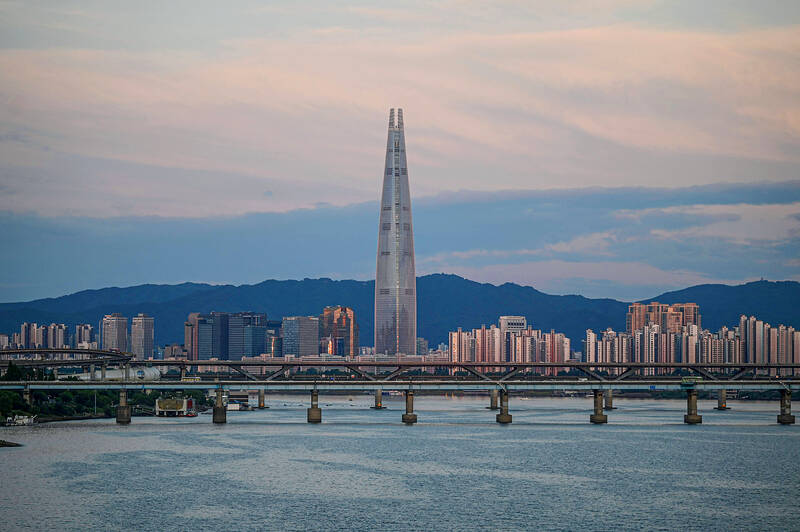
Photo: AFP
It has been strikingly effective, said Kim Jun-young, chief of the Hangang Bridge CCTV Integrated Control Center, with the rescue rate over the river rising to more than 99 percent from 56 percent in 2012.
Emergency crews can reach most bridges within five minutes — the critical window to intervene and save a life, he said.
“We see our role as giving them one more chance to think it over, because it may not be the decision you want,” Kim said.
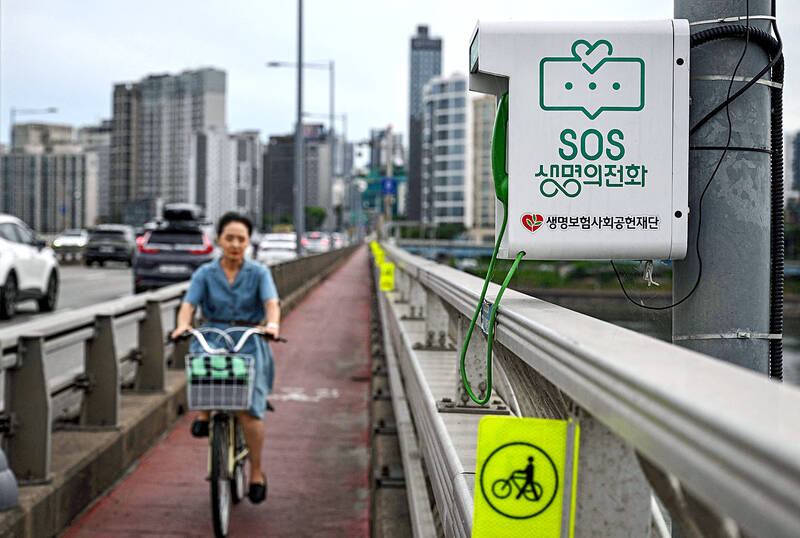
Photo: AFP
From a height of about 30 meters, striking the water is akin to crashing a car at 60 kilometers per hour, he said.
Persuading people who have made up their minds is not easy, Kim said, as they often struggle with rescuers or sprint away “as if running a 100-meter race.”
Others can make a final, split-second decision when they hear approaching sirens, before help arrives.
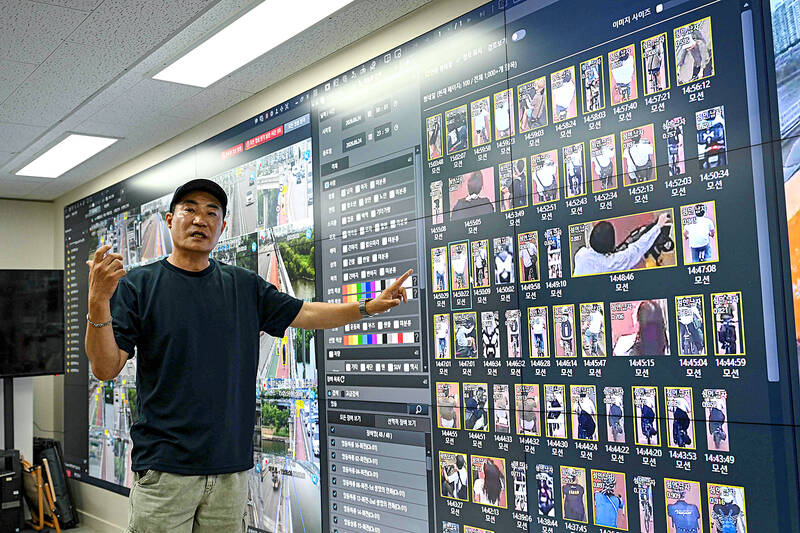
Photo: AFP
Last year, nearly 900 cameras on 17 bridges identified more than 1,200 incidents, he said, but “about eight people” could not be saved.
‘GLOBAL ‘DISGRACE’
The Han River AI system has been operating since 2021, but South Korea remains gripped by a broader suicide crisis called “a disgrace on the world stage” by President Lee Jae-myung.
The suicide rate in 2024 climbed above 29 deaths per 100,000 people, the highest since 2011. It is the leading cause of death among people aged 10 to 49, government figures show.
Relentless academic pressure, heavy workloads and a culture that holds individuals responsible for failure can leave people ill-equipped to cope with life’s setbacks or seek help, said Yoo Jae-hyun, director of suicide prevention at Seoul St. Mary’s Hospital.
Many who have tried to end their lives told him “they feel they have become a burden to those around them, and that everyone else would be better off if they were gone”, Yoo said.
Koreans in their twenties account for the largest share of people treated in emergency rooms after suicide attempts, according to Yoo.
The 33-year-old cartoonist Smiling Stone Hwang now lives what she describes as a resilient life, after she was saved by first responders.
After losing her father to suicide in 2014, Hwang inherited his debts and endured years of lawsuits and asset seizures — leaving her unable to hold a bank account in her own name.
Throughout her 20s, she juggled multiple cash-paying jobs, often working grueling hours.
Suicide “didn’t feel like a particularly tragic choice. It felt like a rational one”, Hwang said.
“Being accepted for who I am” has helped since then, said Hwang.
‘BLINK OF AN EYE’
Many CCTV systems worldwide use some form of AI to help spot danger.
Japanese company Asilla says its AI surveillance system can detect unusual behavior, such as falls, or someone who might be preparing to jump from a height.
Its AI tool has been learning behavior patterns from cameras in public facilities such as shopping centers and stations.
In two separate incidents, it alerted guards to men standing on rooftops who were able to be talked down, chief product officer Yuka Suzuki said.
It is not meant to replace humans and cannot bring down Japan’s suicide rate — the highest in the G7 — alone, she stressed.
“It’s still often difficult to provide proper mental health support,” Suzuki said.
But it is significant “if we can reduce the number of incidents, even by a little, where people lose their lives in the blink of an eye.”
In Seoul, CCTV Control Center’s Kim recalled one case in which a young man was intercepted by the AI system and rescue workers, only to return later that day and suddenly make another attempt while smoking with a friend. Despite rescuers and a boat already being on the water, they were unable to save him.
Cartoonist Hwang’s late father, who had long struggled with alcohol addiction, was once a successful film producer with a passion for cinema.
Shortly before his death, he visited Hwang at the cafe where she worked, according to her cartoon-based memoir, I Am a Suicide Loss Survivor.
He brought her a gift, but the usually empty cafe was packed, and she never got to buy him a coffee.
For a time after his death, Hwang returned daily to leave a cup of coffee “at the cramped table where he never got to sit.”
“One he could never drink again, and one I could never brew for him again,” Hwang wrote.
Unable to solve the enduring mystery of why Taiwan does not attract tourists in the desired numbers (despite the collective screams of all of us knowledgeable long-term foreigners watching the government flail uselessly at the problem), policymakers have decided to establish a Taiwan Tourism Institute (台灣觀光研訓院), which was inaugurated last week to great fanfare and almost certain futility. Premier Cho Jung-tai (卓榮泰), speaking at the opening ceremony for the institute, said that “we hope that the Taiwan Tourism Institute could function like ITRI [Industrial Technology Research Institute] and develop Taiwan’s tourism industry.” The chip industry dates back to the 1960s, but

For anyone unfamiliar with a ballet gala, Wang Tzer-shing (王澤馨) has a ready comparison. “Imagine in the culinary world, it would be like 10 Michelin-starred chefs bringing each a signature dish to the table,” she said. On Sunday, Art Wave’s 17th Ballet Star Gala gathers 10 world-class dancers performing 13 works in a single afternoon, offering Taiwanese audiences a rare chance to experience ballet’s remarkable range. Assembling this year’s gala in a record six weeks, Wang curated a program spanning classical, neoclassical and contemporary ballet. It includes five Taiwanese premieres, two Asian premieres and two world premieres. Yet, she refuses to single
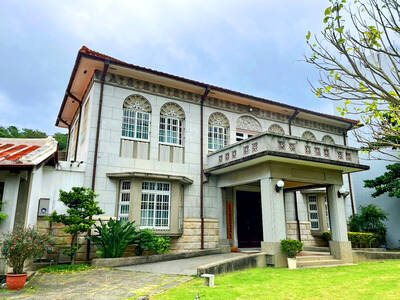
July 27 to Aug. 2 Chiang A-hsin’s (姜阿新) father did not want him to work. As one of the wealthiest families in the Hsinchu area, the Chiangs owned enough property and other assets to live comfortably, and his father reportedly spent much of his time smoking opium. Whenever Chiang came up with a business idea, his father rejected it. “He wanted me to be like him, just sit back and enjoy life. This pained me very much,” he later told his son-in-law, Liao Pan-yun (廖潘運), who wrote about his family in The Days of Golden
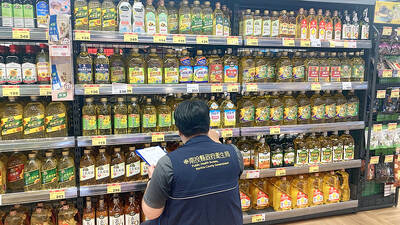
“What year is it?” famously yells the Robin Williams character in the 1995 film Jumanji. He could well be talking about food scandals in Taiwan. Is it 2008, with tainted milk powder coming in from the People’s Republic of China (PRC)? Or 2013, with its revelations that most rice noodles in Taiwan aren’t really made of rice starch? Or maybe 2013, with yet another cooking oil scandal? Is it 2011, bringing us the Great Plasticizer Scandal, where 168 companies pulled their drink products from the market over a plasticizer appearing in beverages, and stories circulated of PRC shippers sending plasticizer-tainted drinks


 RSS
RSS