


Skipper Sampsa Jalo greets three young children on their way home from school as they board an unusual amphibious vessel docked and humming at a wooden pier on the frozen Baltic Sea.
Due to unusually thick ice this winter, a hovercraft called “Snovit” (“Snow White”) has replaced the ferries that normally transport 12-year-old Hugo Wickstrom, nine-year-old Julia Jalkanen and eight-year-old Nils-Johan Ostman to the islands where they live in southwestern Finland’s Pargas archipelago. This is only the third time in 15 years that hovercrafts have been brought in because of thick ice in Finland’s archipelagos.
More than 81,000 islands dot the Nordic country’s 1,100-kilometer coastline.
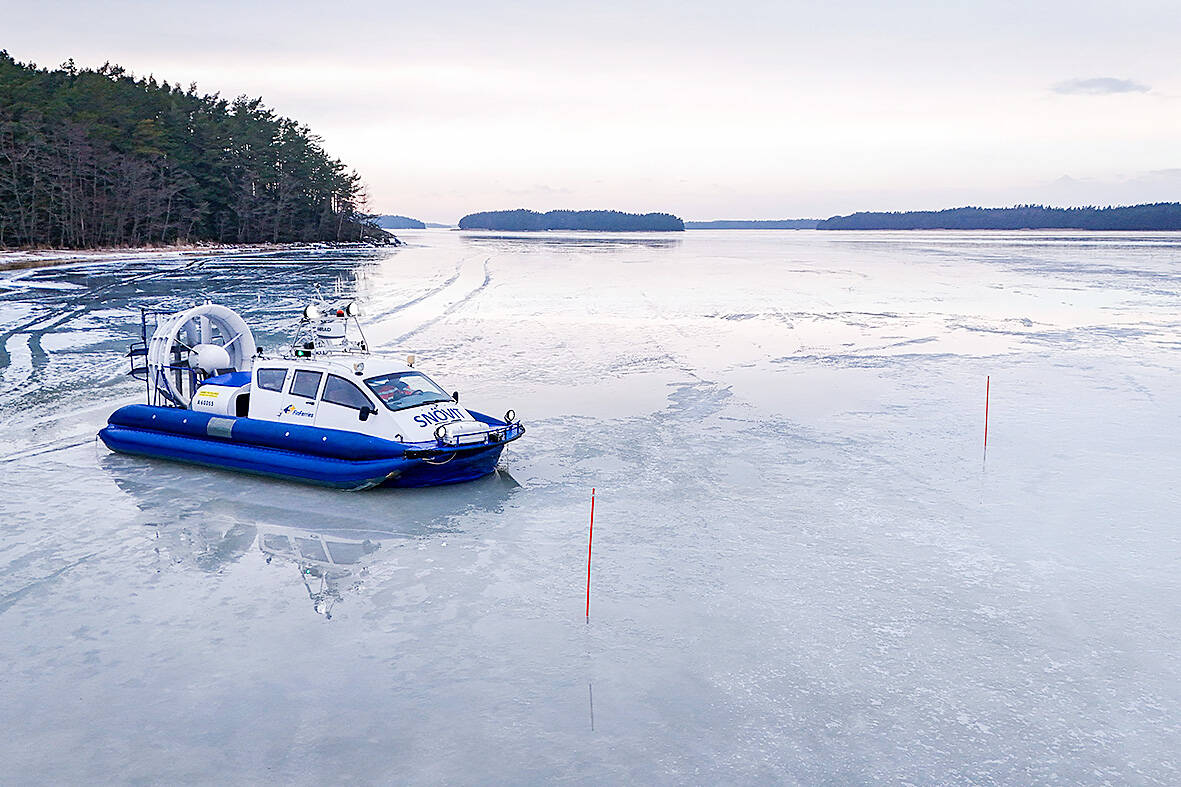
Photo: AFP
Here in the Pargas archipelago, 107 islands are inhabited year-round by nearly 3,000 residents. As the cushions under the vessel filled with air, the hovercraft lifted off the icy surface and set out across the frozen sea. In the back seat, the three children agreed their school commute was “very exciting.”
“Especially when it drifts like this,” said Wickstrom, showing how the hovercraft glides sideways on the ice. “It moves very fast,” Jalkanen said with a little smile. State-owned ferry operator Finferries replaced some of its regular vessels with six hovercrafts when freezing temperatures in February led to the formation of unusually thick ice.
“The ships can handle the ice but it’s so slow and expensive because it uses a lot of fuel,” Jalo explained.
A trip with a commuter ferry or vessel that normally takes an hour now takes “five or six hours to cover the same distance” due to the current ice conditions, he explained.
By hovercraft, “the same journey can be completed in 10 minutes.”
Behind the windows of the vessel, which has room for five to seven people, forest-covered islands slid by.
Soon it was time for Ostman to disembark. Jalo said piloting the hovercraft required “constant concentration” as wind conditions, fog and snowfall all posed challenges when manoeuvring through the landscape at a speed of 30 knots.
“The weather conditions change rapidly here... Let’s say it is both challenging and fun,” he said, smiling. This winter was the second time since 2009 that he had the chance to sit behind the wheel of a hovercraft.
“This is the kind of device you don’t normally see in the archipelago,” he said.
Even sea eagles and a wolf had come up close, “as the animals don’t know to be afraid of it.”
UNUSUAL CONDITIONS
This year’s ice cover in the Baltic Sea was unusual, said researcher Mika Rantanen at the Finnish Meteorological Institute. Peaking on February 20, “the ice cover has been the most extensive in the entire Baltic Sea region since 2011”, he said.
In Finland, winters with long cold periods are becoming increasingly rare due to climate change, Rantanen noted. Of the world’s coastal seas, the Baltic — surrounded by Denmark, Finland, Germany, Poland, Russia, Sweden and the three Baltic states — is warming the fastest.
“Our winters are becoming milder and warmer,” Rantanen said. “In the long term, the maximum winter ice cover in the Baltic Sea is shrinking, and that is due to climate change,” he said.
The lowest ice cover level ever recorded was in 2020. When the hovercraft stopped briefly at a sandy beach, Wickstrom climbed out in his snowsuit and thick winter hat, waving goodbye as pine trees swayed behind him in the wind.
In the morning, he would be picked up again, gliding towards the mainland where a taxi would drive him to school about 30 minutes away. Soon, migrating birds will return and the sea ice will melt completely, transforming the quiet archipelago.
Ship traffic will then resume as normal and Finns who live on the mainland will start heading out to their summer cottages on the islands, often rustic and without running water.
In the Pargas archipelago, there are 9,000 second homes on 1,070 islands, according to Pargas’ head of archipelago affairs, Benjamin Donner.
“Ice is melting really quickly now,” Jalo noted, looking at the thin layer of water covering the ice, before starting the engine and heading back to shore.
Recently the Chinese Nationalist Party (KMT) and its Mini-Me partner in the legislature, the Taiwan People’s Party (TPP), have been arguing that construction of chip fabs in the US by Taiwan Semiconductor Manufacturing Co (TSMC, 台積電) is little more than stripping Taiwan of its assets. For example, KMT Deputy Secretary-General Lin Pei-hsiang (林沛祥) in January said that “This is not ‘reciprocal cooperation’ ... but a substantial hollowing out of our country.” Similarly, former TPP Chair Ko Wen-je (柯文哲) contended it constitutes “selling Taiwan out to the United States.” The two pro-China parties are proposing a bill that would limit semiconductor

Institutions signalling a fresh beginning and new spirit often adopt new slogans, symbols and marketing materials, and the Chinese Nationalist Party (KMT) is no exception. Cheng Li-wun (鄭麗文), soon after taking office as KMT chair, released a new slogan that plays on the party’s acronym: “Kind Mindfulness Team.” The party recently released a graphic prominently featuring the red, white and blue of the flag with a Chinese slogan “establishing peace, blessings and fortune marching forth” (締造和平,幸福前行). One part of the graphic also features two hands in blue and white grasping olive branches in a stylized shape of Taiwan. Bonus points for
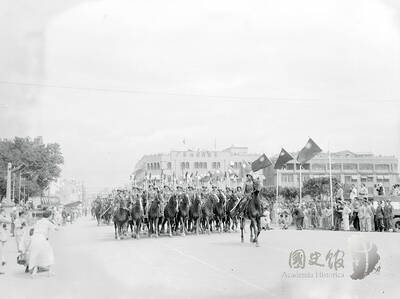
March 9 to March 15 “This land produced no horses,” Qing Dynasty envoy Yu Yung-ho (郁永河) observed when he visited Taiwan in 1697. He didn’t mean that there were no horses at all; it was just difficult to transport them across the sea and raise them in the hot and humid climate. “Although 10,000 soldiers were stationed here, the camps had fewer than 1,000 horses,” Yu added. Starting from the Dutch in the 1600s, each foreign regime brought horses to Taiwan. But they remained rare animals, typically only owned by the government or

“M yeolgong jajangmyeon (anti-communism zhajiangmian, 滅共炸醬麵), let’s all shout together — myeolgong!” a chef at a Chinese restaurant in Dongtan, located about 35km south of Seoul, South Korea, calls out before serving a bowl of Korean-style zhajiangmian —black bean noodles. Diners repeat the phrase before tucking in. This political-themed restaurant, named Myeolgong Banjeom (滅共飯館, “anti-communism restaurant”), is operated by a single person and does not take reservations; therefore long queues form regularly outside, and most customers appear sympathetic to its political theme. Photos of conservative public figures hang on the walls, alongside political slogans and poems written in Chinese characters; South


 RSS
RSS