


There is no question that Tyrannosaurus rex got big. In fact, this fearsome dinosaur may have been Earth’s most massive land predator of all time. But the question of how quickly T. rex achieved its maximum size has been a matter of debate.
A new study examining bone tissue microstructure in the leg bones of 17 fossil specimens concludes that Tyrannosaurus took about 40 years to reach its maximum size of roughly 8 tons, some 15 years more than previously estimated. As part of the study, the researchers identified previously unknown growth marks in these bones that could be seen only using polarized light.
“This growth trajectory is more gradual than expected,” said paleohistologist Holly Woodward of the Oklahoma State University Center for Health Sciences, lead author of the study published this week in the journal PeerJ. “Rather than T. rex ratcheting up to adult size quickly, it spent a lot of its life at juvenile to subadult sizes.”
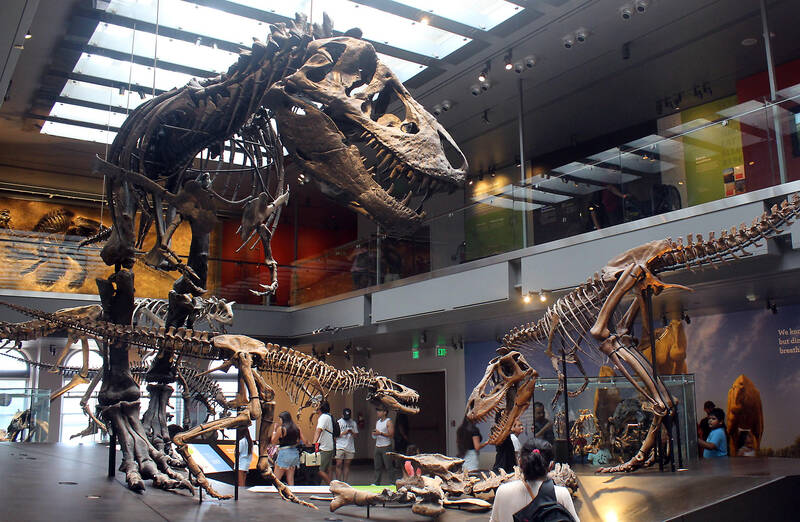
Photo: Reuters
The researchers scrutinized annual growth rings — akin to those present in tree trunks — in the Tyrannosaurus leg bones from the various specimens, which ranged from smaller juveniles to massive adults.
“We also found that growth-ring spacing in individual T. rex was variable. T. rex had a flexible growth pattern. Some years it didn’t grow much, while other years it grew a lot,” Woodward said.
“This likely depended on resource — food — availability or environmental conditions. In other words, if conditions weren’t great, it didn’t spend energy on growing, but when conditions were good, it could grow larger. This flexibility allowed it to survive harsh times while growing larger than other carnivores, so it could outcompete others for resources. Ultimately, T. rex was only competing against other T. rex for food,” Woodward added.

Photo courtesy of Wikimedia Commons
Tyrannosaurus prowled western North America during the Cretaceous Period at the twilight of the age of dinosaurs before an asteroid struck Mexico’s Yucatan Peninsula 66 million years ago. This calamity doomed the dinosaurs and wiped out three-quarters of Earth’s species.
T. rex reached more than 12.3 meters long, possessed a massive head and tremendous bite strength, walked on two strong legs, and bore puny arms with just two fingers.
Previous research had pointed to a Tyrannosaurus lifespan of somewhere around 30 years. The new study, according to paleontologist and study co-author Jack Horner of Chapman University in California, suggests a lifespan more like 45 to 50 years.
This study involved more Tyrannosaurus specimens — many of them held at the Museum of the Rockies in Montana — than previous research into the life history of this species. The authors also said they used a new statistical approach that considered growth records from different specimens to better estimate the growth trajectory of the species across all stages of life, producing a different conclusion than previous work.
“We don’t know for certain which of these estimates are more accurate since we don’t have living T. rexes to measure, but these new estimates make more sense logically and statistically, considering the size these dinosaurs attain,” Horner said.
Tyrannosaurus preyed on various plant-eating dinosaurs, including duckbilled ones such as Edmontosaurus and horned ones such as Triceratops as well as, in the southern part of its range, the enormous long-necked dinosaur Alamosaurus.
“Unfortunately we can’t know the evolutionary advantage of any particular characteristic, but a lengthened growth with an intervening growth hiatus allows the younger individuals a different food strategy than the older, larger individuals,” Horner said.
“And, independent of this current paper, I think the older adults were much more opportunistic — utilizing more scavenging — than the younger, smaller individuals. The extended growth period would provide a longer period of time for the younger individuals to possibly acquire more live prey,” Horner added.

Growing up in a rural, religious community in western Canada, Kyle McCarthy loved hockey, but once he came out at 19, he quit, convinced being openly gay and an active player was untenable. So the 32-year-old says he is “very surprised” by the runaway success of Heated Rivalry, a Canadian-made series about the romance between two closeted gay players in a sport that has historically made gay men feel unwelcome. Ben Baby, the 43-year-old commissioner of the Toronto Gay Hockey Association (TGHA), calls the success of the show — which has catapulted its young lead actors to stardom -- “shocking,” and says

The 2018 nine-in-one local elections were a wild ride that no one saw coming. Entering that year, the Chinese Nationalist Party (KMT) was demoralized and in disarray — and fearing an existential crisis. By the end of the year, the party was riding high and swept most of the country in a landslide, including toppling the Democratic Progressive Party (DPP) in their Kaohsiung stronghold. Could something like that happen again on the DPP side in this year’s nine-in-one elections? The short answer is not exactly; the conditions were very specific. However, it does illustrate how swiftly every assumption early in an

Inside an ordinary-looking townhouse on a narrow road in central Kaohsiung, Tsai A-li (蔡阿李) raised her three children alone for 15 years. As far as the children knew, their father was away working in the US. They were kept in the dark for as long as possible by their mother, for the truth was perhaps too sad and unjust for their young minds to bear. The family home of White Terror victim Ko Chi-hua (柯旗化) is now open to the public. Admission is free and it is just a short walk from the Kaohsiung train station. Walk two blocks south along Jhongshan

Jan. 19 to Jan. 25 In 1933, an all-star team of musicians and lyricists began shaping a new sound. The person who brought them together was Chen Chun-yu (陳君玉), head of Columbia Records’ arts department. Tasked with creating Taiwanese “pop music,” they released hit after hit that year, with Chen contributing lyrics to several of the songs himself. Many figures from that group, including composer Teng Yu-hsien (鄧雨賢), vocalist Chun-chun (純純, Sun-sun in Taiwanese) and lyricist Lee Lin-chiu (李臨秋) remain well-known today, particularly for the famous classic Longing for the Spring Breeze (望春風). Chen, however, is not a name


 RSS
RSS