


When the scientist and inventor Archibald Montgomery Low predicted “a day in the life of a man of the future” one century ago, his prophecies were sometimes dismissed as “ruthlessly imaginative.”
They included, reported the London Daily News in 1925, “such horrors” as being woken by radio alarm clock; communications “by personal radio set;” breakfasting “with loudspeaker news and television glimpses of events” shopping by moving stairways and moving pavements.
One hundred years after Low’s publication of his book The Future some of his forecasts were spot on. Others, including his prophecy that everyone would be wearing synthetic felt one-piece suits and hats, less so.

Photo: Reuters
Researchers from the online genealogy service Findmypast, have excavated accounts of Low’s predictions from its extensive digital archive of historical newspapers available to the public and included them in a collection on its Web site of forecasts made for next year by people a century ago.
Low, born in 1888, was an engineer, research physicist, inventor and author. A pioneer in many fields, he invented the first powered drone, worked on the development of television, was known as the “father of radio guidance systems” for his work on planes, torpedo boats and guided rockets and reportedly attracted at least two unsuccessful assassination attempts by the Germans.
In 1925, he predicted how home loudspeakers and “a television machine” would replace “the picture paper” — or newspapers — for information and on demand entertainment; access to global broadcasting at the press of a button; and the use of secret cameras and listening devices to catch criminals.

Photo: AP
He foresaw the use of moving pavements and stairs, essentially the escalators and travelators of today, as well as “automatic telephones” with the benefit of getting the right number every time, as opposed to the 1920s rotary dial phones.
Some outlandish imaginings included new ways of illuminating streets by herbs (1926), jets of electrically charged water to replace cavalry (1923) and mind-to-mind electrical communication (1925). Others, such as women in trousers becoming the norm (1924) and sex determination before birth (1926) are very much on the mark.
The major investment in offshore wind and solar power of recent years appears to fulfill another prediction: that “wind and tide are also to be harnessed to the service of man.” Yet another was: “Life is to be made far easier by the use of machinery that will do all the heavy and disagreeable work.”
The average man, according to one newspaper report, “will be called punctually by a radio alarm clock set to pick up the particular signal at the time he wishes to rise.”
Before the rise of automated alarms, people would be woken for work by an early-morning “knocker upper,” a person going door-to-door tapping windowpanes with a long wooden stick, which did not die out in Britain until the 1940s and 50s. However, Low’s prediction that the alarm clock would be set for “probably nine-thirty” was optimistic.
Another prophecy, that each morning people would enjoy “a few moments radio light treatment or massage in order to keep fit and alert for the day’s business,” does seem to tap into the modern health and wellness trends of today.
Jen Baldwin, a research specialist at Findmypast, which has more than 87 million digitized historical newspaper pages, said: “It’s amazing that a century ago, one visionary scientist could predict how emerging technology — in its infancy at the time — could have changed the world by 2025. It makes you stop to wonder how the advancements we see around us today will be experienced by our own descendants.”
Low, who died aged 68, carried on making predictions throughout his life. Not all found favor. In 1929, the Daily Express reported, with some outrage, the professor was in some ways an “arrant conservative” who had declared it would be centuries before “women approach men in intelligence” and then only when they take on “men’s physical characteristics.”
“A woman doctor in Munich has just been prophesying that women who bob their hair will in time grow beards. She and Professor Low ought to meet,” the paper said.
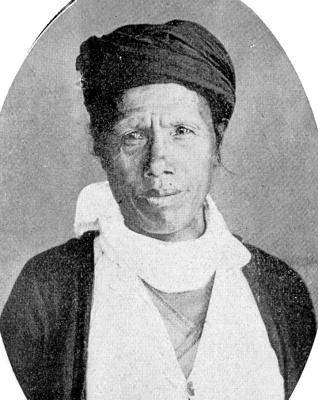
May 11 to May 17 Traversing the southern slopes of the Yushan Range in 1931, Japanese naturalist Tadao Kano knew he was approaching the last swath of Taiwan still beyond colonial control. The “vast, unknown territory,” protected by the “fierce” Bunun headman Dahu Ali, was “filled with an utterly endless jungle that choked the mountains and valleys,” Kano wrote. He noted how the group had “refused to submit to the measures of our authorities and entrenched themselves deep in these mountains … living a free existence spent chasing deer in the morning and seeking serow in the evening,” even describing them as

As a different column was being written, the big news dropped that Chinese Nationalist Party (KMT) caucus whip Fu Kun-chi (傅?萁) announced that negotiations within his caucus, with legislative speaker Han Kuo-yu (韓國瑜) of the KMT, party Chair Cheng Li-wun (鄭麗文), Taichung Mayor Lu Shiow-yen (盧秀燕) and Taiwan People’s Party (TPP) Chair Huang Kuo-chang (黃國昌) had produced a compromise special military budget proposal. On Thursday morning, prior to meeting with Cheng over a lunch of beef noodles, Lu reiterated her support for a budget of NT$800 or NT$900 billion — but refused to comment after the meeting. Right after Fu’s

Yesterday, the Democratic Progressive Party (DPP) nominated legislator Puma Shen (沈伯洋) as their Taipei mayoral candidate, the Chinese Nationalist Party (KMT) put their stamp of approval on Wei Ping-cheng (魏平政) as their candidate for Changhua County commissioner and former legislator Tsai Pi-ru (蔡壁如) of the Taiwan People’s Party (TPP) has begun the process to also run in Changhua, though she has not yet been formally nominated. All three news items are bizarre. The DPP has struggled with settling on a Taipei nominee. The only candidate who declared interest was Enoch Wu (吳怡農), but the party seemed determined to nominate anyone
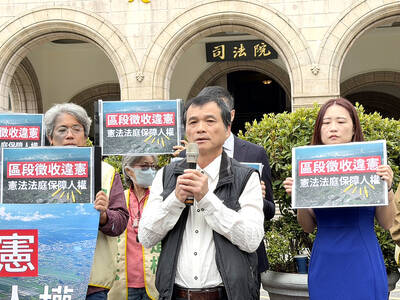
What government project has expropriated the most land in Taiwan? According to local media reports, it is the Taoyuan Aerotropolis, eating 2,500 hectares of land in its first phase, with more to come. Forty thousand people are expected to be displaced by the project. Naturally that enormous land grab is generating powerful pushback. Last week Chen Chien-ho (陳健和), a local resident of Jhuwei Borough (竹圍) in Taoyuan City’s Dayuan District (大園) filed a petition for constitutional review of the project after losing his case at the Taipei Administrative Court. The Administrative Court found in favor of nine other local landowners, but


 RSS
RSS