


Hong Kong was once world famous for its neon-light shop signs but many old masters took their secrets to the grave — now a generation of tech-savvy, globally connected young artists are trying to keep the trade alive.
Karen Chan describes herself as a “neon nomad.” Better known by her professional artistic name Chankalun, she had long been fascinated by the kaleidoscopic neon lights that bathed Hong Kong streets in a warm glow. But finding someone who might teach her was far from easy.
The trade has long been dominated by masters — si fu in Cantonese — who guarded their knowledge even as neon gave way to cheaper, more efficient LED lights and city officials began clamping down on unsafe hoardings.
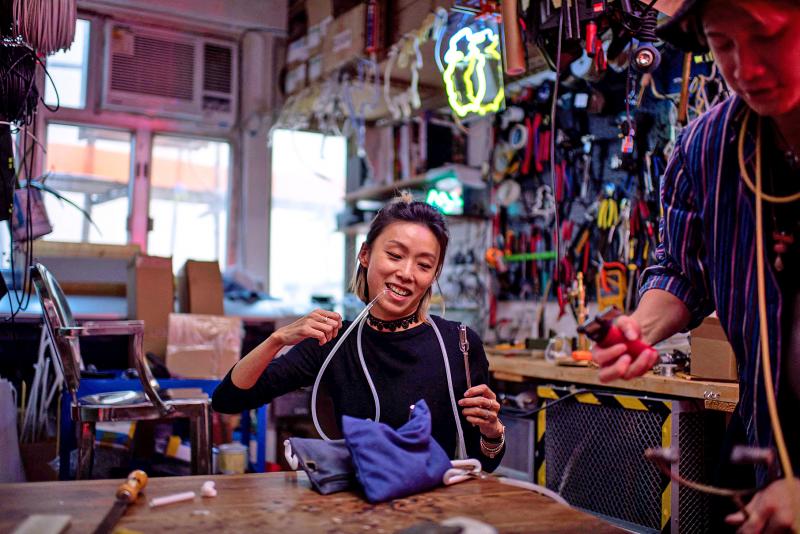
Photo: AFP
“The si fu will not pass on all the knowledge, especially if there are no guidelines or manuals, they will only pass on their skills to their own descendants,” Chan said.
Few family members wanted to take up a skill that was becoming redundant so many masters died without passing on their knowledge.
“If you have very valuable skill or knowledge, you should be spreading it around so that it could live as well,” the 33-year-old artist lamented. “Overprotection can be a cause for a lot of crafts to die.”
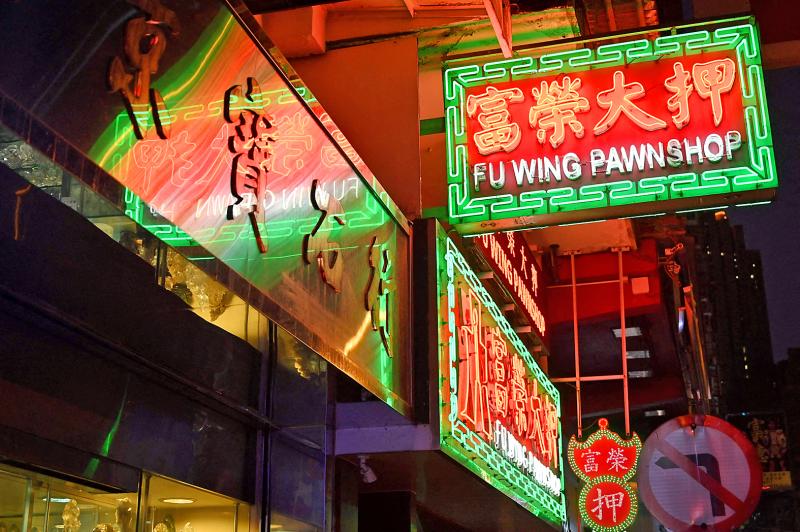
Photo: AFP
SECRET TRADE
Undeterred, Chan turned to the Internet and traveled to places such as Amsterdam and New York to learn from artists there.
There she discovered a global community of neon fans and professionals willing to trade tips.
“There is an open sourcing culture appearing in the new generation of artists,” she said. “Everyone is posting their experiments or their new finds on Instagram or Facebook, and everyone is very happy to share ... this kind of knowledge,” she explained.
“The old generations see it as a secret trade.”
Chan, the only Hong Kong woman currently working within a traditionally male-dominated trade, operates out of a studio run by Jive Lau, a 38-year-old artist who also represents the new breed of younger neon light benders.
Together they work glass to near melting point, bending and blowing the tubes into remarkable shapes over blue flame burners that can reach 1,000 degrees Celsius.
Lau was introduced to neon bending in Taiwan, where he said masters were more willing to share their knowledge with strangers.
But he too has found the Internet a huge help.
“I keep learning from online resources and from watching videos,” he explained.
Today, he offers workshops to a growing number of neon enthusiasts.
“The education can actually help ... (in) promoting the neon culture, keeping it alive,” he said.
MODERN YET LOCAL VIBE
Chan’s current project is called “The Neon Girl” and involves her working with half a dozen neon light masters around the world to create six distinctive pieces.
They are a far cry from the huge flashing signs that used to protrude horizontally from the sides of Hong Kong buildings, advertising everything from restaurants to mahjong parlors.
Instead they have a modern, but still local vibe.
“For neon to live... it needs some other elements to inject into it, and this is what I’m doing as a new generation of neon artist,” she explained.
She hopes the pieces will “break the boundaries or the perspective of how the people think of neon, that it can be expanded so that it can really live on a new form.”
She compares neon glass bending to an Olympic sport that requires strength, precision, and flexibility.
And her stubborn perseverance has paid off in that she eventually found a si fu — known as Master Wong — willing to take her on.
“Because I fell in love with this medium, I tried to do it myself, so I begged Master Wong and other neon benders in Hong Kong but they refused teaching me,” she recalled.
In 2018, she then decided to learn on her own and enlisted the help of a glass sculptor who watched the neon creation process on YouTube to explain the technique to her.
After creating an art piece in a week, she returned.
Master Wong, who is now 80 years-old and eschews publicity, was impressed with her work and agreed to take her on as an apprentice.
“I think the neon masters in Hong Kong will never accept me as a real neon master,” she said, “but maybe as a neon artist, which is fine with me.”
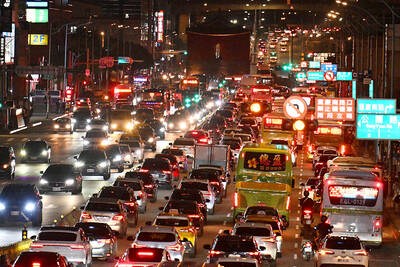
By global standards, the traffic congestion that afflicts Taiwan’s urban areas isn’t horrific. But nor is it something the country can be proud of. According to TomTom, a Dutch developer of location and navigation technologies, last year Taiwan was the sixth most congested country in Asia. Of the 492 towns and cities included in its rankings last year, Taipei was the 74th most congested. Taoyuan ranked 105th, while Hsinchu County (121st), Taichung (142nd), Tainan (173rd), New Taipei City (227th), Kaohsiung (241st) and Keelung (302nd) also featured on the list. Four Japanese cities have slower traffic than Taipei. (Seoul, which has some

Michael slides a sequin glove over the pop star’s tarnished legacy, shrouding Michael Jackson’s complications with a conventional biopic that, if you cover your ears, sounds great. Antoine Fuqua’s movie is sanctioned by Jackson’s estate and its producers include the estate’s executors. So it is, by its nature, a narrow, authorized perspective on Jackson. The film ends before the flood of allegations of sexual abuse of children, or Jackson’s own acknowledgment of sleeping alongside kids. Jackson and his estate have long maintained his innocence. In his only criminal trial, in 2005, Jackson was acquitted. Michael doesn’t even subtly nod to these facts.

Writing of the finds at the ancient iron-working site of Shihsanhang (十 三行) in New Taipei City’s Bali District (八里), archaeologist Tsang Cheng-hwa (臧振華) of the Academia Sinica’s Institute of History and Philology observes: “One bronze bowl gilded with gold, together with copper coins and fragments of Tang and Song ceramics, were also found. These provide evidence for early contact between Taiwan aborigines and Chinese.” The Shihsanhang Web site from the Ministry of Culture says of the finds: “They were evidence that the residents of the area had a close trading relation with Chinese civilians, as the coins can be
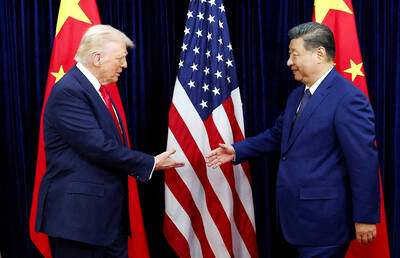
The March/April volume of Foreign Affairs, long a purveyor of pro-China pablum, offered up another irksome Beijing-speak on the issues and solutions for the problems vexing the People’s Republic of China (PRC) and the US: “America and China at the Edge of Ruin: A Last Chance to Step Back From the Brink” rang the provocative title, by David M. Lampton and Wang Jisi (王緝思). If one ever wants to describe what went wrong with US-PRC relations, the career of Wang Jisi is a good place to start. Wang has extensive experience in the US and the West. He was a visiting


 RSS
RSS