


Anyone viewing events in the US last week, with seditionist terrorists attacking and occupying the Capitol building, naturally might ask whether the same events could occur here in Taiwan.
As people are pointing out, in a way they already have. In 2004 after the election Chinese Nationalist Party (KMT) supporters, led by the losing presidential candidate Lien Chan (連戰), staged protests which became violent, while claiming numerous election irregularities, none of which were ever documented. Sit-ins were staged at courthouses across the nation, lingering for a week afterwards.
In 2000 after Chen Shui-bian (陳水扁) won for the first time, KMT supporters staged violent protests against then-president Lee Teng-hui (李登輝) in front of KMT headquarters. One of his advisors, Hsu Li-teh (徐立德), was dragged from his car and beaten. Lee was only able to leave party headquarters after riot police had cleared the street in front with water cannon.

Photo: Liu Hsin-te, Taipei Times
The quiet acceptance that accompanied the KMT’s more recent election losses shows that odds are against a violent putsch by rightists, at least from that quarter. Taiwan also has some advantages that the US does not, including structures for monitoring and neutralizing disinformation, much better social cohesion, a civic nationalism that incorporates democracy into the national identity and far more robust and fair election procedures.
There is no question that the potential is there. Afflicted with competing Chinese and Taiwanese nationalisms, Taiwan hosts a morass of conspiracy nonsense. There are long-running conspiracies about the 2004 assassination attempt on Chen, and on the conduct of the election itself, narrowly won by Chen. On the far right of the KMT there used to be people who argued that former president and KMT chairman Ma Ying-jeou (馬英九) was a closeted Taiwan independence supporter.
More recently, the claim that President Tsai Ing-wen’s (蔡英文) thesis is a fake, invented by deep greens impatient with her approach to independence, has found a populist home across the blue-green divide. Common conspiracy-style analyses, entirely bereft of any knowledge of history, that argue that democracy has been bad for the economy, society is in chaos and authoritarianism would make Taiwan great again are also popular, especially among men over 50.
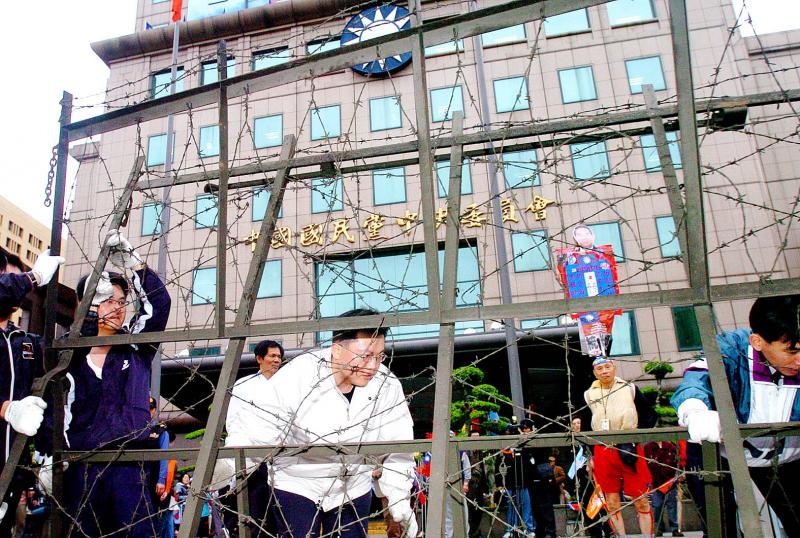
Photo: Chen Tse-ming, Taipei Times
Like the equally mad conspiracy theories in the US, believers have incorporated them into their social identities and will not give them up no matter what evidence they are confronted with.
The potential is especially bad on the pro-KMT side, whose ideology of Chineseness and Lost Cause functions theologically to divide the world into good and evil. For the true believer in such theologies, defeat can only be the result of evil conspiracy, since how else could the good guys lose? Fortunately, at least on the blue side, most of the true believers are too old to engage in seditious violence against the government.
Taiwan also suffers from its own version of white racism — Han chauvinism — and a long history of ethnic rivalry. At present Han chauvinism lacks a well-organized overt politics and is largely directed against perceived outsiders such as foreigners, aborigines and migrant workers, not the government, while intermarriage and the emergence of a Taiwan-centered identity are slowly strangling Taiwan’s poisonous legacy of interethnic conflict.
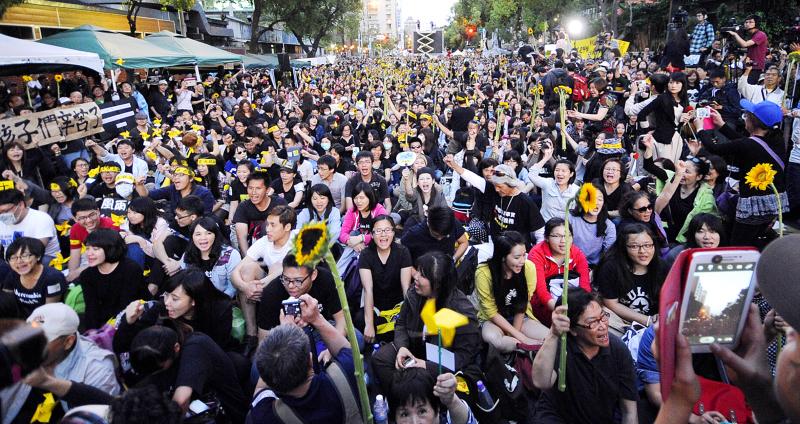
Photo: Chen Chih-chu, Taipei Times
In Taiwan competent democratic governance has given the nation profound advantages. The governing administration can meaningfully act against disinformation and fake news. In last year’s election, the government worked with Facebook to combat disinformation and reduce its potential for polarizing society. Similarly, in November the National Communications Commission (NCC) rejected the license application of CTi News, forcing it to shut down, citing numerous citizen complaints about the station and fines for issues with its news presentations.
The US government has done nothing like that. Indeed, the administration of President Donald Trump has itself become a font of disinformation and fake news.
Further, the government’s practical successes with both the national health insurance program and against COVID-19 have created a deep sense of pride and social cohesion among locals. Local papers annually run articles on the National Health Insurance’s high global rank and high public satisfaction with the system.
Social cohesion is also fed by the deep yearning for international recognition among Taiwanese. Taiwan’s manifest economic and social successes, and its yearning for recognition, feed its democratic, post-independence identity which searches now for recognition as a competent, democratic, modern state. The existence of a very real threat from China not only increases social cohesion and the feeling of shared identity, but also legitimates government action against disinformation and in defense of a sovereign nation-state. Taiwan’s robust civil society with its active NGO ecology is also a powerful force for good.
Yet, we should be wary. Though social cohesion is strong, Taiwan faces long-term issues. There is a large working-class population struggling with stagnant incomes and long work hours (whose political function is to make dissent difficult due to lack of time and energy). Social media, especially Facebook but also WeChat and Line, have deep penetration in society, bringing with them all the problems of polarization and tribalization. Line groups are one of the most important transmission channels for disinformation, yet they remain under-researched. The nation’s north-south, rural-urban and west-east divides are also potential fracture points.
Taiwan also suffers from the problems fundamental to any modern society: the alienation and anomie that often mark modern urbanized populations, exacerbated by growing income inequality and regional wealth maldistribution. Small businesses, fiercely independent, are declining in importance.
Further, the country is a major participant in the system of globalized capitalist consumption in which everything that cannot be relentlessly commodified is discarded as waste. The world of marketing and advertising in this globalized worldscape is eerily like the world of populist nationalism: both are worlds in which things are constantly asserted that smart people know are false.
This globalized world brings globalized news and disinformation campaigns designed to split and polarize whole populations. Via cyberwarfare and social media platforms, nations exploit social weakness on a global stage.
Indeed, the social fracture lines driving racist populism are latent in the whole idea of the modern nation, there for anyone with wealth and power to exploit. The ethnicity-based nation-state bequeathed to the world by 19th century nationalism and Woodrow Wilson is inherently destabilizing and racist. Deep in its heart, this ideal assumes that humans who are different cannot live together in happiness and each group must have its own nation-state. In practice, it can be a recipe for endless atomization and marginalization of ethnic minorities at one end, and vast authoritarian empires on the other.
Let’s not forget: 10 years after the comical and failed Beer Hall Putsch, Hitler was running Germany.
Stay vigilant. Take it seriously. It can happen anywhere.
Long-time resident Michael Turton provides incisive commentary informed by three decades of living in and writing about Taiwan.

Taiwan has next to no political engagement in Myanmar, either with the ruling military junta nor the dozens of armed groups who’ve in the last five years taken over around two-thirds of the nation’s territory in a sprawling, patchwork civil war. But early last month, the leader of one relatively minor Burmese revolutionary faction, General Nerdah Bomya, who is also an alleged war criminal, made a low key visit to Taipei, where he met with a member of President William Lai’s (賴清德) staff, a retired Taiwanese military official and several academics. “I feel like Taiwan is a good example of
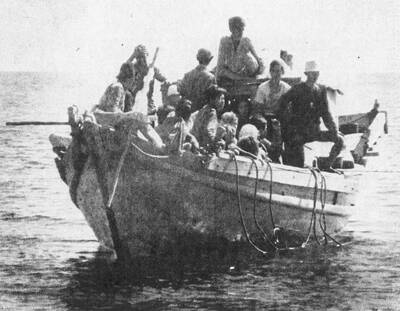
March 2 to March 8 Gunfire rang out along the shore of the frontline island of Lieyu (烈嶼) on a foggy afternoon on March 7, 1987. By the time it was over, about 20 unarmed Vietnamese refugees — men, women, elderly and children — were dead. They were hastily buried, followed by decades of silence. Months later, opposition politicians and journalists tried to uncover what had happened, but conflicting accounts only deepened the confusion. One version suggested that government troops had mistakenly killed their own operatives attempting to return home from Vietnam. The military maintained that the

Before the last section of the round-the-island railway was electrified, one old blue train still chugged back and forth between Pingtung County’s Fangliao (枋寮) and Taitung (台東) stations once a day. It was so slow, was so hot (it had no air conditioning) and covered such a short distance, that the low fare still failed to attract many riders. This relic of the past was finally retired when the South Link Line was fully electrified on Dec. 23, 2020. A wave of nostalgia surrounded the termination of the Ordinary Train service, as these train carriages had been in use for decades

Lori Sepich smoked for years and sometimes skipped taking her blood pressure medicine. But she never thought she’d have a heart attack. The possibility “just wasn’t registering with me,” said the 64-year-old from Memphis, Tennessee, who suffered two of them 13 years apart. She’s far from alone. More than 60 million women in the US live with cardiovascular disease, which includes heart disease as well as stroke, heart failure and atrial fibrillation. And despite the myth that heart attacks mostly strike men, women are vulnerable too. Overall in the US, 1 in 5 women dies of cardiovascular disease each year, 37,000 of them


 RSS
RSS