


On May 23, 1895, the Taiwanese declared independence through the Declaration of Independence of the Republic of Formosa. A few weeks earlier, on April 17 1895, the Qing Dynasty government in Beijing, represented by viceroy Li Hongzhang (李鴻章), had signed the Treaty of Shimonoseki, and under the provisions of the treaty, Taiwan had been ceded to Japan in perpetuity.
The treaty came as a total surprise to the Taiwanese. Neither the population nor officials had been consulted. In 1887, Taiwan had gained more prominence when it was officially declared a province of the Qing Dynasty; infrastructure had been built, the economy had grown and a relatively free and open society had developed.
REPUBLIC OF FORMOSA
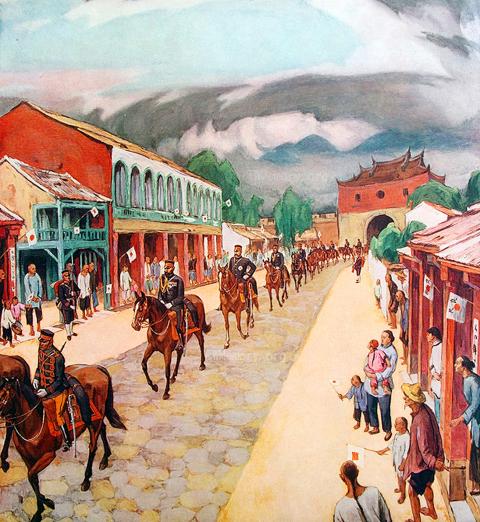
Photo: Wikimedia Commons
Under governor Liu Ming-chuan (劉銘傳, 1887-1891), Taiwan attracted intelligentsia and literati from China, escaping Beijing’s oppressive atmosphere under late Qing rule. The mix of these intellectuals and local gentry brought about a flourishing of art, literature and politics in Taiwan (see “When Taiwan was China’s (for seven years),” Feb. 27 edition of the Taipei Times).
The local gentry abhorred the impending takeover by a new foreign ruler, and convinced Governor Tang Ching-sung (唐景崧) to declare a Republic of Formosa, the first independent republic in Asia, which he led as president. A new government was inaugurated on May 25, 1895.
The Republic of Formosa was quite a progressive enterprise. It had officials “elected by the people of Taiwan,” and a parliament made up of local gentry. It had its own flag — the now-famous yellow tiger flag — issued paper money and postage stamps (today some of the most valuable in the world) and had a functioning cabinet.
The foreign minister in the new government was Chen Chi-tung (陳季同), an experienced diplomat in the Qing government, who spoke French fluently. Chen had lived in Paris for many years and had even written a book, Les Chinois peints par eux memes (The Chinese painted by themselves), explaining “China” to the French public.
His experience in France had exposed him to the workings and symbolisms of the-then young French Republic, and he was the one who designed much of the republican symbols for the new Republic of Formosa.
Another cabinet member was “Black Flag” general Liu Yung-fu (劉永福), who had fought together with Governor Tang against the French in Indo-China, and who had been asked to come to Formosa to help defend it against the incoming Japanese. He commanded an army of some 100,000 Qing government soldiers.
Another military leader was Chiu Feng-chia (丘逢甲), a local Hakka warlord, poet and scholar who had become vice president and headed the gentry in what is today’s Changhua County. Chiu had entered the civil service when Tang was governor, and was one of the most prominent advocates of self-rule, self-determination and independence. He also commanded a local militia of some 50,000 well-trained fighters, who would put up the biggest fight against the incoming Japanese.
Six days after the declaration of the Republic of Formosa, Japanese troops under general Kawamura Kageaki landed near Keelung and started to move south. The Qing soldiers and the local militia in the north were no match for the well-armed and trained Japanese: on June 5, 1895 President Tang fled via Tamsui, and on June 7 1895 the Japanese army entered Taipei.
During the next five months, the Japanese pushed further south. Conquering Taipei had been relatively easy: The Qing soldiers had no real familiarity with the territory, gave up easily and fled without much of a fight. But in central Taiwan, the local militia were strongly attached to “their” territory and put up stiff resistance. In the Battle of Baguashan (八卦山戰役), which took place on Aug. 27, 1895 near Changhua, the Taiwanese militia almost brought the Japanese advance to a halt.
However, because of their overwhelming manpower and gunfire, the Japanese were able to keep going, and by early October Japanese troops were approaching the gates of Tainan, the stronghold of the remaining Republic of Formosa under Black Flag Liu and militia leader Chiu Feng-chia.
Black Flag Liu decided to flee: on Oct. 19, dressed as a coolie he made it to Tainan’s Anping District (安平) with some 100 officers. He boarded the British ship Thales, which sailed the next morning. It was pursued by the Japanese cruiser Yaeyama, which stopped and searched the Thales in the middle of the Taiwan Strait, but Liu had disguised himself well and was not found.
Local merchants in Tainan as well as the small European community worried about the fierce fighting that would inevitably reach the city. They convinced the disillusioned Qing troops and militia to lay down their arms, and then sent a delegation of two Presbyterian missionaries, James Fergusson and Thomas Barclay, to the Japanese camp of general Nogi Maresuke with the message that Tainan was surrendering peacefully.
After the fall of Tainan, the Japanese declared that Taiwan had been pacified, but for some 20 more years — until around 1915 — they would have to resort to major military campaigns to subdue the many uprisings on the island.
SIGNIFICANCE FOR TODAY
The short-lived Republic of Formosa was in a sense way ahead of its time. It tried to lay the foundation for the idea that Asians were ready for progressive rule, based on the democratic concepts which had their basis in the American and French republics. It did show the deep-seated desire of the educated and literate part of the population for representative government.
Additionally, the invasion by a common enemy — the Japanese — became a very formative period in Taiwan’s history and helped shape a Taiwanese identity, as it forced the very disparate population groups (Hoklo-speakers, Hakka and Aborigines) that had until then competed with each other for land and other resources, to work together to fend off the incoming invaders.
The hasty decisions by the leadership in Taipei in May 1895 were made in reaction to the decision at Shimonoseki in April 1895: they wanted to forestall a Japanese takeover. However, they insufficiently considered the lack of military power available for the defense of the island. This proved to be a main factor in its failure.
The second factor was the lack of international allies who would be able to generate sufficient political, diplomatic and military weight to counterbalance the invading force. Foreign Minister Chen had extensive contacts with the French, but they were too far away, and could not mobilize a sufficient force within the required time.
Thus, the Republic of Formosa’s chapter in Taiwan’s history carries important lessons for Taiwan today: Ensure that the country has adequate military capabilities to defend itself, build a solid network of significant allies who can be counted on and who have the capabilities and the political will to come to the country’s defense.
Gerrit van der Wees is a former Dutch diplomat. From 1980 through 2016 he served as the editor of Taiwan Communique. He teaches History of Taiwan at George Mason University.
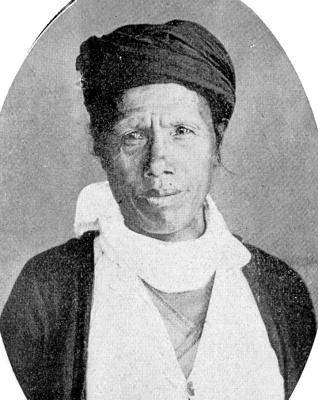
May 11 to May 17 Traversing the southern slopes of the Yushan Range in 1931, Japanese naturalist Tadao Kano knew he was approaching the last swath of Taiwan still beyond colonial control. The “vast, unknown territory,” protected by the “fierce” Bunun headman Dahu Ali, was “filled with an utterly endless jungle that choked the mountains and valleys,” Kano wrote. He noted how the group had “refused to submit to the measures of our authorities and entrenched themselves deep in these mountains … living a free existence spent chasing deer in the morning and seeking serow in the evening,” even describing them as

Yesterday, the Democratic Progressive Party (DPP) nominated legislator Puma Shen (沈伯洋) as their Taipei mayoral candidate, the Chinese Nationalist Party (KMT) put their stamp of approval on Wei Ping-cheng (魏平政) as their candidate for Changhua County commissioner and former legislator Tsai Pi-ru (蔡壁如) of the Taiwan People’s Party (TPP) has begun the process to also run in Changhua, though she has not yet been formally nominated. All three news items are bizarre. The DPP has struggled with settling on a Taipei nominee. The only candidate who declared interest was Enoch Wu (吳怡農), but the party seemed determined to nominate anyone
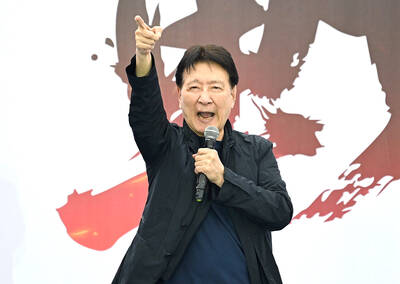
In a sudden move last week, opposition lawmakers of the Chinese Nationalist Party (KMT) and Taiwan People’s Party (TPP) passed a NT$780 billion special defense budget as a preemptive measure to stop either Chinese leader Xi Jinping (習近平) or US President Donald Trump from blocking US arms sales to Taiwan at their summit in Beijing, said KMT heavyweight Jaw Shaw-kong (趙少康), speaking to the Taipei Foreign Correspondents Club on Wednesday night in Taipei. The 76-year-old Jaw, a political talk show host who ran as the KMT’s vice presidential candidate in 2024, says that he personally brokered the deal to resolve
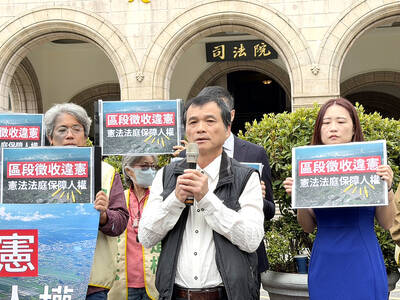
What government project has expropriated the most land in Taiwan? According to local media reports, it is the Taoyuan Aerotropolis, eating 2,500 hectares of land in its first phase, with more to come. Forty thousand people are expected to be displaced by the project. Naturally that enormous land grab is generating powerful pushback. Last week Chen Chien-ho (陳健和), a local resident of Jhuwei Borough (竹圍) in Taoyuan City’s Dayuan District (大園) filed a petition for constitutional review of the project after losing his case at the Taipei Administrative Court. The Administrative Court found in favor of nine other local landowners, but


 RSS
RSS