


Inka Mbing pauses her soft humming and asks Moana Maniapoto to join in the singing.
“I need to work with a live person,” the indigenous Atayal artist says after being asked to sing over a recording. “When our voices resonate, that results in an endless outpour of energy that can make the impossible possible. It can lead to new surprises.”
Moana nods and they both start singing softly to the music while facing the same direction, not looking at each other. Suddenly, Inka Mbing lets loose, exploding with a tremendous voice as if she were channeling all her ancestral spirits.
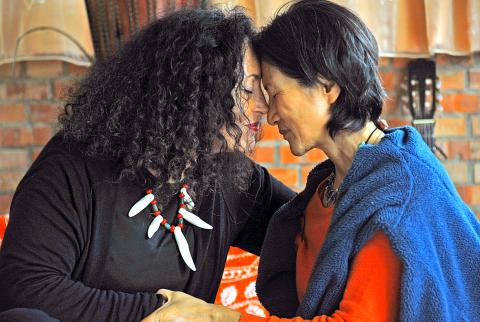
Photo: Han Cheung, Taipei Times
Slowly, the words and imagery start to manifest: “Listen, listen, this is the language that has been passed on for generations … Just as we are constantly breathing, we will make sure our words continue on for eternity.”
It was a whirlwind of a trip for Moana, a New Zealand native whose Maori ancestors are said to have originated in Taiwan.

Photo: Han Cheung, Taipei Times
Communicating through a translator in English and Chinese, the two indigenous women spent three days in the mountains of Hsinchu’s Jianshi Township (尖石), cobbling together a new song with the help of Moana’s producer and electronic musician Paddy Free. By the end of the third day, Inka Mbing was ready to head to Taipei and perform the resulting piece, Toku Reo (“my language” in Maori), in Atayal and Maori, both of which belong to the Austronesian language family.
“I do a lot of improvisation so each time it might come out differently,” Inka Mbing says. “I don’t think we should practice too much otherwise it’ll disrupt the flow.”
Moana agrees. The two proceed to put on a successful “world premiere” of the song this past Sunday during an auction for Father Barry Martinson’s stained glass paintings, which he has sold in the past to help the indigenous community which he served.
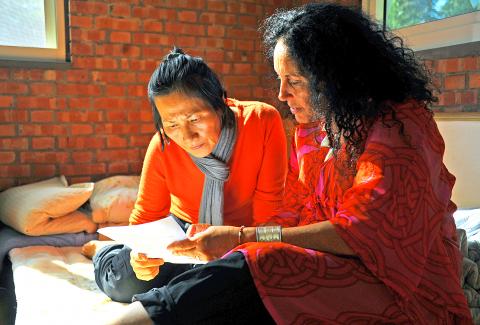
Photo: Han Cheung, Taipei Times
REVIVE OUR LANGUAGE
Toku Reo will appear on Moana’s latest album, Ono, which means “six” in Maori. The concept entails collaborating with six indigenous female artists in countries that Moana and her band has performed in before. The songs are all based on ancient Maori incantations reworked by Scotty Morrison, who Moana describes as the “best Maori speaker of his generation” and appears on several tracks.
“I record some of my parts, and we create space to let her do whatever she wants — as long as it is in her language,” Moana says.
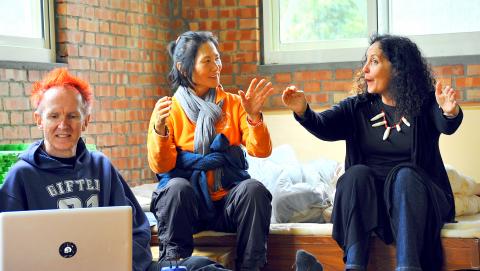
Photo: Han Cheung, Taipei Times
While Moana knew indigenous singers in Finland, Canada, Australia and Scotland, it took a “great search” with many parties coming together to find Inka Mbing and convince her to take part in the project.
“I really wanted someone from Taiwan because of our special relationship,” she says. “I also know that we share similar experiences in terms of loss of language and colonization. But it’s challenging. We might meet, she might look at me and be like, ‘I don’t know about you.’ But I always have the confidence that if we sit down and talk we’ll find something in common.”
Inka Mbing, 64, had mostly retired from the spotlight after a fruitful career where she defied the tribal taboo of women not being allowed to sing ancient melodies. Nowadays, she mostly keeps to herself in her yoga studio deep in the mountains on a journey of spiritual discovery and coexisting with the land.
Photo: Han Cheung, Taipei Times
Out of several songs Moana provided, Inka Mbing chose Toku Reo, which tells the myth of how the Maori gods created language and prays for the gods to allow the endangered language to flourish once more. It’s fitting, since Ink Mbing spent much of her life trying to keep her Atayal language alive.
The 56-year-old Moana, who was inducted into the New Zealand Music Hall of Fame last year, took her time getting to know Inka Mbing first as the two shared their experiences and thoughts about their respective cultures.
Moana gets emotional when she talks about how her father’s generation was punished in school for speaking Maori, and how her generation had to fight to keep it from dying out. Inka speaks about her people being colonized twice by the Japanese and Chinese and how the first song she learned was a Japanese song her father sang while tending the garden. She also spoke of how they would get beaten in school for speaking Atayal. She originally performed Chinese folk songs for a living before finding that she was much more comfortable using her mother tongue.
“I want to express in my part of the song that we are here in Taiwan doing the same thing as you,” Inka Mbing says. “We’ve all suffered political and cultural damage. But like you, we’re working hard. Let’s move forward together.”
ELECTRONIC CONCERNS
It’s the third day and Inka Mbing still has reservations about the project due to the modern electronic elements in Moana’s music.
“I’ve never worked with electronic music before and it’s something I am instinctively against,” she says. “But then I thought, maybe this could be an exercise for me. Some things in modern society I just have to accept, as long as I hold my ground and don’t get blown off course.”
The two disagree with the way traditional music should be performed, with Moana fusing traditional and modern to appeal to a larger and younger audience while Inka Mbing thinks that doing so will dilute the music’s original elements.
“I’m concerned that if you put too much modern influences into traditional music, the next generation will think that the modern elements are our traditional culture,” she says.
Moana says she was nervous that Inka Mbing’s concerns would cause the collaboration to fall apart.
“I knew that the kind of music that we do, it’s a bit of a freak out for people who come from the traditional world. I knew that it might work or it might not,” she says.
But Inka Mbing started relaxing after hearing Moana’s voice.
“Even though she used electronic music, I could tell that her voice had stayed close to her culture,” she says. “I could feel her passion for her traditions. We’re both indigenous people who share the same fate, and that already brings us half way to understanding other. I did not need to be on guard.”
On the final day in the mountains, Inka Mbing tears up when talking about the experience, upon which Moana gives her a traditional Maori greeting called the hongi where she presses her forehead and nose against Inka Mbing’s.
“I thank the ancestral spirits for arranging this encounter. I don’t have anything to thank Moana with, so I will use my voice,” Inka Mbing says as she falls silent before bursting into song.

Dissident artist Ai Weiwei’s (艾未未) famous return to the People’s Republic of China (PRC) has been overshadowed by the astonishing news of the latest arrests of senior military figures for “corruption,” but it is an interesting piece of news in its own right, though more for what Ai does not understand than for what he does. Ai simply lacks the reflective understanding that the loneliness and isolation he imagines are “European” are simply the joys of life as an expat. That goes both ways: “I love Taiwan!” say many still wet-behind-the-ears expats here, not realizing what they love is being an

William Liu (劉家君) moved to Kaohsiung from Nantou to live with his boyfriend Reg Hong (洪嘉佑). “In Nantou, people do not support gay rights at all and never even talk about it. Living here made me optimistic and made me realize how much I can express myself,” Liu tells the Taipei Times. Hong and his friend Cony Hsieh (謝昀希) are both active in several LGBT groups and organizations in Kaohsiung. They were among the people behind the city’s 16th Pride event in November last year, which gathered over 35,000 people. Along with others, they clearly see Kaohsiung as the nexus of LGBT rights.

In the American west, “it is said, water flows upwards towards money,” wrote Marc Reisner in one of the most compelling books on public policy ever written, Cadillac Desert. As Americans failed to overcome the West’s water scarcity with hard work and private capital, the Federal government came to the rescue. As Reisner describes: “the American West quietly became the first and most durable example of the modern welfare state.” In Taiwan, the money toward which water flows upwards is the high tech industry, particularly the chip powerhouse Taiwan Semiconductor Manufacturing Co (TSMC, 台積電). Typically articles on TSMC’s water demand
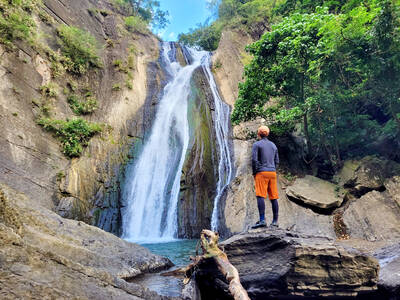
Every now and then, even hardcore hikers like to sleep in, leave the heavy gear at home and just enjoy a relaxed half-day stroll in the mountains: no cold, no steep uphills, no pressure to walk a certain distance in a day. In the winter, the mild climate and lower elevations of the forests in Taiwan’s far south offer a number of easy escapes like this. A prime example is the river above Mudan Reservoir (牡丹水庫): with shallow water, gentle current, abundant wildlife and a complete lack of tourists, this walk is accessible to nearly everyone but still feels quite remote.


 RSS
RSS