

It was only a matter of time before Russia’s war in Ukraine reached deep into Asia. With signing bonuses as high as US$35,000 and promises of a US$3,000 monthly income, it should be no surprise that men from Indonesia and the Philippines are taking on jobs advertised as logistics, security, construction and administration, only to be pushed onto the front lines when they arrive.
Moscow has a personnel problem, and as governments from India to Nepal along with some African nations step in to prevent their citizens being lured into its forever war, it is turning to Southeast Asia’s vulnerable migrant labor market to help fill the gap.
Shady recruitment agents are using social media, opaque contracts and the promise of high wages to attract people desperate for a job, the same ingredients that make migrant workers vulnerable to trafficking networks and scam compounds. Some believe they are going to work in hotels, construction or other civilian sectors in Russia before discovering that the documents they signed are military contracts.
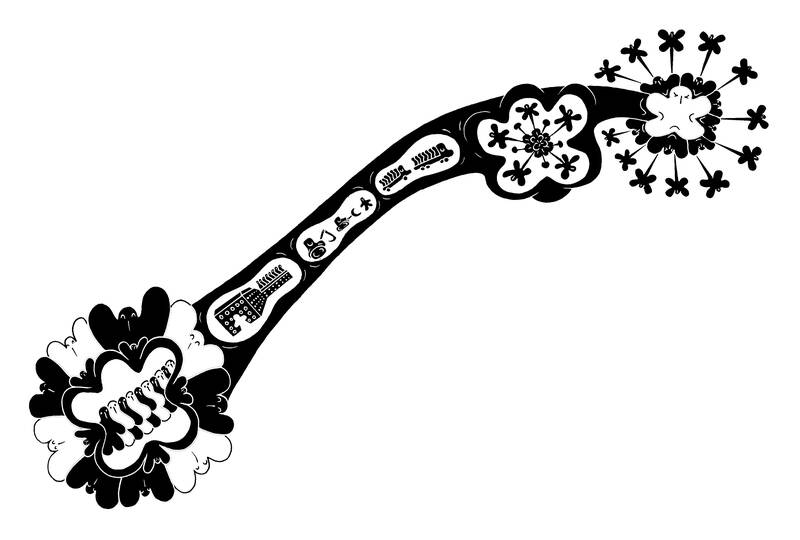
Illustration: Mountain People
Governments should view this as an early warning signal for their migrant labor economies. Indonesia is just the latest front line — and police are treating recent cases as human trafficking when they believe recruits were deceived or coerced, as opposed to voluntarily enlisting.
Jakarta should be ideally placed to help citizens caught in this trap. Since he came to power in 2024, Indonesian President Prabowo Subianto has gone out of his way to build a close relationship with Russian President Vladimir Putin, and has described Indonesia as Russia’s gateway to Southeast Asia. During his time in office, Indonesia has joined the BRICS group of developing nations, while the two upgraded their ties to a strategic partnership last year. A personal president-to-president plea would go a long way.
The government has asked Russia to include Indonesia on the list of countries exempted from official recruitment into the military. It is an important first step; however, it is not clear if Moscow has responded. Police were still intercepting travelers as recently as Wednesday last week and investigating whether they were being trafficked — recruitment is ongoing and will be until Russia says so.
Beyond making Indonesia a no-go zone for these agents, the government has another pressing problem: how to bring home those already trapped in the conflict. The Jakarta police say that the contracts run until the recruit’s death or the end of the war. At the very least, Prabowo’s administration could suspend legal job placements to Russia, which go to sectors including manufacturing, construction and hospitality, until the employers can be verified as legitimate.
Moscow controls the entire process: It sets the pay and the list of countries whose citizens it no longer takes — and brokers go wherever they can, said Radityo Dharmaputra, a lecturer in international relations at Universitas Airlangga in Surabaya.
Radityo is tracking a range of cases, including a prisoner of war held in Ukraine, two reported deaths and police investigations into 58 victims. Most were lured by the offer of civilian work, he said.
The Philippines is particularly vulnerable, given the size of its migrant labor force. At an ASEAN forum on migrant labor last month, Manila reported that it had helped to take down as many as 250,000 online posts linked to fraudulent overseas job offers through cooperation with Meta Platforms Inc and TikTok.
Ukrainian military figures show that 128 Filipinos were recruited in the first nine months of the year, a sharp increase from the small numbers previously identified. The Philippines, like Indonesia, does not appear on Russia’s list of excluded countries. (Note: Russian authorities maintain an unofficial a list of countries whose citizens are barred from being recruited to fight in Ukraine. It reportedly includes nations seen as friendly to Moscow, such as China, India, Brazil, South Africa, Turkey, Cuba, Afghanistan, Venezuela and Iran.)
Last week’s meeting of ASEAN leaders missed an important opportunity to intervene. The gathering adopted a declaration on fair and ethical recruitment of migrant workers that explicitly addresses illegal hiring, labor exploitation, cross-border employment scams and human trafficking — precisely the mechanisms Indonesian police say are being used in some Russia cases. Yet it did not publicly single out Moscow or the plight of citizens lured to fight in the Ukraine conflict.
Governments and the tech companies used by these networks need to take urgent protective measures, including issuing clear public warnings and guidance on the risks of fraudulent job offers linked to working in Russia. It is heartening to see that some nations have recognized that many of those who have signed up are not willing mercenaries. Treating them as trafficked victims creates an opening to negotiate with Russia for their safe return, or with Ukraine if they have already been captured on the battlefield.
This also lines up with findings from the UN Independent International Commission of Inquiry on Ukraine released last month. It reported compelling evidence that Russian authorities, collaborating with overseas agents, had trafficked people from 29 countries using deception or coercion to recruit them into the armed forces.
Russia has successfully weaponized economic desperation. Southeast Asian nations need to act before this new channel of underground labor exploitation becomes permanent.
Ruth Pollard is a Bloomberg Opinion columnist covering Asia politics and policy. She previously covered South and Southeast Asia on the Bloomberg government team and was Middle East Correspondent for the Sydney Morning Herald. This column reflects the personal views of the author and does not necessarily reflect the opinion of the editorial board or Bloomberg LP and its owners.

Beijing’s National Security Commission coordinates 50,000 to 100,000 Taiwanese informants via gray-zone tactics to alter elections through covert financing, criminal proxies, digital blackmail, and street intimidation. To secure the vote, this article proposes shifting from a top-down military model to a comprehensive Whole-of-Society Deterrence Framework. Central to this defense is a proposed Taiwanese Democratic Resilience and Whole-of-Society Omnibus Security Bill, turning open democratic systems into counterintelligence defenses against espionage and United Front Work Department (UFWD) operations. Below are key proposed gap fillers. The current Anti-Infiltration Act (反滲透法) is reactive, tracking illicit cross-strait capital only after distribution. This structural delay can leave
During a recent visit to Shenzhen, China, entrepreneur Elon Musk participated virtually in a technology summit held in the US. In his remarks, he expressed great admiration for China’s economic and technological development and stated that “probably at some point in the coming years, there will be some geopolitical bumps in the road over a certain country that starts with the letter T.” Although Musk did not explicitly name the country, his comment has been widely understood as referring to Taiwan. This was not the first time that Musk showed a poor understanding of relations across the Taiwan Strait. He previously

It was not immediately clear whether I was stepping into the past or the future when I got a peek at a computer that took up an entire room. As in quantum mechanics, it felt as if two possibilities could exist at once. At a research facility on the outskirts of Tokyo, I donned a hair net, blue plastic coverings over my shoes and a lab coat before entering an air-shower chamber to blast off residual dust. Then, I got to gawk at the massive collection of neatly organized cords, lasers housed in thick metal boxes and giant tanks of helium
EDITORIAL CARTOON


 RSS