

Taiwan’s approach to managing extreme heat is evolving. On Sept. 3, the Ministry of Environment held its first extreme heat response drill, running a scenario where temperatures reached 40°C or higher and bringing together dozens of central and local government agencies to test their responses.
Extreme heat is shifting from a weather phenomenon to an immediate public safety issue. If typhoons, torrential rain and earthquakes each have their own disaster-response systems, Taiwan should seriously consider similar measures for extreme heat. What is needed is a clear, tiered response system that the public can understand and that government agencies know how to implement.
Most people’s understanding of heat warning is still based on the yellow, orange and red alerts issued by the Central Weather Administration. There is less certainty when it comes to what actually happens when a certain level of risk is reached. Should local governments move to open more public spaces as cooling centers? Should there be welfare checks for older people living alone? Should outdoor activities be adjusted in schools? Should large-scale events provide more drinking water, shade or medical support? Should hospital emergency departments and fire and ambulance services raise their heat-injury response levels? If each agency is left to make these decisions on an ad hoc basis, all the public receives is an alert on their phone, without any knowledge of the protective measures the government has implemented.
Taiwan should establish responses based on factors such as temperature, humidity, duration, overnight temperature lows and population vulnerability in different areas.
Under ordinary high-temperature conditions, the focus could be on information alerts and self-protective measures.
At higher risk levels, local governments could open dedicated cooling spots, extend outreach to homeless people and elderly people living alone, and adjust outdoor public activities.
At extreme levels, the central emergency response system could take over with coordination between agencies.
This way, heat alerts would become more than just a color: They would represent the actions the government and the public must take. Ensuring that everyone knows their role and responsibilities before danger strikes is the most important part of disaster governance.
The risks posed by extreme heat do not manifest as obviously as typhoons. Trees do not fall, roads do not flood and buildings do not collapse, yet harm still accumulates.
An elderly person living in a rooftop addition without air-conditioning and an office worker sitting in an air-conditioned workplace might live in the same city, but they face vastly different levels of heat risk.
Heat response efforts cannot be limited to a flat warning for an entire administrative district. Taiwan should gradually develop a map of population vulnerability: areas with high concentrations of elderly people living alone, communities with aging housing and places lacking sufficient green space or shade could all become factors in how local governments allocate resources.
Mature heat governance is not about asking everyone to fight 40°C or hotter temperatures in the same way; it is about first identifying those who are least able to withstand it.
Taiwan’s decision to conduct its first full-scale extreme heat drill is a good first step, but the question is whether it can lead to lasting institutional changes. As climate change renders temperatures once considered unusual increasingly common, the government must shift how it thinks about natural disasters.
A disaster might not come with fierce winds and torrential rain, but arrive on a clear day. A city might appear to be functioning normally, but the number of hospital patients with heat-related illnesses would continue to rise.
As Taiwan conducts exercises for 40°C or hotter temperatures, we can no longer treat extreme heat as a blip in the weather forecast. The next step is ensuring that every heat warning is backed by concrete actions. Disaster preparedness under climate change is not just about forecasting how hot it is going to get; it is about understanding in advance who needs protecting and how to do so.
Chen Jie-an is a legal specialist for a technology corporation.
Translated by Gilda Knox Streader

Taiwan’s democracy and high-tech economy play a crucial role in global affairs and are central to the world’s embrace of a raft of next-generation technologies, including AI. It is underpinned by a security relationship with the United States that’s existed in several iterations since 1949 and the Chinese Nationalist Party’s (KMT) retreat from China. A central pillar of that security relationship is the American willingness to sell arms to Taiwan. Indeed, since 1979 it has been embedded in US law, with the Taiwan Relations Act (TRA) charging the US with helping to improve the island’s ability to deter an attack from
Academia Historica director Chen Tsui-lien (陳翠蓮), speaking at the handover ceremony for her new role on Monday, said that when she accepted the position, she knew that her peaceful life as a history professor was a thing of the past, and that from now on she would have to “wear a helmet.” A specialist in Taiwan’s post-World War II history and the 228 Incident, she has been accused of being politically divisive. A phrase she used in her acceptance speech set headlines alight this week, putting her in the sights of editorials in blue-leaning media. She said opposition figures calling for
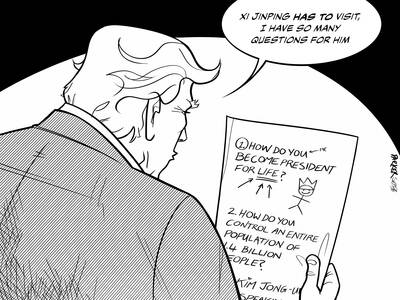
EDITORIAL CARTOON
When Panama severed diplomatic relations with Taiwan and recognized China in 2017, Beijing achieved one of its most important diplomatic victories in Central America. However, nearly a decade later, Panama is demonstrating that diplomatic recognition does not necessarily eliminate Taiwan from a country’s political system. Panama and Taiwan had diplomatic relations for more than 100 years and the goodwill between the countries was displayed last week when Panama’s National Assembly established an interparliamentary exchange group with the Legislative Yuan. Forty-five of the assembly’s 71 lawmakers joined the group, representing more than 60 percent of the legislature. Its members include National Assembly President Shirley


 RSS
RSS