

Sept. 6 could mark a turning point in Germany’s post-World War II political history. In the Saxony-Anhalt state election, the far-right Alternative for Germany (AfD) party came within three seats of an absolute majority, winning 43.8 percent of the vote — more than twice its share in the 2021 election. The AfD’s gains came at the expense of the center-right Christian Democratic Union, the state’s incumbent governing party and the party of German Chancellor Friedrich Merz, which won just 17.2 percent, down from 37.1 percent in 2021.
There is no shortage of explanations for the surge in support for the AfD in parts of Germany. Immigration, cultural conflict and distrust of the political establishment are among the most cited — and for good reason. However, the economic factors fueling the AfD’s rise have so far received much less attention.
Saxony-Anhalt has endured profound economic challenges in the past few decades. Reunification brought the collapse of East Germany’s industrial base, destroying millions of jobs and causing large numbers of younger workers to relocate, leaving the region with one of the country’s oldest and fastest-shrinking populations.

Illustration: Mountain People
After more than three decades of economic deterioration, Saxony-Anhalt appeared to be recovering. That upturn has stalled. Saxony-Anhalt’s economy has contracted since 2021, bringing GDP close to its 2013 level.
Intensifying competitive pressure from Chinese exporters is threatening to make matters much worse. Saxony-Anhalt’s imports from China increased 87 percent in 2024, reaching 20 percent of the state’s total imports, and by a further 46 percent in the first nine months of last year.
The China shock is not confined to Saxony-Anhalt. Germany’s economy has stagnated since 2019, with output increasing by only about 0.12 percent annually, on average, from 2020 to last year. During that period, Chinese producers claimed an expanding share of the global market for advanced manufacturing products, such as automobiles and machinery, which were once central to Germany’s export model.
However, the effects are not felt equally across regions. Consider the southwestern state of Baden-Wurttemberg, home to automotive giants such as Mercedes-Benz and Porsche, major suppliers such as Bosch, a dense network of specialized engineering companies, and globally competitive Mittelstand companies, including the laser technology group Trumpf and the engineering company Durr. While Baden-Wurttemberg remains one of Europe’s most important industrial regions, many of the mainstays of its economy are directly exposed to intensifying Chinese competition.
The western state of Rhineland-Palatinate — a hub of chemical and pharmaceutical production, exemplified by companies such as BASF and Boehringer Ingelheim, as well as automotive suppliers and machinery manufacturers — is similarly exposed. At a time of weak domestic demand, high energy costs, structural changes in the automotive industry and a global trade slowdown, neither state can afford the added pressure generated by China’s growing dominance in the industries that have long formed the backbone of their economies.
Baden-Wurttemberg and Rhineland-Palatinate look very different from Saxony-Anhalt, economically and demographically, but the prosperity of all three depends heavily on industries exposed to Chinese competition. It is then probably no coincidence that the AfD has also made major electoral gains in Baden-Wurttemberg, nearly doubling its vote share to 18.8 percent in March, and in Rhineland-Palatinate, securing 19.5 percent of the vote two weeks later.
Not surprisingly, support for the AfD was higher among industrial workers than among the broader electorate: 61 percent in Saxony-Anhalt, 37 percent in Baden-Wurttemberg and 39 percent in Rhineland-Palatinate. The center-left Social Democratic Party, long the party of Germany’s industrial workers, suffered major losses. In Rhineland-Palatinate, it was ousted after 35 years in government, while in Baden-Wurttemberg it only narrowly retained parliamentary representation.
For most of its history, the AfD had been viewed as a creature of eastern Germany, and the party’s eastern roots might go some way toward explaining why it made its biggest breakthrough in Saxony-Anhalt. However, in view of rising support in western Germany, that outcome should be viewed as a warning, not an outlier. Industrial crisis, exacerbated by an intensifying China shock, creates fertile ground for political extremism.
None of this is to say that Chinese imports automatically lead to votes for the AfD. Economic decline is only one of many forces that shape electoral outcomes, but the pattern is too striking to ignore, especially as it has precedents elsewhere. Empirical research has shown a causal link between the China shock the US experienced in the early 2000s and US President Donald Trump’s 2016 electoral victory, underscoring the political salience of trade-induced economic dislocation.
Against this backdrop, treating the China shock as simply an economic story would be a mistake. For decades, Germany’s stability rested on an implicit bargain: A high-value manufacturing would provide good jobs, strong export revenues and broad-based prosperity, which political institutions would translate into social cohesion. Competition from China shakes that bargain to its foundations.
The risk is not simply that Germany loses market share in automobiles, chemicals or machinery. It is that the regions most exposed to the transformation will lose faith in the political system that has for so long maintained stability.
Dalia Marin, professor of international economics at the School of Management of the Technical University of Munich, is a research fellow at the Centre for Economic Policy Research and a nonresident fellow at Bruegel.
Copyright: Project Syndicate

Taiwan’s democracy and high-tech economy play a crucial role in global affairs and are central to the world’s embrace of a raft of next-generation technologies, including AI. It is underpinned by a security relationship with the United States that’s existed in several iterations since 1949 and the Chinese Nationalist Party’s (KMT) retreat from China. A central pillar of that security relationship is the American willingness to sell arms to Taiwan. Indeed, since 1979 it has been embedded in US law, with the Taiwan Relations Act (TRA) charging the US with helping to improve the island’s ability to deter an attack from
Academia Historica director Chen Tsui-lien (陳翠蓮), speaking at the handover ceremony for her new role on Monday, said that when she accepted the position, she knew that her peaceful life as a history professor was a thing of the past, and that from now on she would have to “wear a helmet.” A specialist in Taiwan’s post-World War II history and the 228 Incident, she has been accused of being politically divisive. A phrase she used in her acceptance speech set headlines alight this week, putting her in the sights of editorials in blue-leaning media. She said opposition figures calling for
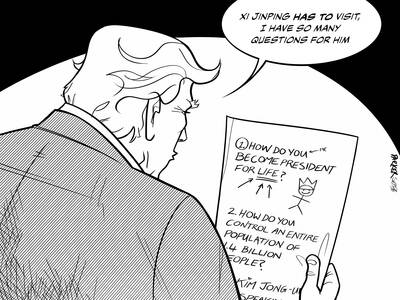
EDITORIAL CARTOON
Taiwanese-Americans, lawmakers and civic groups marched through Manhattan on Saturday last week in support of Taiwan’s participation in the UN. Marshall Islands Permanent Representative to the UN John Silk joined the demonstration, saying he hoped Taiwan would one day be able to participate in UN meetings as a member, and Democratic Progressive Party Legislator Wang Yi-chuan (王義川) took part while visiting New York City with a delegation. Taiwanese communities in Vancouver held a “UN for Taiwan” event. The campaign comes as the 81st UN General Assembly gets under way. In Taipei, President William Lai (賴清德) said China was deliberately misinterpreting UN


 RSS
RSS