

EVA Air has announced five weekly direct flights between New Delhi and Taipei starting in December, removing a long-standing practical barrier to closer Taiwan-India relations. Direct air connectivity would enable deeper engagement by facilitating business partnerships, academic exchanges, tourism and people-to-people ties. The air link would also make interaction between the two societies easier, more frequent and more sustainable, creating a stronger foundation for broader cooperation.
This step has the potential to bolster ties between the two countries. India has been a priority country for Taiwan, particularly under the New Southbound Policy Plus initiative, Taiwan’s integrated diplomacy approach, and its broader Indo-Pacific strategy. The New Southbound Policy Plus is fundamentally people-centric, making people-to-people connectivity a central pillar of its success. Stronger links between societies require greater mobility, and direct air connectivity is an essential starting point.
However, it is just one of many issues that require attention. The improvement in direct connectivity was long overdue and is a welcome step, but Taiwan’s broader economic and strategic focus on India appears to have diminished. Taiwan still tends to view India through a traditional and outdated lens, and much of its understanding of India’s foreign policy outlook appears more reactive than evidence based.
One example is the interpretation of India’s efforts to manage and stabilize ties with China as a reset in relations and, consequently, as evidence that India is inching closer to China. This is flawed. Managing ties with China does not mean abandoning engagement with Taiwan. India has refrained from viewing its engagement with Taiwan in areas of existing cooperation primarily through the China lens. Of course, the China factor looms large, but India has also attempted to minimize its role in its ties with Taiwan. That has gone unnoticed and underappreciated in Taiwan.
Additionally, it is never simply a question of China versus the US for India. As strategic autonomy gains greater importance, as the international system becomes less unipolar and as middle powers exercise greater agency, Taiwan still appears to be looking at international relations largely through the prism of US-China competition.
Another important factor is the perception that growing India-US differences signal a weakening of the Indo-Pacific itself. This interpretation misses the larger regional picture. The Indo-Pacific is not disappearing. Rather, the credibility and reliability of the US are being questioned by an increasing number of countries.
Many regional states are either doubling down on the Indo-Pacific construct or placing greater emphasis on regional agency and their own strategic interests. Taiwan should pay closer attention to these changing perceptions of the US, including Washington’s transactional approach toward its traditional partners and allies.
Understandably, Washington is Taipei’s most important security partner. However, the unpredictability arising from the US’ approach means that Taiwan also needs to seriously consider diversifying its partnerships and playing a larger role in making regional countries, including India, more cognizant of the threat of invasion and the potential for regional instability.
There is no doubt that there can be no meaningful Indo-Pacific strategy without India. As one of the region’s largest economies and a critical strategic actor, India’s role is indispensable to any vision of a free, open, inclusive and resilient Indo-Pacific region.
Against this backdrop, Taiwan needs to focus more clearly on its own Indo-Pacific strategy and move beyond an approach centered primarily on the West. India should be an important part of that calculation. Strengthening ties with India should be about recognizing New Delhi’s growing importance to the regional order on its own terms.
It is necessary for Taiwan to strengthen the New Southbound Policy Plus and connect it more closely with its Indo-Pacific strategy. The initiative needs to articulate more clearly what the Indo-Pacific region means for Taiwan. A conflict in the Taiwan Strait would have spillover effects across the region, but lobbying efforts and sustained engagement today could pay off tomorrow. Such support might not involve a direct military response, but regional countries could exert other forms of pressure on China. Taiwan should be aware that any such pressure could be helpful and might contribute to deterrence.
There is no doubt that Taiwan and India are important to each other. The new direct flights are pivotal, but they also serve as a reminder that much more remains to be done. Taiwan needs a sustained India strategy of its own. For Taiwan, investing in India is about building greater regional resilience, diversifying partnerships, and ensuring that Taiwan has stronger support and understanding across the Indo-Pacific region when it matters most.
Sana Hashmi is a fellow at the Taiwan-Asia Exchange Foundation. The views expressed in this article are personal.
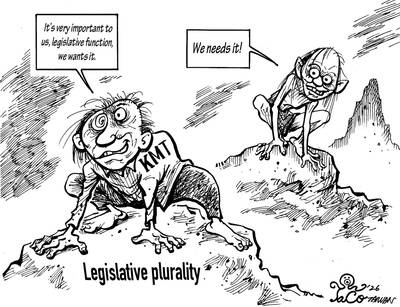
EDITORIAL CARTOON
For the last 15 years, China has relied on gray zone operations to advance its territorial ambitions across Asia. And for 15 years, the US has struggled to respond. But the open door on which China has been pushing may finally be closing. Gray zone operations involve the assertive use of a variety of tools in ways that create conditions that can be described as neither peace nor war. Military forces might act provocatively — even dangerously — while carefully avoiding violence, whereas law enforcement employs nonlethal violence as a first resort. Such an approach creates difficult calculations for its targets.
China’s new exit and entry regulations might signal an increase in the risk that Taiwanese travelers will face, an analyst said on Tuesday last week. The new rules, which take effect on Sept. 15, expand the power of authorities to restrict travel on national, industrial and technological security grounds, question travelers about their reasons for leaving and inspect electronic data. Taiwanese who do not support the ruling party should not dismiss the warnings as fearmongering or propaganda. Beijing applies its “anti-secession” laws indiscriminately, an official said recently while presenting a report on proposed amendments to combat China’s efforts at transnational repression. Chinese
President William Lai (賴清德) late last month received a delegation of Polish members of the European Parliament at the Presidential Office — the first single-party, single-nation delegation from the EU legislature to visit Taipei in nearly two terms. The group, led by former Polish prime minister Beata Szydlo, also met Legislative Yuan Speaker Han Kuo-yu (韓國瑜), a gesture spanning Taiwan’s political divide. For most Taiwanese observers, this was a pleasant, if minor, diplomatic event. It was much more than that — and the timing matters. Within the same fortnight, Hudson Institute senior fellow Ken Moriyasu said in the Washington Examiner


 RSS
RSS