


The Chinese Nationalist Party (KMT) is often accused of getting close to, and even conspiring with, the Chinese Communist Party (CCP). There are certainly good reasons behind these accusations, yet the confounding truth is that it makes neither historical nor logical sense for it to do so.
Whether one believes that the Chinese civil war fought between the KMT and CCP in the previous century has ended or has yet to be resolved, the KMT’s retreat to Taiwan in 1949 resulted in the CCP governing China and the KMT taking root in Taiwan.
For years, the KMT refused to even contemplate talking with the CCP “bandits.” This changed with the detente in the early 2000s, with then-KMT chairman Lien Chan (連戰) visiting China and meeting CCP officials in 2005, and the “diplomatic truce” of former president Ma Ying-jeou (馬英九), who advocated for closer ties with the CCP, met with Chinese President Xi Jinping (習近平) in 2015 in what is still the meeting between the highest-ranking Taiwanese official and a Chinese leader since 1949, and who accepted — as he still insists the KMT does — the “1992 consensus” as a prerequisite for cross-strait negotiations.
While the gradual warming of ties between the KMT and CCP does lend a certain historical coherence to the current situation — the most recent manifestation being the meeting between Xi and KMT Chairwoman Cheng Li-wun (鄭麗文), who does not hail from the KMT establishment, in Beijing on April 10 — the partnership still makes no logical sense.
The KMT holds that the “1992 consensus” says that “there is only ‘one China’, with each side having its own interpretation,” yet Xi no longer includes the second clause when speaking about the CCP’s claims over Taiwan. Neither does the CCP consider the KMT or the Republic of China (ROC) that it represents to even exist in the present day: In reference to the allegations that Beijing had intervened to have the Seychelles, Mauritius and Madagascar abruptly cancel overflight permissions for President William Lai’s (賴清德) visit to Eswatini in April, Chinese Ministry of Foreign Affairs spokesperson Guo Jiakun (郭嘉昆) said that “the so-called ‘president of the ROC’ has long ceased to exist in the world.”
That is, if the CCP ever does succeed in annexing Taiwan, KMT members should not expect to be treated well by their new CCP overlords, and the ROC that the KMT holds so dear would simply disappear. If the KMT wishes to survive, if it wants the ROC to continue to exist after a cross-strait merging, logic suggests that it must hold out for a post-CCP China.
That is not an unreasonable hope: As prominent former bishop of Hong Kong Cardinal Joseph Zen (陳日君) wrote in an editorial published in the New York Times in October 2018, directing his message to the underground bishops and priests of China, “Till the soil. Wait for better times... Communism is not eternal.”
Another legacy from the post-war experience of the KMT is its distrust of US promises of support. The present-day manifestation of this distrust is the attitude of “US skepticism” that the KMT has fostered. While this position contributes to the accusations of the KMT conspiring with the CCP, it also provides logical argument for its reluctance to pass Lai’s special national defense budget.
At the Taipei Foreign Correspondents’ Club on Wednesday night, KMT heavyweight and former Broadcasting Corp of China chairman Jaw Shaw-kong (趙少康) spoke of his own views on relations with the CCP. Jaw said that he continues to believe in the eventual unification of Taiwan and China, but not under current conditions. Referring to the different systems of government, he said that Taiwan’s approach should be to say to Beijing that there is no need to rush things.
“You think your system is good, but we feel our system is better. So for now, we rule Taiwan with our system. But in China’s history, 100 or 200 years is a very short time,” he said.
Hold hands with the CCP, but hold out for a post-CCP future, in which the KMT would not fall foul of civil-war enmity and in which the ROC would not cease to exist: That is the logic behind the KMT’s long game approach.
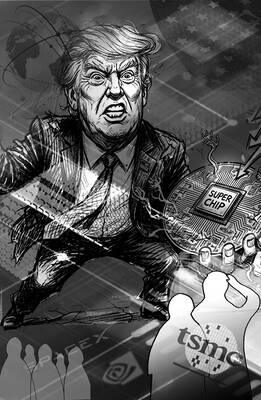
The White House’s decision to take a 9.9 percent stake in Intel Corp is looking like very shrewd business indeed. Since the government bought in at US$20.47 a share last August, the US chipmaker’s surging stock price has delivered the US a US$43 billion return. One of the reasons the investment has so far proved so sound is that the White House has made sure of it. According to The Wall Street Journal, Howard personally pushed deals on Intel’s behalf with some of the most lucrative clients imaginable. They include Nvidia Corp, the company at the heart of the AI
A single photograph can cut through a lot of noise, but it can also be used to misrepresent the truth. At the very least, it can concentrate the mind on something that requires further investigation. On Monday last week, Ma Ying-jeou Foundation CEO Tai Hsia-ling (戴遐齡) and former National Security Council secretary-general King Pu-tsung (金溥聰) held a news conference in which they showed a photograph of former foundation CEO Hsiao Hsu-tsen (蕭旭岑), now Chinese Nationalist Party (KMT) deputy chairman. In the image Hsiao is seated next to Xiamen Taiwan Businessmen Association chairman Han Ying-huan (韓螢煥). The two men were holding
I first met Professor Ray Jiing (井迎瑞) as a film and documentary student at Shih Hsin University’s (SHU) Department of Radio Television and Film in 1988. The following year, he went on to become the director of the Chinese Taipei Film Archive — forerunner of the Taiwan Film and Audiovisual Institute (TFAI). Over his eight-year tenure, Jiing rescued and restored over 200 classic Taiwanese films. In 1997, he established the Graduate Institute of Studies in Documentary and Film Archiving at Tainan National University of the Arts (TNNUA), and I joined the program in his third cohort of students. Beyond a
A recent report concerning a student who is suing his teacher posed the question in its headline: Does failing a student in two subjects constitute bullying? The college student in Chiayi County apparently sought NT$2 million (US$63,603) in state compensation, but a court dismissed the case. The first reaction of many might have been to ask: What has happened to students nowadays? Some say that teachers have lost their authority, while others say students are overindulged. Some even start reminiscing over the days when “whatever the teacher says goes.” However, the real issue might be overlooked if emotional reactions like that are the


 RSS
RSS