


Lee Chiao (李喬), a prominent Hakka writer in Taiwan, published the short story The Informant (告密者) in 1985. Though fictional, it offers a sharp critique of life under Martial Law and a cautionary message, with the protagonist ultimately descending into madness. Taiwan’s martial law period was prolonged, and the Chinese Nationalist Party (KMT) remained in power until 2000.
In 1988, one year after martial law was lifted, democracy advocate Deng Nan-jung (鄭南榕) became a martyr when he locked himself in the offices of Freedom Era Weekly and set himself and the building on fire on April 7. This underscores how party-state control persisted beyond the formal end of Martial Law, arguably until the first direct presidential election in 1996 or the democratic transfer of power in 2000.
Earlier this month, Academia Historica held a book launch for Postwar Taiwan Political Cases: A Compilation of Historical Materials on the Cheng Nan-jung Case, drawing on extensive archived surveillance records across five volumes. These materials reveal how, during the era of party-state control, networks of informants were deployed to monitor dissidents, and those pursuing freedom and democracy.
Although Taiwan has since democratized, with transitional justice still incomplete, the shadows of party-state rule remain. The materials from Deng’s case expose traces of these informant networks, bringing fragments of this history into the light.
At a democracy and human rights-related gathering, a young attendee showed me files tied to my own “case.” They included surveillance records on my work as a literary figure, covering my involvement with Taiwan Literature and Arts magazine the Taiwan Association for Human Rights, Taiwan PEN, and even my visits to overseas Taiwanese communities. Seeing them brought back memories of the early 1980s, when personnel from the Taiwan Garrison Command investigated the company where I worked.
I have written and translated poetry, novels, essays, and commentaries. Since the 1970s, I was involved in editing literary publications, linking cultural movements with political reform. In the 1980s, I wrote newspaper columns expressing a vision of Taiwan as a nation, which made me a target of surveillance.
Now that such documents are accessible, it appears some within the KMT at the time were more inclined toward alignment with the Chinese Communist Party (CCP) than toward strengthening Taiwan itself.
Access to surveillance records from the Martial Law period can now be applied for through the National Archives Administration, effectively making them public.
During the White Terror era, some individuals, whether due to ignorance, weakness or coercion, became informants or collaborators, leaving troubling records behind.
For the full realization of transitional justice, such individuals should acknowledge their involvement and seek understanding and forgiveness. If they refuse, public condemnation is a natural consequence.
The psychological contortions of KMT members who shifted from anti-CCP to pro-CCP positions may reflect the lingering effects of incomplete transitional justice.
Some may seek to atone for past actions by aligning with the CCP. What they often overlook is that those who remained in China after 1949, including members of the Revolutionary Committee of the Chinese Kuomintang (中國國民黨革命委員會), also faced political purges and persecution.
Taiwan’s democracy must continue to develop. The formation of a national collective requires learning through setbacks and reflection. Truth and apology must precede forgiveness or reconciliation.
The tragedies in Taiwan’s history stem not only from external oppression but also internal divisions. As Taiwanese look toward a new future and national vision, they must also confront and clear away the residue of the past.
Lee Min-yung is a poet.
Translated by Gilda Knox Streader
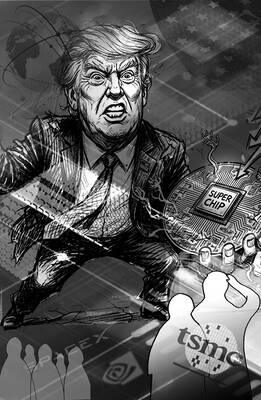
The White House’s decision to take a 9.9 percent stake in Intel Corp is looking like very shrewd business indeed. Since the government bought in at US$20.47 a share last August, the US chipmaker’s surging stock price has delivered the US a US$43 billion return. One of the reasons the investment has so far proved so sound is that the White House has made sure of it. According to The Wall Street Journal, Howard personally pushed deals on Intel’s behalf with some of the most lucrative clients imaginable. They include Nvidia Corp, the company at the heart of the AI
A single photograph can cut through a lot of noise, but it can also be used to misrepresent the truth. At the very least, it can concentrate the mind on something that requires further investigation. On Monday last week, Ma Ying-jeou Foundation CEO Tai Hsia-ling (戴遐齡) and former National Security Council secretary-general King Pu-tsung (金溥聰) held a news conference in which they showed a photograph of former foundation CEO Hsiao Hsu-tsen (蕭旭岑), now Chinese Nationalist Party (KMT) deputy chairman. In the image Hsiao is seated next to Xiamen Taiwan Businessmen Association chairman Han Ying-huan (韓螢煥). The two men were holding
I first met Professor Ray Jiing (井迎瑞) as a film and documentary student at Shih Hsin University’s (SHU) Department of Radio Television and Film in 1988. The following year, he went on to become the director of the Chinese Taipei Film Archive — forerunner of the Taiwan Film and Audiovisual Institute (TFAI). Over his eight-year tenure, Jiing rescued and restored over 200 classic Taiwanese films. In 1997, he established the Graduate Institute of Studies in Documentary and Film Archiving at Tainan National University of the Arts (TNNUA), and I joined the program in his third cohort of students. Beyond a
A recent report concerning a student who is suing his teacher posed the question in its headline: Does failing a student in two subjects constitute bullying? The college student in Chiayi County apparently sought NT$2 million (US$63,603) in state compensation, but a court dismissed the case. The first reaction of many might have been to ask: What has happened to students nowadays? Some say that teachers have lost their authority, while others say students are overindulged. Some even start reminiscing over the days when “whatever the teacher says goes.” However, the real issue might be overlooked if emotional reactions like that are the


 RSS
RSS