


Former Taipei mayor and Taiwan People’s Party (TPP) founding chairman Ko Wen-je (柯文哲) was sentenced to 17 years in prison on Thursday, making headlines across major media. However, another case linked to the TPP — the indictment of Chinese immigrant Xu Chunying (徐春鶯) for alleged violations of the Anti-Infiltration Act (反滲透法) on Tuesday — has also stirred up heated discussions.
Born in Shanghai, Xu became a resident of Taiwan through marriage in 1993. Currently the director of the Taiwan New Immigrant Development Association, she was elected to serve as legislator-at-large for the TPP in 2023, but was later charged with involvement in Beijing-directed election interference, fraud and forgery, as well as other financial crimes.
The evidence presented by prosecutors included chat logs from June 2019 to October last year between Xu and Chinese Ministry of Civil Affairs Service Center for Cross-Strait Marriages and Families Director Yang Wentao (楊文濤), as well as Chinese Kuomintang Shanghai Council for the Promotion of Peaceful Reunification Revolutionary Committee deputy head Sun Xian (孫憲).
Prosecutors said Xu explicitly declared her loyalty to the Chinese Communist Party (CCP), and provided long-term reports about the Taiwanese political landscape to Yang and Sun while participating in election activities under their instruction, as well as coordinating a plan to promote the participation of Chinese spouses in Taiwanese politics. She also allegedly reported on the daily activities of Chinese spouses in Taiwan, aiding the CCP in exerting control over them.
According to the indictment, Xu became disillusioned with the Chinese Nationalist Party (KMT) because it did not nominate Chinese spouses for legislator-at-large positions. She even voiced her complaints to Yang, saying that the KMT “never really wanted unification, it’s only fooling Beijing.”
With instructions to turn a party towards the goals of the CCP, Xu looked to the TPP and began organizing Chinese spouses to campaign for former Taipei deputy mayor and incumbent TPP Legislator Vivian Huang (黃珊珊) to run for Taipei mayor in 2022, as well as rallying support for Ko in his presidential campaign in an attempt to secure a legislator-at-large seat.
Prosecutors also alleged that Xu facilitated Sun’s 10-day visit to Taiwan in October last year, concealing his government connections through a shell company and falsifying a daily itinerary which allowed him to secretly meet with KMT and TPP officials.
Although Xu eventually gave up her legislator nomination in 2023 due to concerns over her suspected CPP-linked background, the indictment said that Xu had sent Sun the personal profile of Li Zhenxiu (李貞秀), another Chinese spouse and naturalized Taiwanese citizen. Li became a TPP legislator-at-large last month, but was embroiled in a scandal over her alleged failure to renounce her Chinese nationality. Xu and Sun’s chat log indicated that Li was handpicked by Xu and approved by Sun, who even provided a backup plan for if Li failed to secure the seat.
The indictment was sobering for many, as it detailed how the CCP’s espionage operations in Taiwan are not limited to the military, and can be coordinated by “local collaborators” in civic groups and political parties which then meddle in Taiwanese elections and legislation.
Mainland Affairs Council MAC Deputy Minister Liang Wen-chieh (梁文傑) on Thursday said the indictment revealed that the CCP’s intervention in Chinese spouse groups operates through a “highly organized chain of command,” which aims mainly to infiltrate the KMT and TPP.
While many people also blame the TPP for allegedly harboring CCP spies, Liang said any party can be a victim of Chinese infiltration, and the focus should be on how the TPP responds to the indictment.
When questioned by reporters in 2023, Ko claimed to have “never seen Xu,” but photos of the two together as early as 2019 were later revealed by the media, and the indictment listed in-person meetings between Ko and Xu before 2023.
TPP Chairman Huang Kuo-chang (黃國昌) on Wednesday criticized the indictment, saying that it resembled the authorship of the “Democratic Progressive Party’s (DPP) troll army.” On Thursday, Huang said that Xu was nominated by the party through an open audition, and Ko called the DPP the “real [Chinese] communist bandits.”
Although a verdict has not yet been reached on the case, the indictment serves as a warning for Taiwanese on potential methods of CCP infiltration — potentially the tip of the iceberg of a wider, more systematic “united front” network. The TPP should explain why it continued to work with Xu and why it now insists on backing Li’s legislative seat despite the unsettled controversy over her qualifications.
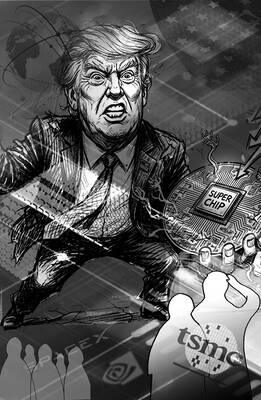
The White House’s decision to take a 9.9 percent stake in Intel Corp is looking like very shrewd business indeed. Since the government bought in at US$20.47 a share last August, the US chipmaker’s surging stock price has delivered the US a US$43 billion return. One of the reasons the investment has so far proved so sound is that the White House has made sure of it. According to The Wall Street Journal, Howard personally pushed deals on Intel’s behalf with some of the most lucrative clients imaginable. They include Nvidia Corp, the company at the heart of the AI
A single photograph can cut through a lot of noise, but it can also be used to misrepresent the truth. At the very least, it can concentrate the mind on something that requires further investigation. On Monday last week, Ma Ying-jeou Foundation CEO Tai Hsia-ling (戴遐齡) and former National Security Council secretary-general King Pu-tsung (金溥聰) held a news conference in which they showed a photograph of former foundation CEO Hsiao Hsu-tsen (蕭旭岑), now Chinese Nationalist Party (KMT) deputy chairman. In the image Hsiao is seated next to Xiamen Taiwan Businessmen Association chairman Han Ying-huan (韓螢煥). The two men were holding
I first met Professor Ray Jiing (井迎瑞) as a film and documentary student at Shih Hsin University’s (SHU) Department of Radio Television and Film in 1988. The following year, he went on to become the director of the Chinese Taipei Film Archive — forerunner of the Taiwan Film and Audiovisual Institute (TFAI). Over his eight-year tenure, Jiing rescued and restored over 200 classic Taiwanese films. In 1997, he established the Graduate Institute of Studies in Documentary and Film Archiving at Tainan National University of the Arts (TNNUA), and I joined the program in his third cohort of students. Beyond a
A recent report concerning a student who is suing his teacher posed the question in its headline: Does failing a student in two subjects constitute bullying? The college student in Chiayi County apparently sought NT$2 million (US$63,603) in state compensation, but a court dismissed the case. The first reaction of many might have been to ask: What has happened to students nowadays? Some say that teachers have lost their authority, while others say students are overindulged. Some even start reminiscing over the days when “whatever the teacher says goes.” However, the real issue might be overlooked if emotional reactions like that are the


 RSS
RSS