


Today marks the 30th anniversary of Taiwan’s first direct presidential election. This year also marks a broader democratic milestone, as the years Taiwan has spent as a free nation have now exceeded the years it endured under martial law. Taiwan’s democracy remains a living project, still growing stronger and deeper with time. That progress belongs to Taiwanese, and it gives this generation a clear duty to protect the peace and security that sustain it.
Taiwan’s democracy did not emerge fully formed; it was built through social struggle, political reform and the steady expansion of public participation. Direct presidential elections gave Taiwanese the power to choose their leader, while the end of the authoritarian era allowed democratic institutions to take root in everyday life. Today, these hard-won gains shape how Taiwan governs itself, how Taiwanese debate public affairs and how power is held accountable.
That democratic development carries a practical lesson — freedom requires protection. Democratic institutions need a secure environment in which to function. A society that values open elections, civil liberties and a constitutional government must also take national defense seriously. After all, Taiwan faces ongoing military pressure and “gray zone” coercion from China. Under these conditions, preserving peace depends on maintaining credible defense capacity. Stability does not come from wishful thinking; it rests on preparedness, resilience and the ability to deter aggression.
National defense is essential to Taiwan’s democratic survival. In his first term as chair of the Foreign Affairs and National Defense Committee, the first item Democratic Progressive Party (DPP) Legislator Chen Kuan-ting (陳冠廷) placed on the agenda was a review of the special defense bill. That choice sent a clear signal. As Taiwan’s democracy continues to deepen, strengthening defense readiness remains a serious political priority.
Moreover, that signal matters internationally. Taiwan’s partners watch closely for signs of political seriousness and strategic consistency. Beijing watches for signs of hesitation, division and drift. The legislature’s agenda therefore carries meaning beyond domestic politics. Safeguarding democracy requires investment, planning and resolve. Consequently, that message bolsters deterrence and reassures those who support Taiwan that its democratic system is capable of acting with purpose.
Legislative oversight is an essential part of democratic governance. Defense budgets should be reviewed seriously, with careful attention to strategic priorities, implementation timelines and the responsible use of public funds. However, oversight should not be turned into performative obstruction. What Taiwan needs is substantive scrutiny that strengthens national defense, not meaningless political blocking that delays urgent preparations and weakens the signal Taiwan sends to the outside world.
Looking back, 30 years after the first direct presidential election, Taiwan has every reason to take pride in how far it has come. It has built a democracy that is open, competitive and resilient. More broadly, it has entered a new stage in which the years of freedom now outweigh the years of authoritarian control. That achievement should inspire confidence, but also vigilance. A democracy that continues to grow must also continue to defend itself.
Taiwan’s democratic story is still being written. Protecting that story requires more than remembrance. It requires the will to preserve peace through strength, to defend democratic institutions through preparedness and to act with clarity when national security is on the line.
Gahon Chiang is a congressional staff member in the office of DPP Legislator Chen Kuan-ting, focusing on Taiwan’s national security policy.
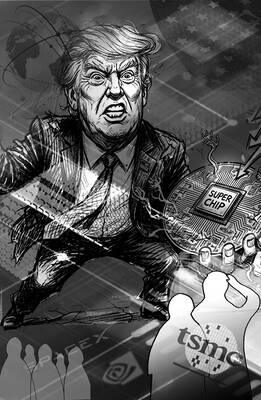
The White House’s decision to take a 9.9 percent stake in Intel Corp is looking like very shrewd business indeed. Since the government bought in at US$20.47 a share last August, the US chipmaker’s surging stock price has delivered the US a US$43 billion return. One of the reasons the investment has so far proved so sound is that the White House has made sure of it. According to The Wall Street Journal, Howard personally pushed deals on Intel’s behalf with some of the most lucrative clients imaginable. They include Nvidia Corp, the company at the heart of the AI
A single photograph can cut through a lot of noise, but it can also be used to misrepresent the truth. At the very least, it can concentrate the mind on something that requires further investigation. On Monday last week, Ma Ying-jeou Foundation CEO Tai Hsia-ling (戴遐齡) and former National Security Council secretary-general King Pu-tsung (金溥聰) held a news conference in which they showed a photograph of former foundation CEO Hsiao Hsu-tsen (蕭旭岑), now Chinese Nationalist Party (KMT) deputy chairman. In the image Hsiao is seated next to Xiamen Taiwan Businessmen Association chairman Han Ying-huan (韓螢煥). The two men were holding
I first met Professor Ray Jiing (井迎瑞) as a film and documentary student at Shih Hsin University’s (SHU) Department of Radio Television and Film in 1988. The following year, he went on to become the director of the Chinese Taipei Film Archive — forerunner of the Taiwan Film and Audiovisual Institute (TFAI). Over his eight-year tenure, Jiing rescued and restored over 200 classic Taiwanese films. In 1997, he established the Graduate Institute of Studies in Documentary and Film Archiving at Tainan National University of the Arts (TNNUA), and I joined the program in his third cohort of students. Beyond a
A recent report concerning a student who is suing his teacher posed the question in its headline: Does failing a student in two subjects constitute bullying? The college student in Chiayi County apparently sought NT$2 million (US$63,603) in state compensation, but a court dismissed the case. The first reaction of many might have been to ask: What has happened to students nowadays? Some say that teachers have lost their authority, while others say students are overindulged. Some even start reminiscing over the days when “whatever the teacher says goes.” However, the real issue might be overlooked if emotional reactions like that are the


 RSS
RSS