


Chinese Nationalist Party (KMT) Chairwoman Cheng Li-wun (鄭麗文) earlier this month said it is necessary for her to meet with Chinese President Xi Jinping (習近平) and it would be a “huge boost” to the party’s local election results in November, but many KMT members have expressed different opinions, indicating a struggle between different groups in the party.
Since Cheng was elected as party chairwoman in October last year, she has repeatedly expressed support for increased exchanges with China, saying that it would bring peace and prosperity to Taiwan, and that a meeting with Xi in Beijing takes priority over meeting with US officials in Washington.
While there are rumors about the time and other details of a potential Cheng-Xi meeting, she said it would take place between April and June, but Beijing remained mum.
While Cheng says she would not choose sides between Beijing and Washington, she has also said that she feels “immense goodwill and sincerity” from Beijing and repeatedly called herself “a Chinese.”
Her push for engagement with Beijing — including restarting a KMT-Chinese Communist Party (CCP) think tank forum last month that had been suspended for nine years — coupled with KMT legislators repeatedly blocking the Cabinet’s special defense budget, which includes US arms purchases, has led many to believe that the KMT under Cheng’s leadership is heading toward a more pro-China and US-skeptical stance.
However, with the local elections approaching, many KMT members and nominees have expressed concerns that Cheng’s stance would harm the party’s election results, while some called for a bigger defense budget or even visited the US to reconcile KMT-US relations.
KMT Legislator and Tainan mayoral election nominee Hsieh Lung-chieh (謝龍介) on Wednesday last week said that it is very difficult to gain benefits in a local election from focusing on cross-strait issues.
KMT Legislator and Kaohsiung mayoral election nominee Ko Chih-en (柯志恩) said cross-strait issues should be mentioned less in local elections and suggested that Cheng “listen more to mainstream public opinions.”
KMT Taoyuan City Councilor and former National Policy Foundation executive Ling Tao (凌濤), who is widely considered a protege of former KMT chairman Eric Chu (朱立倫), said the party should focus on economic and livelihood policies rather than cross-strait exchanges, and that the national defense budget should be at least NT$900 billion (US$28.15 billion), not the NT$380 billion that the KMT caucus proposed.
Taichung Mayor Lu Shiow-yen (盧秀燕), who is widely seen as a potential KMT candidate for the 2028 presidential election, this month made an 11-day trip to the US and said Taiwan “seriously needs a solid ally like the US” that has supported Taiwan’s defense and diplomacy for 80 years, adding that arms purchases are as necessary as buying insurance. She even cited a poll in which 77 percent of Taiwanese said they support strengthening Taiwan-US relations.
KMT Legislator Huang Chien-hao (黃健豪), who is close to Lu, also said that Lu preferred the NT$810 billion defense budget proposed by KMT Legislator Hsu Chiao-hsin (徐巧芯), prompting speculation that Lu and Cheng’s political views differ and that they struggle for influence in the party.
Some candidates have chosen to receive endorsement from former chairman Chu or Taipei Mayor Chiang Wan-an (蔣萬安) rather than from Cheng, which might be an attempt to distance themselves from the party headquarters.
Cheng has the lowest approval rate among political party leaders in the nation, recent polls showed.
Meanwhile, the Ma Ying-jeou Foundation last week issued a statement saying that former chief executive officer Hsiao Hsu-tsen’s (蕭旭岑) remarks no longer represent former president Ma Ying-jeou’s (馬英九) stance, a sign that Ma wants to distance himself from Cheng. Cheng appointed Hsiao, a close ally of Ma, as deputy chairperson, and he last month made remarks targeting American Institute in Taiwan Director Raymond Greene shortly after meeting with CCP Consultative Conference Chairman Wang Huning (王滬寧) in Beijing.
Moreover, KMT members have expressed concerns regarding the party’s process of determining local election nominees. While Cheng said the headquarters respects primary election results, some candidates have said the process is unclear and unfair. New Taipei City Mayor Hou You-yi (侯友宜), not Cheng, mediated the talks to determine the party’s mayoral nominee in the city, raising doubts regarding her coordination skills and control over the party.
As the Legislative Yuan is scheduled to discuss the special defense budget bills this week and the KMT wraps up most of its primaries this month, Cheng’s leadership and policy direction will soon be put to the test. The real test is in November.
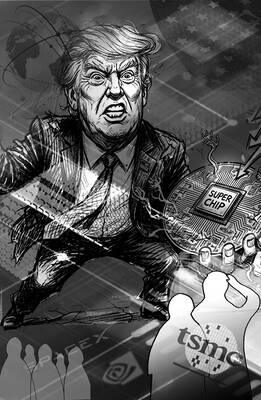
The White House’s decision to take a 9.9 percent stake in Intel Corp is looking like very shrewd business indeed. Since the government bought in at US$20.47 a share last August, the US chipmaker’s surging stock price has delivered the US a US$43 billion return. One of the reasons the investment has so far proved so sound is that the White House has made sure of it. According to The Wall Street Journal, Howard personally pushed deals on Intel’s behalf with some of the most lucrative clients imaginable. They include Nvidia Corp, the company at the heart of the AI
A single photograph can cut through a lot of noise, but it can also be used to misrepresent the truth. At the very least, it can concentrate the mind on something that requires further investigation. On Monday last week, Ma Ying-jeou Foundation CEO Tai Hsia-ling (戴遐齡) and former National Security Council secretary-general King Pu-tsung (金溥聰) held a news conference in which they showed a photograph of former foundation CEO Hsiao Hsu-tsen (蕭旭岑), now Chinese Nationalist Party (KMT) deputy chairman. In the image Hsiao is seated next to Xiamen Taiwan Businessmen Association chairman Han Ying-huan (韓螢煥). The two men were holding
I first met Professor Ray Jiing (井迎瑞) as a film and documentary student at Shih Hsin University’s (SHU) Department of Radio Television and Film in 1988. The following year, he went on to become the director of the Chinese Taipei Film Archive — forerunner of the Taiwan Film and Audiovisual Institute (TFAI). Over his eight-year tenure, Jiing rescued and restored over 200 classic Taiwanese films. In 1997, he established the Graduate Institute of Studies in Documentary and Film Archiving at Tainan National University of the Arts (TNNUA), and I joined the program in his third cohort of students. Beyond a
A recent report concerning a student who is suing his teacher posed the question in its headline: Does failing a student in two subjects constitute bullying? The college student in Chiayi County apparently sought NT$2 million (US$63,603) in state compensation, but a court dismissed the case. The first reaction of many might have been to ask: What has happened to students nowadays? Some say that teachers have lost their authority, while others say students are overindulged. Some even start reminiscing over the days when “whatever the teacher says goes.” However, the real issue might be overlooked if emotional reactions like that are the


 RSS
RSS