


The streets of Tokyo over the past few days could have been mistaken for a little Taiwan. Resounding cheers for Taiwan filled the Tokyo Dome at the World Baseball Classic (WBC) last week, with fans packing the stands. Among them was Premier Cho Jung-tai (卓榮泰), whose low-profile visit to the stadium on Saturday inevitably attracted attention.
Cho’s seemingly simple act of “baseball diplomacy” broke new ground, overcoming some significant and long-standing political taboos.
The trip was the first time that a sitting premier has stepped foot on Japanese soil since the severing of official relations with Taiwan 54 years ago — something of a home run for high-level visits in the Taiwan-Japan relationship.
The last time an official of equal rank made such a visit was in 1970, when then-premier Yen Chia-kan (嚴家淦) attended Expo ’70 in Osaka. Since then, Taiwan-Japan relations have remained necessarily understated and informal, limited under the shadow of Tokyo’s “one China” policy.
However, more than half a century has passed since then. Cho’s quick trip to Japan, even in his capacity as a private citizen and baseball fan, could never have been achieved without the tacit understanding and support of high-level officials in Taiwan, Japan and, indeed, the US.
The development gives further diplomatic weight to Japan’s affirmation that “a Taiwan contingency is a Japan contingency,” and is a tangible confirmation of Taipei’s position of strategic resilience, as it shuttles between friendly nations in the Indo-Pacific region.
Similar unspoken agreements are also emerging in the South Pacific. The Chinese-language United Daily News reported that General Lu Kun-hsiu (呂坤修), commander of the army headquarters, made several secret trips to the Philippines. That is an important piece of the puzzle for military cooperation in the region.
Lu’s visits reportedly involved negotiations on military base upgrades and cooperation on ammunition supply chains. That would demonstrate that the defense of the first island chain is gradually turning from a matter for individual countries to manage on their own into a collective consensus among Taiwan, Japan and the Philippines under US integration.
Between Cho’s political breakthrough in the north and Lu’s military engagements in the south, Taiwan’s efforts in flexible and comprehensive diplomacy are deftly transforming geopolitical threats into grounds for regional defensive partnerships.
Ironically, Taipei Mayor Chiang Wan-an (蔣萬安) and other Chinese Nationalist Party (KMT) politicians have been so preoccupied with calculating the minutia of public funds to be reimbursed that they have, in their shortsightedness, failed to see the forest for the trees and recognize the diplomatic ground being broken.
Of course that shallowness stems from the KMT’s collective anxiety over its own incompetence in diplomacy — a weakness that is rooted in its fear and need to appease China.
The government’s unwavering diplomatic advancements have been met with quibbling over batters paying for their bats. However, in the end, responding to geopolitical breakthroughs with smear tactics only highlights one’s own deficiencies.
Taiwan is continuing to stride confidently onto the world stage. Taiwan must win its diplomatic battle to defend national sovereignty, and ensure that our flag of democracy stands firm against the waves of the Pacific.
Yang Chih-chiang is a teacher.
Translated by Gilda Knox Streader
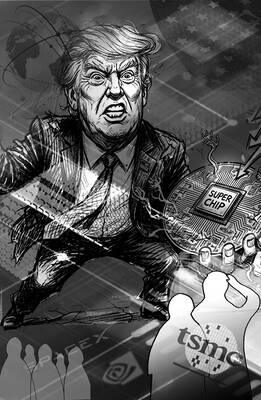
The White House’s decision to take a 9.9 percent stake in Intel Corp is looking like very shrewd business indeed. Since the government bought in at US$20.47 a share last August, the US chipmaker’s surging stock price has delivered the US a US$43 billion return. One of the reasons the investment has so far proved so sound is that the White House has made sure of it. According to The Wall Street Journal, Howard personally pushed deals on Intel’s behalf with some of the most lucrative clients imaginable. They include Nvidia Corp, the company at the heart of the AI
A single photograph can cut through a lot of noise, but it can also be used to misrepresent the truth. At the very least, it can concentrate the mind on something that requires further investigation. On Monday last week, Ma Ying-jeou Foundation CEO Tai Hsia-ling (戴遐齡) and former National Security Council secretary-general King Pu-tsung (金溥聰) held a news conference in which they showed a photograph of former foundation CEO Hsiao Hsu-tsen (蕭旭岑), now Chinese Nationalist Party (KMT) deputy chairman. In the image Hsiao is seated next to Xiamen Taiwan Businessmen Association chairman Han Ying-huan (韓螢煥). The two men were holding
I first met Professor Ray Jiing (井迎瑞) as a film and documentary student at Shih Hsin University’s (SHU) Department of Radio Television and Film in 1988. The following year, he went on to become the director of the Chinese Taipei Film Archive — forerunner of the Taiwan Film and Audiovisual Institute (TFAI). Over his eight-year tenure, Jiing rescued and restored over 200 classic Taiwanese films. In 1997, he established the Graduate Institute of Studies in Documentary and Film Archiving at Tainan National University of the Arts (TNNUA), and I joined the program in his third cohort of students. Beyond a
A recent report concerning a student who is suing his teacher posed the question in its headline: Does failing a student in two subjects constitute bullying? The college student in Chiayi County apparently sought NT$2 million (US$63,603) in state compensation, but a court dismissed the case. The first reaction of many might have been to ask: What has happened to students nowadays? Some say that teachers have lost their authority, while others say students are overindulged. Some even start reminiscing over the days when “whatever the teacher says goes.” However, the real issue might be overlooked if emotional reactions like that are the


 RSS
RSS