


In 1979, US band Sister Sledge sang We Are Family.
Whether Chinese President Xi Jinping (習近平) is a fan of the four-sister group of the late disco era is unknown, but he echoed that sentiment in a New Year’s speech last week, extolling the concept of the state as a benevolent, loving and kind large family made of up of striving and dedicated smaller families.
We Are Family is a much-loved wedding floor-filler, but it is not exactly new. Similarly, the political concept of state as a family made up of families is not exactly groundbreaking — the family as a stabilizing influence on the state is a large part of Confucianism.
“When every small family is warm and thriving, China as the big family will prosper,” Xi said.
After outlining some big family achievements — such as the Tianwen-2 mission starting a new era of space exploration, new aircraft carriers, and Chinese progress in artificial intelligence and chip development — he turned to how the big family helps the small, such as in education, employment for young people and medical care for elderly people.
He described a symbiotic relationship between families in China doing well and the large, benevolent family of big government also doing well.
Xi has also included the concept of happiness in many of his recent speeches, saying that happiness of the people should be a top priority of the state. Xi appears to be offering a Jeffersonian life and happiness, but without liberty.
What about the happiness — and liberty — of the people across the Taiwan Strait? Are they in the family to which Xi is referring?
Presumably they are, as he regards Taiwan as a “province of China.”
That would make Taiwanese the black sheep, the prodigal sons and daughters ready to be welcomed back. The father threatens punishment — as evidenced by military exercises close to Taiwan — but is willing to stretch a welcoming hand on their return, along with a list of new house rules.
Since my arrival in Taiwan 25 years ago, I have witnessed the rise of a Taiwanese identity. Starting in the south of Taiwan around the turn of the millennium with the first Democratic Progressive Party administration, the identity is founded on an eclectic mix of geography, democracy and progressiveness. “I am Taiwanese” is proudly declared by most junior-high school students today. Is this just to be contrary to someone from China who says “I am Chinese”?
Has Taiwanese identity really solved the Chinese family conundrum?
Are the only Chinese those now living in China?
Most Taiwanese are ethnically Han Chinese and are literate in Mandarin in traditional characters (as opposed to the simplified script across the Strait). So, are they not also Chinese?
Entering this debate in October last year was Chinese Nationalist Party (KMT) Chairwoman Cheng Li-wun (鄭麗文), saying: “Let Taiwanese people proudly say I am Chinese.”
This, of course, started a lively debate in Taiwan. It was perhaps also not unnoticed across the Taiwan Strait. If Taiwanese are Chinese, then their small, striving families could be easily welcomed back into the big family.
Whether they would wish this to happen is another question.
The other question to consider in the “good neighbor” realpolitik created by what happened to deposed Venezuelan president Nicolas Maduro might be: Is anyone going to ask them at all?
Paul Bryan Anderson, a pseudonym, is a long-term resident of Taiwan, where he works as a teacher.
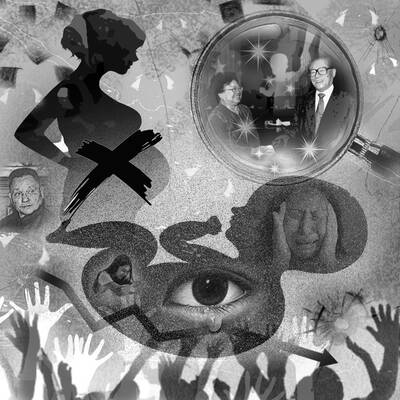
Jan. 1 marks a decade since China repealed its one-child policy. Just 10 days before, Peng Peiyun (彭珮雲), who long oversaw the often-brutal enforcement of China’s family-planning rules, died at the age of 96, having never been held accountable for her actions. Obituaries praised Peng for being “reform-minded,” even though, in practice, she only perpetuated an utterly inhumane policy, whose consequences have barely begun to materialize. It was Vice Premier Chen Muhua (陳慕華) who first proposed the one-child policy in 1979, with the endorsement of China’s then-top leaders, Chen Yun (陳雲) and Deng Xiaoping (鄧小平), as a means of avoiding the

The last foreign delegation Nicolas Maduro met before he went to bed Friday night (January 2) was led by China’s top Latin America diplomat. “I had a pleasant meeting with Qiu Xiaoqi (邱小琪), Special Envoy of President Xi Jinping (習近平),” Venezuela’s soon-to-be ex-president tweeted on Telegram, “and we reaffirmed our commitment to the strategic relationship that is progressing and strengthening in various areas for building a multipolar world of development and peace.” Judging by how minutely the Central Intelligence Agency was monitoring Maduro’s every move on Friday, President Trump himself was certainly aware of Maduro’s felicitations to his Chinese guest. Just
A recent piece of international news has drawn surprisingly little attention, yet it deserves far closer scrutiny. German industrial heavyweight Siemens Mobility has reportedly outmaneuvered long-entrenched Chinese competitors in Southeast Asian infrastructure to secure a strategic partnership with Vietnam’s largest private conglomerate, Vingroup. The agreement positions Siemens to participate in the construction of a high-speed rail link between Hanoi and Ha Long Bay. German media were blunt in their assessment: This was not merely a commercial win, but has symbolic significance in “reshaping geopolitical influence.” At first glance, this might look like a routine outcome of corporate bidding. However, placed in
China often describes itself as the natural leader of the global south: a power that respects sovereignty, rejects coercion and offers developing countries an alternative to Western pressure. For years, Venezuela was held up — implicitly and sometimes explicitly — as proof that this model worked. Today, Venezuela is exposing the limits of that claim. Beijing’s response to the latest crisis in Venezuela has been striking not only for its content, but for its tone. Chinese officials have abandoned their usual restrained diplomatic phrasing and adopted language that is unusually direct by Beijing’s standards. The Chinese Ministry of Foreign Affairs described the


 RSS
RSS