

Sanae Takaichi could bring about a new era. Japan on Tuesday turned a new page in its history with the election of its first female prime minister, Sanae Takaichi.
Takaichi has demonstrated resilience and composure while navigating the stormy seas of politics — from party factions to external power struggles — reaching the summit despite countless challenges. Her combination of resilience and flexibility, and her calm resolve in the face of a crisis, embody the spirit of her nickname, the “Iron Lady.”
Takaichi’s journey to the helm has been anything but easy. Her first days in office are filled with major diplomatic challenges — attending the 47th ASEAN summit in Malaysia on Sunday, receiving US President Donald Trump in Japan on Monday next week and then heading to South Korea for this year’s APEC summit on Friday next week.
She faces three trials in just one week, each a test of her abilities as prime minister, but more urgent challenges loom on the horizon.
Japan’s prime minister is the nation’s leader in name, but in practice must walk a tightrope balancing competing party factions. Takaichi is not one for socializing and interpersonal relationships are not her strong suit, but her professionalism and competence have earned her respect. In Japan’s current political landscape with a weak ruling party and strong opposition, Takaichi’s best chance to break free from these constraints is to dissolve the National Diet, rally disillusioned conservative voters, and seize the moment to establish authority and achieve greatness.
If economic reforms fail to deliver immediate results amid soaring prices, the new administration could easily fall back into Japan’s typical cycle of short-lived governments. Former Japanese prime minister Taro Aso — now serving as vice president of Takaichi’s Liberal Democratic Party (LDP) — and LDP Secretary-General Shunichi Suzuki, both former finance ministers, are well-versed in fiscal affairs. Japanese Minister of Finance Satsuki Katayama also came from the finance ministry. Whether this fiscal triangle can revive the economy would be a watershed determining the administration’s very survival.
Former Japanese prime minister Shinzo Abe maintained a close relationship with Trump, while Takaichi, often dubbed the “female Abe,” once worked for former US representative Pat Schroeder. Less than one week after Takaichi took office, Trump is traveling to Japan to offer his congratulations in a gesture symbolizing a rock-solid US-Japan alliance.
Through pragmatic diplomacy of being pro-US and pro-Taiwan while cooperating with China, Japan would become a key player in maintaining stability in the volatile Indo-Pacific region.
Born in Japan’s ancient capital of Nara, Takaichi possesses a deep understanding of tradition and public sentiment. She is not a feminist — she opposes having a female emperor, separate surnames for married couples and same-sex marriage — yet her stance is not rooted in rigid conservatism. Rather, it is rooted in a genuine respect for tradition. Although authoritarian states and left-leaning media have mocked her as being far-right, this label is actually a symbol of her clear conviction and adherence to principle.
Takaichi’s rise to the top represents the shattering of Japan’s political glass ceiling. If she manages to balance strength with flexibility to lead the LDP’s resurgence, she would not only rewrite Japan’s political history, but also bring a stabilizing force to a turbulent region. This historic journey — led by a woman — could mark the beginning of a new era for Japan.
Wang Hui-sheng is a founding member of the East Asian Research Institute.
Translated by Kyra Gustavsen

Taiwan’s domestic political situation is following recognizable political rhythms, while the international environment surrounding Taiwan is undergoing a major transformation. Within Taiwan, there are ongoing battles between the legislative and executive branches over the budget, and between cities and the central government over resources. Tensions between political parties dominate headlines and consume much of the attention of party leaders. Jockeying is underway for local elections this November and national elections in 2028. And the longstanding philosophical debate inside Taiwan over how best to protect Taiwan and promote the good life remains unresolved. Amidst all of this, Taiwan continues to function well. It
In an article published on Tuesday in The Atlantic, titled “Will Taiwan Just Give Up?”, journalist Simon Shuster emphasizes the unpredictability of the US as an ally under US President Donald Trump and cites diminishing faith in the US as a contributor to what he sees as waning determination to resist China. As the title suggests, Shuster views a deal between Taiwan and China as an increasingly inevitable alternative to a costly war — one that Taiwan, lacking reliable allies and military capabilities, would eventually be destined to lose. He focuses on Chinese Nationalist Party (KMT) Chairwoman Cheng Li-wun (鄭麗文) — her
With candidate registration for this year’s local elections closed on Sept. 4 and the elections less than 80 days away, Democratic Progressive Party (DPP) Legislator and Taipei mayoral candidate Puma Shen’s (沈伯洋) rapidly growing popularity has become the focus of political talk shows and online discussions over the past week, heating up the mayoral election race in Taipei. Local media headlines and political pundits have picked up his supporters’ slogan “ocean current” (洋流) — a play on the last character of Shen’s name, which literally means “ocean” (洋), and the character (流), which can mean “current,” “flow” or “trend” — to
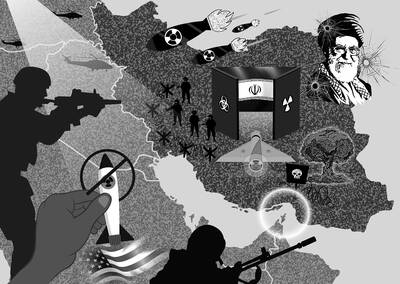
When was the last time you heard a meaningful proposal to prevent Iran from developing a nuclear arsenal? There has been nothing on the subject since the June Memorandum of Understanding between the US and Iran; the promised 60 days of talks to settle questions around Tehran’s uranium-enrichment program never began and have long since expired. When the war was launched, on Feb. 28, a resolution of the nuclear dispute was prominent among the dizzying array of US and Israeli aims to explain the attack. But as should be clear by now, the attempt was entirely reliant on achieving regime change. That


 RSS
RSS