


Last week, a team of Taiwanese freedivers who were competing in the Individual Depth Freediving World Championship in Cyprus had a nasty surprise when the organizers, the International Association for the Development of Apnea, without warning, removed the team’s national flag from a live feed of the event, leaving a blank space in its place. Later, the organizers issued a formal apology to Taiwan, saying that the stream had been cut off by Chinese authorities.
The “Chinese model” of combating the COVID-19 pandemic has involved using the authoritarian methods of a powerful state to impose and enforce lockdowns. China has been publicizing its pandemic-control achievements around the world, while engaging in dollar diplomacy and thereby demonstrating its “sharp power” on the international stage.
Meanwhile, in addition to making nonstop military threats against Taiwan, China has since February been repressing the nation’s agricultural sector, imposing bans without warning, while not replying to inquiries.
These actions are intended to cause misunderstandings and disagreements between Taiwanese officials and farmers, while also undermining farmers’ rights and morale. As well as having a transparent political purpose, these bans are a clear example of the cross-strait cognitive warfare that China has been working hard to develop, and how Beijing is employing it in practice.
Based on the US armed forces’ experience and observation of actual combat, Washington divides the process by which war develops into phases, namely “shape, deter, seize initiative, dominate, stabilize.”
Before engaging in actual warfare, armed forces must “shape” the conditions for operations in the theater of war by using political, economic, diplomatic and military means to create a favorable situation in advance.
Observing China’s recent actions from this point of view, Taiwanese must not ignore what Beijing is doing just because there is no actual fighting going on — they must cautiously face up to its serious implications.
Sun Tzu’s (孫子) The Art of War says that strategic planning and diplomacy are better methods for defeating an enemy than fighting bloody battles. After China suppressed Taiwan’s national flag at the freediving competition, 10 countries’ teams expressed their support for the nation by asking for their own national flags to also be removed from the livestream.
This gesture of solidarity illustrates how Taiwan’s sovereignty has over the past few years gained greater support and recognition around the world, so Taiwanese should not fall into China’s trap by belittling their country and conceding Taiwan’s national sovereignty.
Hou Hsin-tien is a student at National Defense University’s War College.
Translated by Julian Clegg
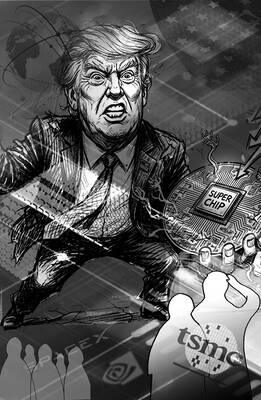
The White House’s decision to take a 9.9 percent stake in Intel Corp is looking like very shrewd business indeed. Since the government bought in at US$20.47 a share last August, the US chipmaker’s surging stock price has delivered the US a US$43 billion return. One of the reasons the investment has so far proved so sound is that the White House has made sure of it. According to The Wall Street Journal, Howard personally pushed deals on Intel’s behalf with some of the most lucrative clients imaginable. They include Nvidia Corp, the company at the heart of the AI
A single photograph can cut through a lot of noise, but it can also be used to misrepresent the truth. At the very least, it can concentrate the mind on something that requires further investigation. On Monday last week, Ma Ying-jeou Foundation CEO Tai Hsia-ling (戴遐齡) and former National Security Council secretary-general King Pu-tsung (金溥聰) held a news conference in which they showed a photograph of former foundation CEO Hsiao Hsu-tsen (蕭旭岑), now Chinese Nationalist Party (KMT) deputy chairman. In the image Hsiao is seated next to Xiamen Taiwan Businessmen Association chairman Han Ying-huan (韓螢煥). The two men were holding
I first met Professor Ray Jiing (井迎瑞) as a film and documentary student at Shih Hsin University’s (SHU) Department of Radio Television and Film in 1988. The following year, he went on to become the director of the Chinese Taipei Film Archive — forerunner of the Taiwan Film and Audiovisual Institute (TFAI). Over his eight-year tenure, Jiing rescued and restored over 200 classic Taiwanese films. In 1997, he established the Graduate Institute of Studies in Documentary and Film Archiving at Tainan National University of the Arts (TNNUA), and I joined the program in his third cohort of students. Beyond a
President William Lai Ching-te’s (賴清德) May 20 second-anniversary address was not just a routine policy review; it was damage control. US President Donald Trump’s remarks — that he did not want to see anyone move toward independence and that the delivery of a major Taiwan arms package could depend on the progress of US-China relations — unsettled Taiwan’s public and created an opening for opposition parties to question whether Taiwan was being treated as a bargaining chip in Washington’s dealings with Beijing. Lai’s speech was designed to close that opening. The address covered the expected ground: sovereignty, cross-strait relations, defense spending,


 RSS
RSS