

Taiwan’s manufacturing sector continued to expand strongly last month, buoyed by robust artificial intelligence (AI)-related demand, although shortages of key components are delaying some AI server shipments, the Chung-Hua Institution for Economic Research (CIER, 中華經濟研究院) said yesterday.
The manufacturing purchasing managers’ index (PMI) eased to 62.5 from 63.4 a month earlier, while the non-manufacturing index (NMI) fell to 55.4 from 56.9. Both remained well above the 50-point threshold separating expansion from contraction, indicating that business activity continued to grow, the CIER said.
CIER president Lien Hsien-ming (連賢明) said the manufacturing sector remained on a solid growth path, with AI-related demand continuing to support production and orders.
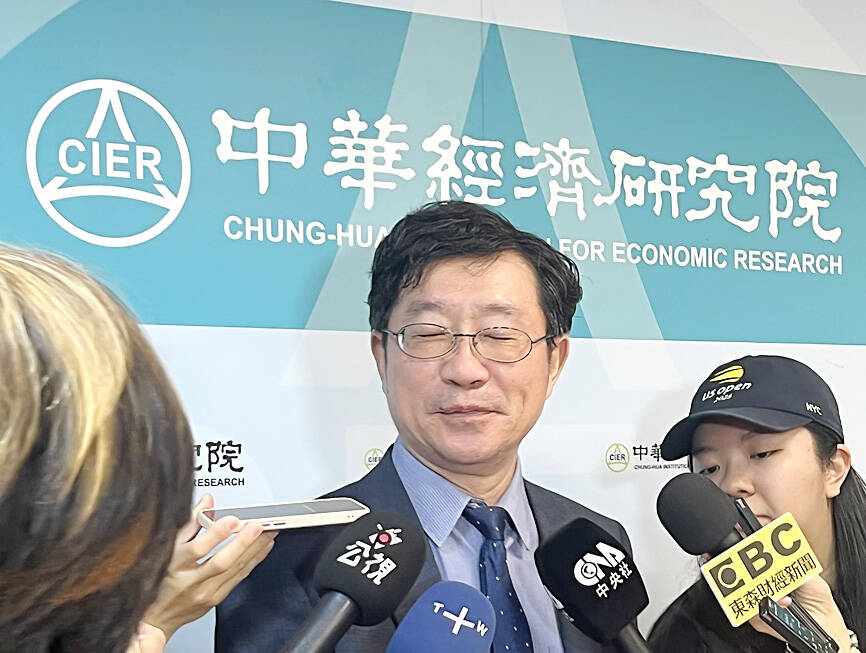
Photo: Liao Chia-ning, Taipei Times
However, supply constraints involving key raw materials and components have become a growing obstacle, preventing some manufacturers from shipping products as scheduled, he said.
The problem is particularly evident in AI servers, which require a large number of components to be assembled into a finished product. A delay in obtaining even one critical component can hold up the entire production process, Lien said.
Memory chips are not the only bottleneck, as substrates have also become increasingly difficult to secure, he said. Substrate production is constrained by limited capacity, while some upstream materials are sourced from Japan, making the supply chain vulnerable to disruptions at multiple stages, he added.
The CIER’s survey showed that the new orders index remained robust at 63.2 last month, indicating continued growth in demand.
However, the backlog of orders index fell to 53.9, its slowest expansion since January, amid continuing production and delivery difficulties, the CIER said.
Meanwhile, the supplier delivery times and raw material prices indices remained near 70, reflecting longer delivery times and persistent cost pressures as companies compete for increasingly scarce supplies, it said.
Asked whether the simultaneous declines in the PMI and NMI signaled that the economy had peaked, Lien said it was too early to draw such a conclusion.
Both PMI and NMI measure changes in business activity from the previous month, rather than the overall level of activity, Lien said. As both remained above 50, the readings indicated continued expansion, not an economic downturn, he said.
Lien also cautioned against assuming that the AI industry could sustain its current growth pace indefinitely. As production capacity expands and the industry’s base becomes larger, maintaining annual capacity growth of 20 percent to 30 percent will become increasingly challenging, he said.
Nevertheless, manufacturers remain optimistic about their business outlook, as the six-month business outlook index rose to 61.7 last month, staying above 60 for the 10th consecutive month.
The services-oriented NMI also registered its 20th consecutive month of expansion, although at a slower pace, Lien said.
Travel fairs, department store anniversary sales and major online shopping festivals this month are expected to boost retail, hotel and restaurant sales, he said.
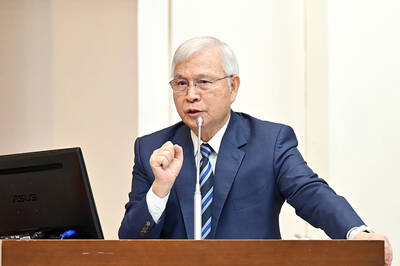
RESERVES ADEQUATE: The central bank governor rejected claims that Taiwan was facing a cash shortage, saying that its financial system had ample savings The New Taiwan dollar’s 3 percent fall this year despite record exports and a widening trade surplus stems from foreign investors cashing in on the local stock market’s technology-driven rally and moving funds overseas, central bank Governor Yang Chin-long (楊金龍) told lawmakers yesterday. The NT dollar has become one of Asia’s weakest-performing major currencies this year. Foreign investors have reaped substantial gains from Taiwan’s surging stock market, prompting them to sell shares and rebalance their portfolios, Yang told a meeting of the legislature’s Finance Committee in Taipei. Their withdrawals have added to downward pressure on the NT dollar, offsetting support
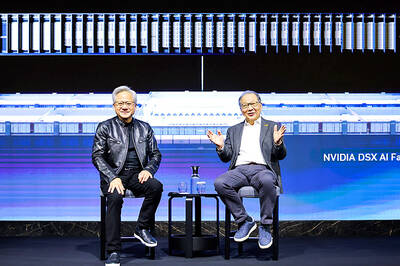
‘ON SCHEDULE’: Chief executive officer Rick Tsai said that TSMC ‘remains our most important partner’ as MediaTek seeks to meet robust customer demand Chip designer MediaTek Inc (聯發科) yesterday said it has secured a second customer for its customized artificial intelligence (AI) accelerator for data centers, while volume production of a second-generation chip for an existing customer is on track for early 2028, potentially easing market concerns about possible delays. This is a new customer and, crucially, not from China, MediaTek said. The remarks were meant to dismiss speculation that ByteDance Ltd (字節跳動), the parent company of TikTok, was the second customer for MediaTek’s new customized AI application-specific integrated circuit (ASIC) business. “It is on track, on schedule. We understand there is some noise about the

The artificial intelligence (AI) supercycle should last for more than two decades, former Intel Corp chief executive officer Pat Gelsinger told an event in Taipei yesterday, dismissing fears of an AI bubble amid mounting skepticism over massive infrastructure investments. “We do see that there will be periods of disruption, correction, etc. So, we do not think of it as an AI bubble,” Gelsinger, who is a general partner at Playground Global LLC, said at the US venture capital firm’s second annual Taiwan Deep Tech Summit. However, “we’ll have some speed bumps as different areas and different technology disruptions occur along it,” Gelsinger
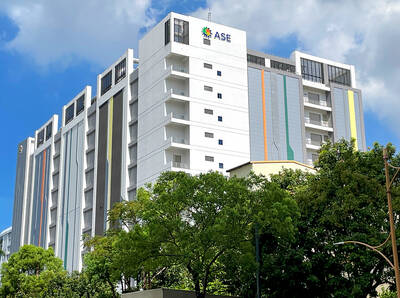
ROOM TO GROW: The company’s biggest bottleneck is still space, chief financial officer Joseph Tung said, adding that it was scouting existing factories to acquire ASE Technology Holding Co (日月光投控) yesterday raised its annual capital expenditure budget for the third time to US$11.5 billion, driven by expectations that customer demand next year would continue to outpace capacity, particularly for its leading-edge advanced packaging (LEAP) technologies used in artificial intelligence (AI) chips. ASE, the world’s biggest chip packaging and testing service provider, plans to add US$1 billion to its US$10.5 billion outlay on capacity expansion. About 60 percent of the US$500 million equipment budget would be allocated for LEAP and 40 percent for mainstream packaging technology capacity, ASE chief financial officer Joseph Tung (董宏思) told an online investors’


 RSS