

US liquefied natural gas (LNG) is expected to account for more than 20 percent of Taiwan’s LNG imports this year, up from 10 percent last year, and rise to 25 percent by 2029, Minister of Economic Affairs Kung Ming-hsin (龔明鑫) said yesterday.
If talks to purchase LNG from an Alaskan project proceed smoothly, supply could begin as early as 2032, potentially raising the US share in Taiwan’s LNG imports to 30 percent or more, Kung said.
Under a planned investment of up to US$4.4 billion in the project, CPC Corp, Taiwan (台灣中油) would purchase 6 million tonnes of LNG from Alaska annually once production begins, the ministry said.
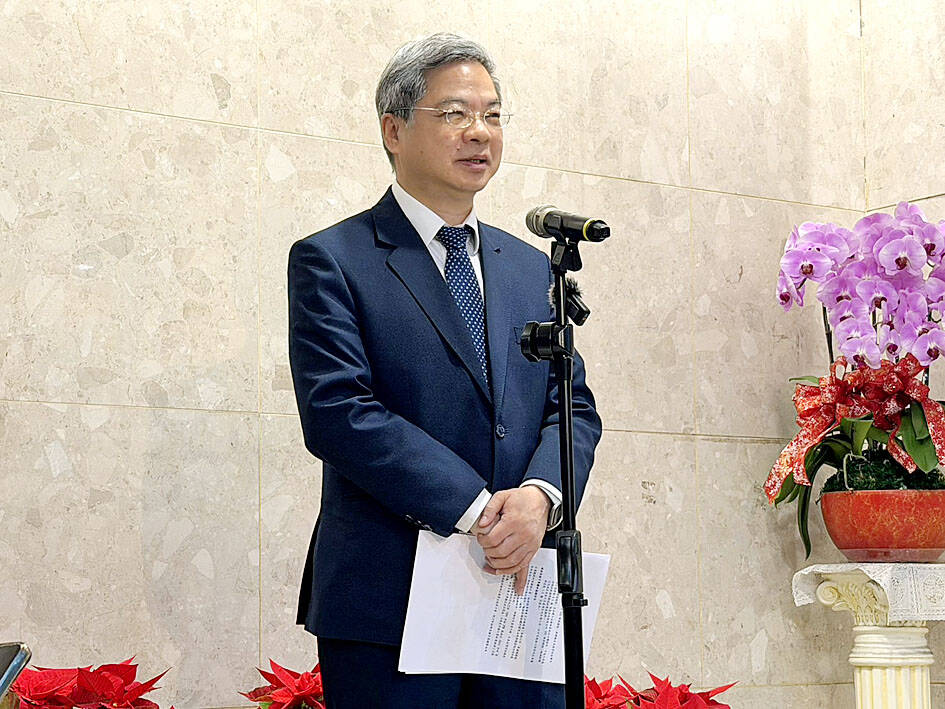
Photo: Lin Jing-hua, Taipei Times
As Taiwan’s natural gas demand continues to rise, with 25 additional large gas-fired power units expected to be added by 2035, the government needs to secure supplies in advance and diversify procurement sources to strengthen energy resilience, Kung said.
In addition, securing stable supplies through long-term contracts could help reduce price volatility in LNG imports, he said.
Alaska is also relatively close to Taiwan, with a shipping time of about 10 days, which could reduce transportation time and shipping risks, Kung said.
For the US$4.4 billion investment, the government has a preliminary plan and an investment ceiling, but the actual amount, equity stake and other terms still need to be determined through negotiations, he said.
Kung said he is confident in CPC’s ability to negotiate favorable investment terms, but declined to disclose pricing because of commercial confidentiality.
The source of funding for the investment would depend on the final investment structure, timetable and CPC’s financial position, and could include capital injections, capitalization of retained earnings or loans, he said.
Funds would also be committed in stages in line with project progress rather than paid in a lump sum, he said.
As Taiwan’s trade surplus with the US has widened, increasing energy purchases from the US could also help narrow the imbalance, Kung said.
Separately, asked about Pegatron Corp (和碩) chairman Tung Tzu-hsien’s (童子賢) suggestion of developing an artificial intelligence (AI) park in the Danhai New Town (淡海新市鎮) area of New Taipei City’s Tamsui District (淡水), Kung said it was “a pretty good idea.”
The area has advantages including large contiguous parcels of land, convenient transportation and access to labor, he said.
The Danjiang Bridge would also improve access to the Port of Taipei and provide links to Taiwan Taoyuan International Airport, improving the area’s transportation advantages, he said.
In contrast, Taipei Mayor Chiang Wan-an’s (蔣萬安) proposal to develop an AI park on the site of Taipei International Airport (Songshan airport) could remain in the discussion phase for another decade because opinions remain divided, Kung said.
Taiwan’s AI industry cannot afford to wait for a consensus before moving ahead, he added.

INFRINGEMENT: The investigation comes after a complaint from Vicor Corp, with the company seeking a limited exclusion order as well as cease-and-desist orders, the ITA said The US International Trade Commission (USITC) has launched a Section 337 investigation naming Taiwanese technology companies, including Hon Hai Precision Industry Co (鴻海), Delta Electronics Inc (台達電) and Quanta Computer Inc (廣達), as respondents. The Ministry of Economic Affairs (MOEA) pledged assistance if needed. The USITC said on Friday in a statement that it had voted to institute an investigation under Section 337 of the US Tariff Act of 1930 into certain vertical power delivery systems, related components and computing devices incorporating such systems. The investigation covers 20 companies from Taiwan, China, Germany and the US, the commission said, adding that it
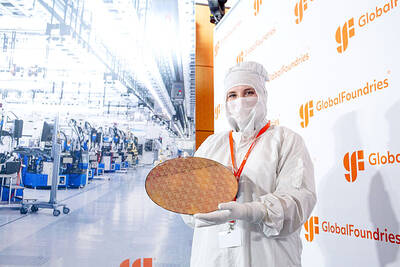
PACKAGING PUSH: The chipmaker said that it would begin ramping up silicon interposer production in New York in the first half of 2028 to support AI systems GlobalFoundries Inc shares gained as much as 7 percent after the chip manufacturer announced a five-year, US$2 billion deal to provide US production capacity to Taiwan Semiconductor Manufacturing Co (TSMC, 台積電). Under the agreement, announced on Thursday, GlobalFoundries is to help supply components known as silicon interposers. The US company is to rely on manufacturing at its facility in Malta, New York, and said it has the option to expand capacity “as customer demand grows.” An interposer is a small layer of silicon that sits between a chip and its packaging. It is home to the wires that carry electronic signals and
A man charged along with Super Micro Computer Inc co-founder Yih-Shyan “Wally” Liaw (廖益賢) of conspiring to send cutting-edge chips to China in violation of US export controls pleaded guilty, court documents said. Ting-Wei “Willy” Sun (孫廷瑋), a former outside contractor described by US authorities as a “fixer” who allegedly aided in the sales, pleaded guilty on Thursday at a hearing in federal court in New York as part of an agreement with prosecutors, court filings showed. Prosecutors claimed the men were part of a scheme to send Nvidia Corp-powered servers to an unnamed Southeast Asian company and then divert them to

Microsoft Corp chief executive officer Satya Nadella said companies should treat powerful artificial intelligence (AI) models as potential insider threats, assume they could be compromised and create an “emergency brake” system to prevent agentic models from going rogue. Nadella said that those deploying advanced AI should not rely on assurances from model makers. “We must assume a model is compromised and contain it from the start,” Nadella wrote on Saturday in a post on X. “Think of it like an emergency brake. An authorized person should always be able to pause or shut down a model mid-task.” The statement comes as Anthropic PBC


 RSS
RSS