

The halls of the Development Center for Ship Technology and Transport Systems (DST) in Duisburg, Germany are lined with model ships, small-scale prototypes of vessels that may end up working on Europe’s busiest waterway, the Rhine.
This year, DST’s researchers are focusing on how to cope with the conditions of the river. Water levels on the Rhine hit a record low this week, prolonging a shipping crisis caused by a summer of droughts across Europe. As climate change makes extreme weather conditions like this more likely, industries that relied on the river are having to adapt.
“Suddenly the Rhine becomes a source of uncertainty,” said DST researcher Cyril Alias, whose colleagues are working on vessels with smaller propellers and side-mounted wheels to help navigate shallower waters. “It’s crazy.”
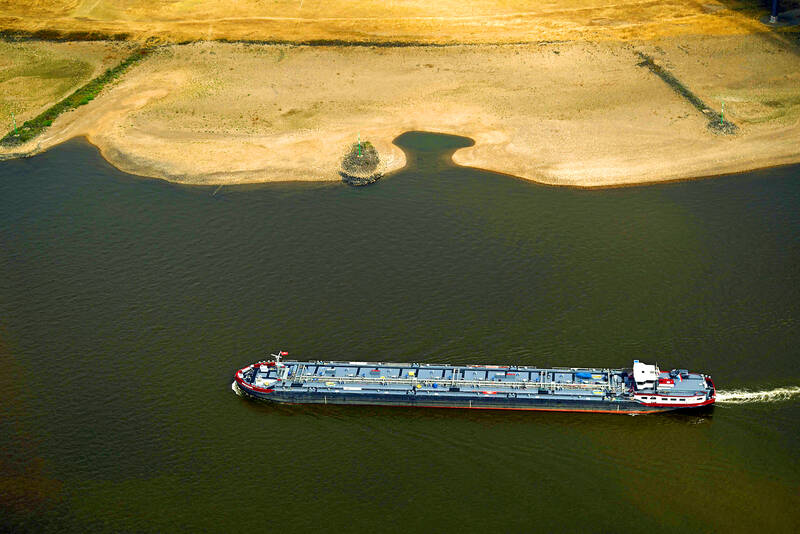
Photo: AFP
The Rhine is a vital artery connecting factories in Europe’s industrial heartland with global markets. Along the Rhine are major chemical plants, steelworks and refineries operated by companies including Covestro AG, BASF SE, Shell plc and Bayer.
With water levels at some points the lowest in records stretching back to the 1880s, companies are confronting the possibility that reliable access to the Rhine can no longer be taken for granted.
The months-long disruption has forced chemical producers to curb output or declare force majeure on some products, exposing a widening divide between companies that invested in resilience after past droughts and those that did not. Europe’s chemical industry is already grappling with weak demand, persistently high energy costs and growing competition from lower-cost producers in China and elsewhere.
“The chemical industry is already fighting for survival, so I understand why many companies haven’t made the necessary investments to protect themselves,” said Ruirui Zong-Ruhe, a partner at consultancy Roland Berger.
Low water levels on the Rhine are pushing up transport costs, as more barges are needed to move the same amount of cargo. Freight costs are about five times higher than at the start of the summer. Companies, including Lanxess AG and Shell, have shifted some shipments to rail and road, although these alternatives are also expensive.
The disruption has shown how industries can adapt. After a severe drought brought shipping to a near standstill in 2018, some companies invested in vessels designed specifically to navigate a shallower Rhine, as well as alternative rail and road links. Those investments are allowing them to keep goods moving this year even as conventional barges struggle.
Chemical giant BASF worked with logistics company HGK Group to develop a new generation of low-water vessel capable of carrying significantly more cargo in shallow conditions than traditional ships. BASF, which is building out alternative transport links at its Ludwigshafen complex, said it does not expect any “acute, major economic damage” from this year’s low water levels.
“The disruption has exposed a divide between companies that invested in resilience after the severe low-water episode of 2018 and those that did not,” Zong-Ruhe said.
The industry as a whole may struggle to rapidly adapt. Of just 13 low-draft vessels available in Germany, nine belong to HGK. Replacing the wider fleet would take time because ships typically have a lifespan of about 50 years and the sector is highly fragmented, with many vessels owned by small, often family-run operators.
“If we want to modernize the fleet, we must enable small and medium-sized enterprises and individual shipowners in particular to invest in the next generation of vessels,” said Steffen Bauer, chief executive officer of HGK, who called for government support.
The problem is unlikely to disappear with the changing season. Low water has persisted for over two months and could stretch into next month, according to Rico Luman, senior sector economist for transport and logistics at ING Groep NV. Forecasts show the barge clearance level at Kaub, a key Rhine choke point, could stay near record low levels this weekend. The gauge does not measure river depth, but helps operators determine how much cargo vessels can safely carry.
Companies have already started to work around the low-water constraints as much as possible, Luman said, but the record lows could still lead to new production cuts.
While companies are investing for an uncertain future, and technology can help them adapt, DST’s Alias warned that it is unlikely they can mitigate all the risks.
“You can prepare as much as you want, you still lose,” he said. “You can cushion the impact, but you can’t avoid it without consequences.”

Federal Reserve Bank of Philadelphia President Anna Paulson on Thursday joined the chorus of policymakers saying additional interest-rate increases may be needed to ensure inflation returns to the central bank’s 2 percent goal. “Looking ahead, if conditions evolve as I expect, some modest further tightening may be warranted,” Paulson said on Thursday at an event in Philadelphia. Earlier on Thursday, New York Fed President John Williams said he and his colleagues “still have a lot of work to do” in dealing with lingering inflation risks. Several other officials have aired similar comments, in line with the signal given last week when policymakers voted
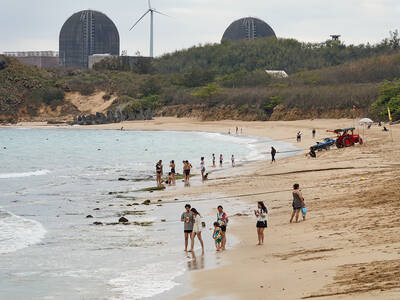
COURSE CHANGE: The shift comes amid pressure from chipmakers for stable, low-carbon electricity. Officials said Ma-anshan could be restarted as early as 2028 Taiwan has approved a preliminary plan to restart an idled atomic power plant, marking a reversal of the ruling party’s anti-nuclear stance as the nation pursues greater energy security. The Nuclear Safety Commission has cleared its review of an initial proposal to restart the Ma-anshan Nuclear Power Plant, it said in a statement on Thursday. Taiwan Power Co (台電) will still need to carry out follow-up work including safety inspections, before submitting another report on implementation for review, the commission said. The earliest the plant could resume operations is 2028, according to previous reports in local media, citing Minister of Economic Affairs

MINIMAL EXPECTATIONS: Analysts think that the two sides are likely to aim for ‘status quo’-level agreements, maintaining civility, without major trade breakthroughs US Secretary of the Treasury Scott Bessent and Chinese Vice Premier He Lifeng (何立峰) were set to meet yesterday to try to set up potential agreements on artificial intelligence (AI), tariffs and critical minerals for a summit in Washington this week between US President Donald Trump and Chinese President Xi Jinping (習近平). The meetings at JPMorgan Chase & Co’s headquarters in Manhattan, which included US Trade Representative Jamieson Greer, were due to start at about 10:30am on Sunday morning and were expected to run all day. Key topics would be the status of a US-China trade truce that is set to expire
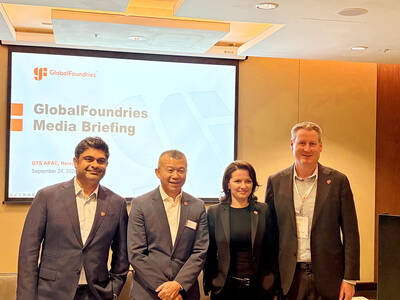
GlobalFoundries Inc yesterday said it plans to accelerate global capacity optimization and expansion to accommodate exponential growth in radio frequency (RF) and other chips driven by the artificial intelligence (AI) boom. Singapore will pay a vital role in the company’s capacity expansion, alongside production line optimizations across its manufacturing sites, GlobalFoundries Asia Pacific head Vincent Feng (范曾文) told a news conference in Hsinchu City. “Many might be surprised to hear that the RF market is thriving now. We are gearing up for a massive capacity expansion, and it is all being driven by AI,” Feng said. He declined to disclose details of the


 RSS
RSS