

In the coastal Gambian town of Tanji, Sirah Darboe-Manneh cleans fish next to a row of ice boxes laying empty because of relentless power cuts. With limited supplies of ice, storing the daily catch has become almost impossible.
Since June the tiny west African nation has been hobbled by prolonged blackouts, which have reached a fever pitch in recent weeks, right at the peak of the hot season.
Two nights of chaotic, spontaneous protests broke out last week with demonstrators blocking roads and calling for Gambian President Adama Barrow to step down, just months before he runs for a third term.
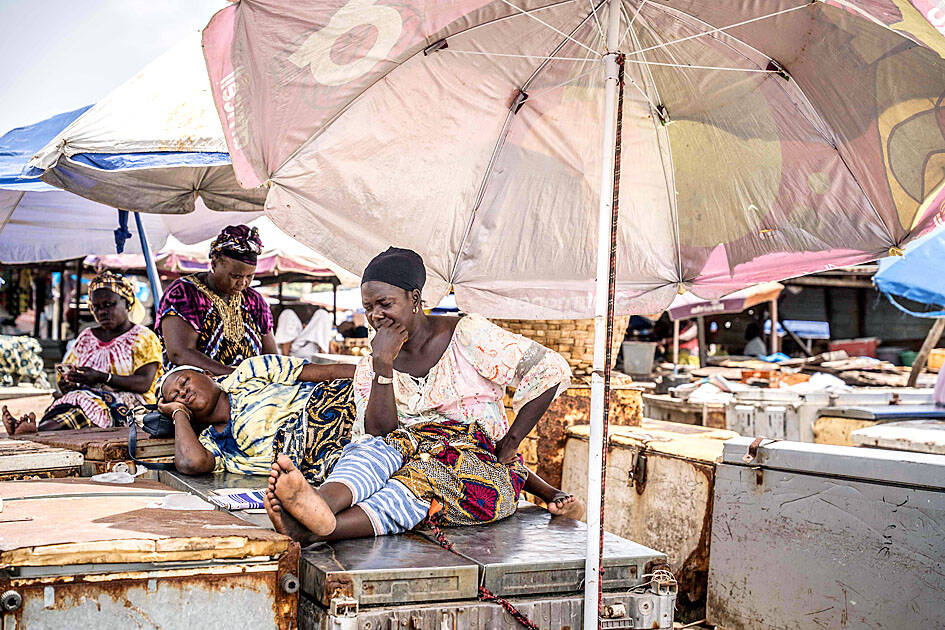
Photo: AFP
The outages which have sometimes lasted 12 to 48 hours have plunged those living in the deeply impoverished country into steaming darkness at night.
Businesses have shuttered, hospitals have had to turn to generators that have occasionally faltered, and residents have been scrambling to charge phones and refrigerate food. In some locations, water supply has been cut for up to 24 hours.
In Tanji, home to the Gambia’s largest fish landing, the stench of rotting catch is becoming an issue.
“The customers are not forthcoming. They are not buying fish anymore because they don’t have a place to keep it,” Darboe-Manneh, who works as a monger, told reporters while she cleaned the scales from a local species known as sompato.
That in turn means the 31-year-old mother of six has not had money for her children’s school supplies as the new academic year begins.
The cost of ice has more than doubled, Darboe-Manneh said, as the ice vendors — who often make it in home freezers — do not have electricity.
In the sweltering heat, fellow fish vendor Faraba Fatty stated bluntly that “without electricity, we have a very bad life.”
The 58-year-old has 13 children, but said he might “sit the whole day without selling anything.”
The outages come just months ahead of the Gambia’s Dec. 5 elections.
As anger mounts, Barrow has promised the electricity situation will improve by the end of next month.
Gambian Vice President Muhammed Jallow said during a visit to a transmitter substation in the town of Bijilo on Sept. 12 that Barrow has set up a taskforce that is “meeting literally on a daily basis.”
In the short term, the Gambia must make sure that “everything comes back normal” before implementing a “long-term sustainable strategy,” he said.
A 24 megawatt (MW) generator will be commissioned by the end of next month in Brikama, not far from the capital, Banjul, Barrow said in a TV address last week.
Meanwhile a contract for a 50MW solar power plant in Soma has also been awarded, he said.
People stop by Amadou Gaye’s shack at the market in the western town of Sukuta to use his small electric mill to grind millet for cooking porridge or the local steamed grain dish called chere.
However, he is unable to run the machine without power.
“People depend on millet for livelihood. We depend on electricity for livelihood,” the 40-year-old told reporters.
In the Gambia, the money people use to feed their families is known colloquially as “fish money.” It is used to purchase ingredients like meat, chicken or fish.
Pointing out that everything is “intertwined,” Gaye is now less able to buy fish from mongers like Darboe-Manneh.
The Gambia’s energy provider, National Water and Electricity Co (NAWEC), in the middle of last month said the blackouts were due to surges in demand, mainly because of high temperatures, combined with “constraints on electricity imports” and a technical incident.
In June, Barrow said that the Gambia owed money to Senegal’s public electricity provider, Senelec, and that the financial strain has complicated efforts to stabilize the power supply.
“We cannot deny that NAWEC is indebted to Senelec and this is affecting our ability to deliver consistent electricity to Gambians,” he said.
That has meant that tailor Ebrima Camara, 31, has had to sew using a foot-pedal machine rather than his usual electric model as he struggles to complete orders for school uniforms for the new year.
“Using foot-pedaling to sew uniforms is very hard because it is slow,” he told reporters.
It is bad timing for Camara, but it is also bad timing for Barrow.
Although many Gambians have chafed at his bid for a third term, he was seen as the country’s most viable candidate until the recent electricity problems.
Now his fate lies in the hands of those such as Camara, who is frenetically pedaling late into the night to make ends meet.
“It’s very, very hard. It’s very painful, but I don’t have a choice,” Camara said.
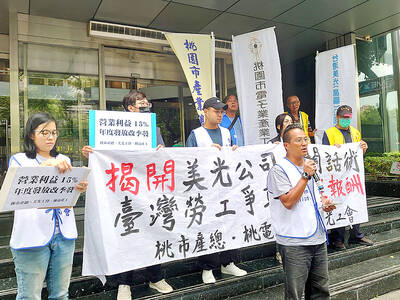
UNION DETERMINATION: Rejecting an offer for a one-time payout as an attempt to influence opinion, the union said a strike at the memory chip manufacturer is possible The Micron Taiwan workers’ union yesterday rejected a one-time payout unveiled by US-based Micron Technology Inc last week, saying it wants a long-term mechanism under which employees would share 15 percent of the company’s operating profits. While the union and the company are still in talks over the dispute, the reward package was proposed unilaterally by the employer without reaching an agreement with the union, union head Jerry Lin (林哲瑞) told reporters. Lin said he suspected the company was seeking to influence public opinion with the move. On Friday last week, Micron announced a reward package under which employees in Taiwan would receive

BUILDER’s RITES: The topping out ceremony is held when a project being built has its highest point laid out, a sure sign that TSMC’s European project is making solid progress A “topping out” ceremony was held on Monday at a plant under construction in Germany by Taiwan Semiconductor Manufacturing Co (TSMC, 台積電), indicating that the fab is progressing as planned and within budget, the head of a joint-venture company in charge of the project said. A topping out ceremony is the construction milestone of laying the final beam or structural piece at the highest point of a building, and it honors the construction crew, architects and engineers. European Semiconductor Manufacturing Co (ESMC) president Christian Koitzsch said that about 2,000 workers from 106 countries are working around the clock at the site in

SOME CUSHION: Taiwan’s GDP is forecast to grow more than 11 percent this year, so the economy should be able to absorb the impact of a rate hike, an expert said With domestic inflation topping the 2 percent alert level for a fourth consecutive month last month and several major central banks around the world raising their key interest rates, Taiwan’s central bank is facing growing pressure to raise rates at its quarterly policymaking meeting on Thursday, economists said. At its June meeting, the central bank left interest rates unchanged for the ninth consecutive quarter, with the discount rate at 2 percent. Central Bank Governor Yang Chin-long (楊金龍) had said that the bank maintained a somewhat hawkish stance, with two board directors voicing support for a rate hike at the meeting. Cathay United

APPEAL: Any agreement to produce advanced memory such as HBM or DRAM could run into opposition from Seoul as those technologies are sensitive, sources said South Korea’s SK Hynix Inc is in talks with Intel Corp about a deal that would see it manufacture memory chips on US soil for the first time, three people familiar with the discussions said. Under one potential scenario, SK Hynix would lease part of Intel’s long-planned chipmaking facility in Ohio, they said. Under another scenario, it could form a venture with Intel and major cloud firms that are keen to lock in memory supplies, two of the people said. A deal would relieve pressure on Intel, which has been struggling, and mark a big win for US President Donald


 RSS
RSS