

Taiwan Semiconductor Manufacturing Co (TSMC, 台積電) is accelerating capacity expansion fivefold this year, but it is still unable to keep up with the booming demand for artificial intelligence (AI), TSMC deputy cochief operating officer Cliff Hou (侯永清) said yesterday.
This year alone, the company is building 25 chip manufacturing fabs and advanced packaging facilities worldwide, including 13 plants in Taiwan, which is unprecedented, Hou said at a CEO Summit fireside chat at Semicon Taiwan in Taipei.
In the past, the company was able to build five or six factories a year, said Hou, who is also chairman of the Taiwan Semiconductor Industry Association.
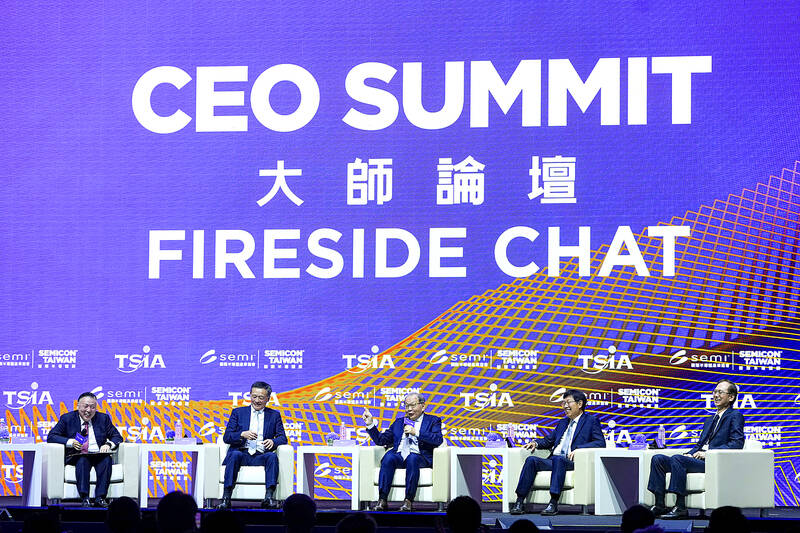
Photo: CNA
As exponential scaling of AI relies on advancing computational capacity and optimizing power efficiency, customers are showing much faster demand for advanced process technologies, packaging technologies and system performance than ever before, he said.
“Compared with the pattern 30 years ago, we have never seen the demand increase that much, that frequency of changes,” Hou said.
TSMC has twice raised its capital expenditure budget for this year within six months, expanding its overall outlays by about 90 percent from an estimate made at the end of last year, he said.
TSMC is not the only company facing the pressure of supply constraints, Hou said.
The whole AI supply chain is doubling down on capacity expansion to solve supply issues, he said.
At the fireside chat, MediaTek Inc (聯發科) chief executive officer Rick Tsai (蔡力行) said his company had asked for more capacity from next year to 2029 from TSMC and ASE Technology Holding Co (日月光投控), the world’s biggest chip packager, to address the supply constraints.
MediaTek, the world’s biggest smartphone chip designer, is as an AI accelerator designer for cloud service providers.
The company, based in the Hsinchu Science Park (新竹科學園區), has secured stable chip supply from TSMC, Tsai said.
He said the company’s latest strategic collaborations with Nvidia Corp would have a positive impact on its AI custom chip business, using Nvidia’s NVLink Fusion technology, which is used to connect server racks at high speed.
On Monday, Nvidia announced a US$3.5 billion investment in MediaTek’s corporate bonds, which Tsai said was a vote of confidence in his company.
MediaTek maintained its AI custom chip revenue target of US$2 billion in the next quarter.
At the same event, Hon Hai Precision Industry Co (鴻海精密) chairman Young Liu (劉揚偉) said Taiwan’s technology sector should shift from concentrating production at home to a "made with Taiwan" model as surging AI demand and geopolitical pressures reshape global supply chains.
Customers increasingly want production distributed across countries to reduce risks, while governments want more of the products they consume to be manufactured domestically, Liu said. Therefore, Taiwanese companies are expanding abroad to meet both customer demand and host countries’ localization needs, he said.
"We all have to think about how to make with Taiwan, not in Taiwan," Liu said.
Taiwan’s culture, education system and stable government policies have made it particularly capable of delivering both quality and speed, he said. Taiwanese companies could apply those strengths while moving some production to countries where their products are used, he added.
MediaTek’s Tsai said that Taiwan’s advantage lies in its combination of technological capability, flexibility and speed, which has enabled its companies to support customers through successive waves of innovation, from personal computers and mobile phones to AI.
Taiwan’s supply chain is already "a global Taiwan" rather than a purely domestic operation, Tsai said, adding that local companies could continue expanding internationally and work with overseas partners in areas where they lack capabilities.
Unimicron Technology Corp (欣興電子) chairman Chien Shan-chieh (簡山傑) said AI demand has intensified a shortage of semiconductor substrates while creating requirements for larger and more complex designs.
The industry depends on suppliers of critical tools and materials, many of them small and medium-sized Japanese companies facing their own capacity pressures, Chien said.
SEMI international board chairman and ASE chief operating officer Tien Wu (吳田玉), who moderated the fireside chat, cited that dependence in advocating for cooperation throughout the semiconductor ecosystem.
"Again and again, collaborate because we cannot do this alone," Wu said. "Our dependency goes beyond comprehension."
Additional reporting by CNA

Silicon photonics would play a dominant role next year and make chip-level co-packaged optics (CPO) packaging possible, Taiwan Semiconductor Manufacturing Co (TSMC, 台積電) said yesterday. “For years, critics questioned the reliability of CPO. The doubts are being thoroughly dismantled by real-world data and market validation,” TSMC vice president of advanced packaging technology development K.C. Hsu (徐國晉) said at a SEMI forum in Taipei. The company is on track to enter production of CPO later this year, Hsu said in another forum arranged by Imec in Taipei yesterday, about four months after TSMC announced its progress in CPO development in May.
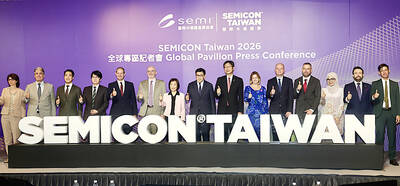
EXPANDING: Firms are accelerating commercialization of the technologies as the industry moves beyond chip-level speeds to upgrading rack-to-rack links, SEMI said Silicon photonics and copackaged optics (CPO), technologies seen as critical to meeting the surging bandwidth demands of artificial intelligence (AI) infrastructure, would be among the main themes at the Semicon Taiwan trade show, which opens on Wednesday, event organizer SEMI said yesterday. The forum runs until Friday at the Taipei Nangang Exhibition Center, with technical forums beginning today. The event is expected to set a record in terms of the number of participants, SEMI said, projecting more than 1,300 exhibitors from 65 countries across 4,300 booths and more than 100,000 attendees. Optical interconnects underpinning AI infrastructure would be one of the highlights, with

In China’s hilly Guizhou Province, a cluster of European-style buildings complete with clock tower and multi-arched bridge emits a low, permanent hum — a clue to its unexpected identity as tech giant Huawei’s largest data center. The town-like complex is unique in design, but not in its placement. Dozens of data centers have been constructed in the southwestern province in the past few years. They are part of a government strategy that has seen much of the digital infrastructure for breakneck artificial intelligence (AI) development across China’s eastern seaboard established in the country’s less populated, rural west. The build-out is ongoing. China
Taiwan Semiconductor Manufacturing Co (TSMC, 台積電) has increased its second-quarter employee bonuses by more than 50 percent from a year earlier, as the world’s largest contract chipmaker posted record earnings in the three-month period. TSMC distributed its second-quarter bonuses to employees on Friday. Employee bonuses for the April-to-June period totaled NT$36 billion (US$1.14 billion), the chipmaker’s financial data showed. During the period, TSMC posted NT$706.56 billion in net profit, up 77.4 percent from a year earlier and 23.4 percent from a quarter earlier. Second-quarter earnings per share (EPS) rose to NT$27.25, compared with NT$15.36 a year earlier and NT$22.08 in the first


 RSS
RSS