

Export orders last month rose 61.9 percent year-on-year to a record US$97.94 billion, marking the 18th consecutive month of increases, the Ministry of Economic Affairs said yesterday.
The expansion accelerated from the 59.4 percent annual increase in June and exceeded the ministry’s forecast of a 54.5 to 57.8 percent increase for last month. It also beat DBS Bank Ltd’s estimate of a 56.6 percent rise.
Export orders — including those received by Taiwanese firms and produced domestically or abroad — are an indicator of product and component shipments to overseas markets ahead of customs clearance by one to three months.
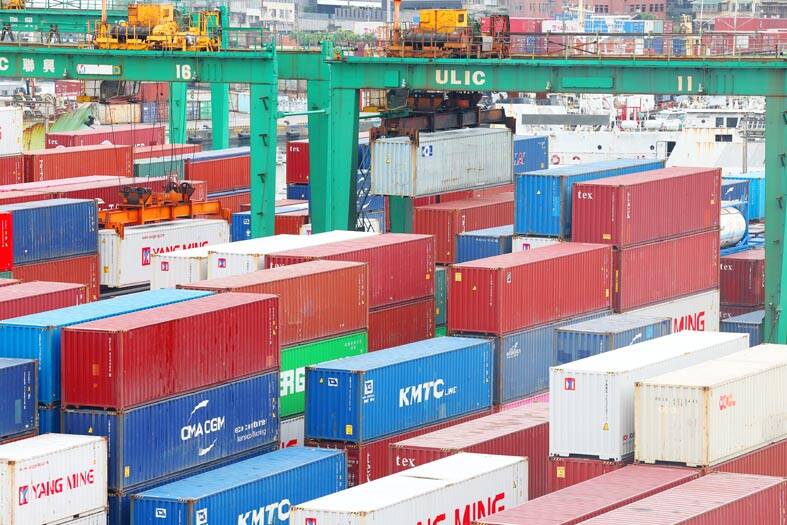
Photo: CNA
Last month, 45.6 percent of all orders received by firms were produced overseas, down 0.6 percentage points from a year earlier, as makers of information and communications technology (ICT) products boosted domestic production, the ministry said in a report.
The stronger-than-expected performance last month reinforces the view that demand for applications related to artificial intelligence (AI), high-performance computing and cloud services remains strong, supporting growth across related supply chains, the ministry said.
Orders for ICT products (including servers) increased 89.5 percent, and electronic products (including thermal components) climbed 71.7 percent year-on-year last month, benefiting from the rapid development of AI applications, the ministry said.
However, orders for optoelectronic products decreased 10.6 percent due to weak demand for flat panels, it said.
Traditional industries benefitted from semiconductor firms’ capacity expansion and rising copper and steel demand amid the AI boom. Orders for machinery and base metals increased 31.3 percent and 24.3 percent respectively, the ministry said.
Orders for chemicals edged up 0.2 percent due to a high comparison base last year, and those for plastic and rubber products rose 3.2 percent on inventory replenishment demand, it said.
By destination, orders last month from the US registered the largest annual increase of 88.9 percent, followed by increases of 61.1 percent from ASEAN and 47.2 percent from China (including Hong Kong), the ministry said.
Orders from Japan grew 37.1 percent and those from Europe were up 33.1 percent, it said.
Spurred by last month’s strong performance, cumulative orders in the first seven months of the year grew 52.5 percent to a record US$602.03 billion, the ministry said.
Last month’s order growth is expected to carry on into this month, as the ministry-compiled diffusion index of export orders — a gauge of manufacturers’ expectations on orders for the following month — surpassed the neutral level to 51.3, suggesting that firms remain confident about the business outlook as August marks the start of the peak season for consumer electronics in the second half of the year.
As a result, orders are forecast to increase 61.4 to 64.8 percent year-on-year to between US$97 billion and US$99 billion this month, and the figure could top US$100 billion next month if demand for smartphones proves strong, it said.
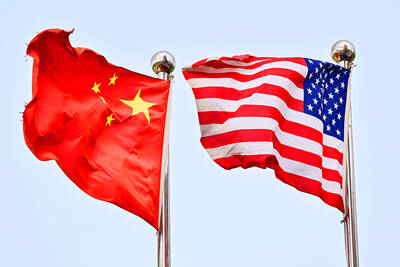
RIVAL BLOCS: Kazakhstan has signed on to the US’ and China’s AI frameworks; a US official said it was difficult to see how a country can be trusted while in a competing pact The US is preparing to tell dozens of countries they must pick sides in the artificial intelligence (AI) race with China, warning they would be excluded from a US-led AI coalition if they also sign up for Beijing’s competing framework, according to a US official and an internal draft reviewed by Reuters. Washington last year launched the Pax Silica initiative aimed at securing supply chains for AI models, semiconductors and critical minerals, amid a fierce technology rivalry with Beijing. About two dozen countries have joined, including Kazakhstan, a key potential source of critical minerals that has also joined China’s coalition,
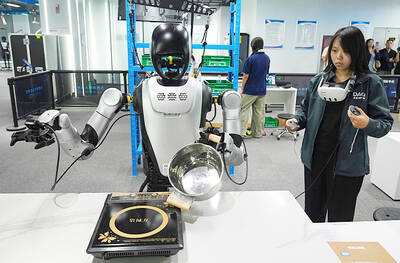
Taiwan and other technology democracies have a "golden but narrowing" three-to-five-year window to lay the foundations for an advanced robotics supply chain outside China, particularly for humanoid robots, a Taiwan-based researcher said yesterday. A report released on Monday by the Research Institute for Democracy, Society and Emerging Technology (DSET) examines China-West competition in physical artificial intelligence (AI) and Taiwan’s potential role in developing alternatives to Chinese robot supply chains. Humanoid robots remain unproven, meaning China’s lead in shipments currently has a limited impact on the real economy, Nathanael Cheng (鄭秉信), a policy analyst in the DSET Economic Security Program, said in a
Outbound investments approved by Taiwan’s government surged more than 200 percent from the year before during the January to July period largely due to Taiwan Semiconductor Manufacturing Co (TSMC, 台積電) spending heavily overseas, the Ministry of Economic Affairs reported on Monday. The Department of Investment Review approved US$61.26 billion of outbound investment in 395 applications during the first seven months of this year, up 208.43 percent from a year earlier, the ministry said in a statement. Significant growth came after TSMC, the world’s largest contract chipmaker, secured approval to raise capital investments by US$20 billion in its US subsidiary TSMC Arizona Corp,
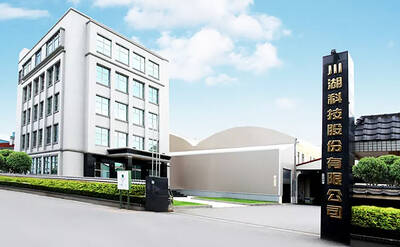
Shares in King Slide Works Co (川湖科技), a supplier of rail kits used in servers, rose by the 10 percent daily limit to close at a record high of NT$13,750 yesterday, making the company’s founder and chairman Lin Tsung-chi (林聰吉) Taiwan’s richest person for the time being. According to Forbes’ real-time billionaires list, Lin’s net worth increased by US$1.8 billion to US$19.5 billion yesterday, surpassing Yageo Corp (國巨) founder and chairman Pierre Chen (陳泰銘), who has a net worth of US$17.4 billion, to become the richest person in Taiwan and rank 140th globally. The stock’s rally came as the company on Friday


 RSS
RSS