

Industrial PC maker Nexcom International Co (新漢) remains cautiously optimistic about its business performance in the second half of this year, given its solid order backlog, company chairman Clement Lin (林茂昌) said yesterday.
“We have emerged from the downturn, and our business performance should continue to improve going forward,” he said.
The company’s revenue in the first quarter fell 30.49 percent year-on-year to NT$1.15 billion (US$36.01 million) as several customers delayed orders.
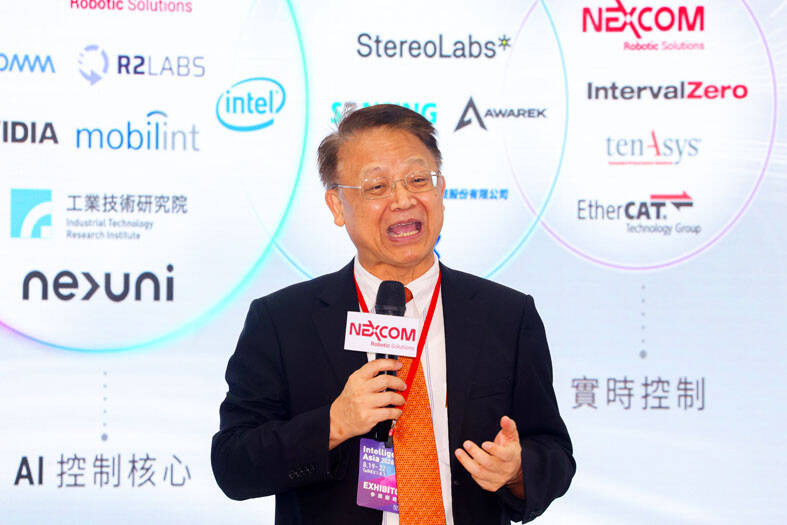
Photo: CNA
Revenue in the second quarter rebounded 13 percent year-on-year to NT$1.68 billion, with growth continuing, Lin said.
Nexcom unveiled its “RoboWIZ Artificial Intelligence (AI) Robot Open Platform” for the development of humanoid, quadruped and dual-arm robots during the the Taipei International Industrial Automation Exhibition yesterday at the Taipei Nangang Exhibition Center.
The platform brings together dozens of ecosystem partners, including the Industrial Technology Research Institute, Compal Electronics Inc (仁寶) and Germany-based motion control supplier Synapticon GmbH.
Nexcom’s robotics business is mainly developed through its subsidiary, NexCOBOT Co (創博).
NexCOBOT’s orders surged 80 percent year-on-year in the first half, while shipments rose 30 percent, with strong growth momentum expected to continue in the second half, company president Jenny Shen (沈倩怡) said.
Growth is being driven mainly by strong demand for AI controllers that integrate high-level AI computing and motion controllers for dual-arm robots mounted on mobile platforms, Shen said.
Functional safety controllers for collaborative and humanoid robots are another major growth driver, she said.
AI controllers account for about 30 percent of NexCOBOT’s revenue, and the share is expected to rise significantly next year as safety certifications, software integration and data collection progress, she added.
Asked about the timeline for volume production of AI and humanoid robots, Lin said industrial customers tend to be highly conservative.
Significant volume production of such robots could begin in the next few quarters, but actual deployments still depend on customer demand, he said.
Traditional robotic arms and automation equipment would remain Nexcom’s main revenue sources this year, with most AI and humanoid robot projects still in the sampling and specification-integration stages, he added.
Nexcom is integrating AI, robotics and industrial equipment to develop uncrewed production lines and smart factories, while offering its modular production management platform, “NexAI Assistant,” to lower adoption barriers for small and medium-sized manufacturers, Lin said.
The company plans to work with other Taiwanese makers to jointly expand to global markets, he added.

E.Sun Financial Holding Co (玉山金控) is to formally merge with Mercuries Life Insurance Co (三商美邦人壽) on Sept. 1, creating Taiwan’s fifth-largest listed financial holding company by assets and paving the way for capital injections totaling NT$22 billion (US$683.91 million) to shore up the insurer’s finances, top executives said yesterday. “The first priority after the merger will be to bring the insurer back to health through capital injections,” E.Sun Financial chairman Joseph Huang (黃男州) told a news conference in Taipei ahead of a company earnings call. E.Sun would inject NT$16 billion into Mercuries Life next month, followed by another NT$6 billion next year,

RIVAL BLOCS: Kazakhstan has signed on to the US’ and China’s AI frameworks; a US official said it was difficult to see how a country can be trusted while in a competing pact The US is preparing to tell dozens of countries they must pick sides in the artificial intelligence (AI) race with China, warning they would be excluded from a US-led AI coalition if they also sign up for Beijing’s competing framework, according to a US official and an internal draft reviewed by Reuters. Washington last year launched the Pax Silica initiative aimed at securing supply chains for AI models, semiconductors and critical minerals, amid a fierce technology rivalry with Beijing. About two dozen countries have joined, including Kazakhstan, a key potential source of critical minerals that has also joined China’s coalition,
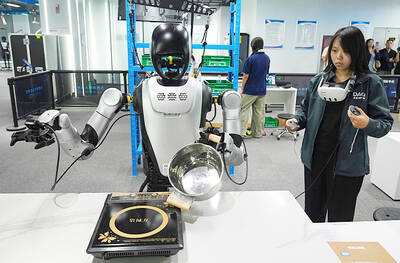
Taiwan and other technology democracies have a "golden but narrowing" three-to-five-year window to lay the foundations for an advanced robotics supply chain outside China, particularly for humanoid robots, a Taiwan-based researcher said yesterday. A report released on Monday by the Research Institute for Democracy, Society and Emerging Technology (DSET) examines China-West competition in physical artificial intelligence (AI) and Taiwan’s potential role in developing alternatives to Chinese robot supply chains. Humanoid robots remain unproven, meaning China’s lead in shipments currently has a limited impact on the real economy, Nathanael Cheng (鄭秉信), a policy analyst in the DSET Economic Security Program, said in a
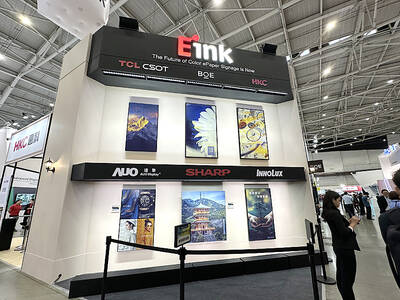
E-PAPER TRANSITION: Increasing memory prices have caused customers to postpone new product launches, with the firm expecting a later peak season this year E Ink Holdings Inc (元太科技), the world’s biggest e-paper display supplier, yesterday revised downward its revenue growth forecast for this year to between 10 and 15 percent, from the 20 to 25 percent it previously estimated, as surging memory prices are hurting demand for its e-readers and e-notes. The company had expected a transition from monochrome color e-paper displays to color displays used in e-readers and e-notes to continue this year. However, rapidly increasing memory prices have caused customers to postpone new product launches, while demand for models from previous generations has also dwindled due to higher prices, E Ink said. That created


 RSS
RSS