

On a 0.8 hectare farm outside Bengaluru, India, Billy, Jessie and Banu put on their gear, enter a laboratory packed with samples and clock in for a shift detecting early signs of cancer.
Their most important diagnostic equipment is their noses.
Billy, Jessie and Banu are part of a team of beagles, labradors, Dutch shepherds and other dog breeds being trained by start-up Dognosis to sniff out traces of cancer in human breath.
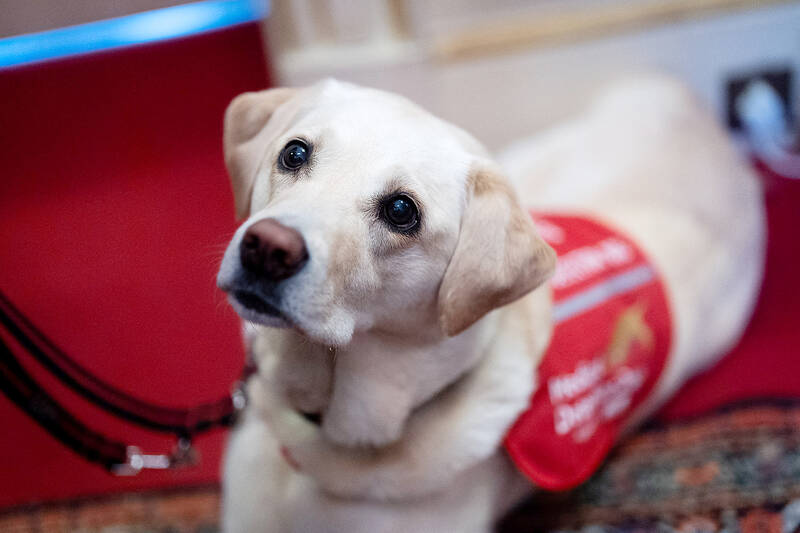
Photo: Reuters
Dognosis is repurposing the canine sense of smell — traditionally used to detect drugs or explosives — for low-cost health screening and aiming to make early detection accessible to far more people.
Dogs have previously been shown to detect illnesses ranging from cancer to COVID-19, and the two-year-old company aims to apply that capability at scale in India. It joins a small set of start-ups harnessing dogs’ olfactory abilities to develop a non-invasive diagnostic tool.
Patients breathe into masks sent to the company’s facility, where dogs are exposed to the sample. Sensors and artificial intelligence (AI) then interpret signals including the animals’ movements, respiration, brain activity and body language to determine whether the sample carries signs of cancer — without imaging scans, blood tests or biopsies.
“It is like finding a needle in a haystack of who in a population has an undiagnosed case of cancer,” cofounder Akash Kulgod said.
Its backers include early stage investors such as Accel India and San Francisco-based Caffeinated Capital. They raised US$1.5 million via a preseed round in 2024 and then an undisclosed sum recently. This is enough for the next two years if the firm sticks to its planned growth trajectory, Kulgod said.
The dogs live together at Dognosis’ farm and laboratory, are given walks and playtime, and spend 30 minutes to an hour a day on the detection platform, where the work is designed as a game. Their reward: treats.
During one recent session, two-year-old beagle Whiskey worked through 10 samples, bounding past the first five. At the sixth, she paused, sniffed, moved away and returned, circling for several seconds before the system marked it positive.
In a Phase 2 study published in the Journal of Clinical Oncology, Dognosis reported about 90 percent sensitivity for early-stage cancers across seven broad groups spanning more than 20 cancer types.
The dogs also seem capable of expanding their detection abilities: Trained on the scent of 10 cancer types, they identified an 11th they had not encountered before, Kulgod said.
The bigger test now is proving that performance holds up outside controlled trials. India has the third-highest prevalence of new cancer cases globally, while routine screening remains exceedingly rare, the International Agency for Research on Cancer said.
The agency estimated 1.5 million new cancer cases and more than 900,000 deaths from the disease in India in 2024.
About one in 10 Indians are at risk of developing the disease before age 75. Breast cancer was the most commonly diagnosed type, followed by cancers of the lip and oral cavity, lung and cervix.
Yet only 1.9 percent of Indian women surveyed in 2019-2021 said they had ever been screened for cervical cancer, while 0.9 percent had undergone exams for breast or oral cancer. Among men, just 1.2 percent reported having undergone oral cancer screening.
Against the backdrop, Dognosis plans to launch an at-home, multi-cancer prescreening test in India next year.
Dognosis aims to process 1 million tests a year, double its canine workforce to 30 and halve turnaround times to one week. It is also eyeing the US, where Kulgod said it could open a facility by late next year or early 2028.
New Jersey start-up SpotitEarly has reported similar results from canine cancer-detection trials, although such testing has yet to be commercialized.
Getting there would mean showing that accuracy holds across larger, more varied populations, while building the logistics to move and process huge numbers of breath samples. It would also require persuading doctors and patients to trust a screening system built around dogs.
Emerging technologies “offer exciting opportunities, but they should strengthen — not replace — existing screening programs,” said Pankaj Chaturvedi, deputy director of the Centre for Cancer Epidemiology at Tata Memorial Centre in Mumbai.
Dognosis is forging ahead, having started its Phase 3 trial in April with 10 hospitals — and plans to recruit about 10,000 people over 12 months. The study would test asymptomatic people at higher risk of cancer and survivors at risk of recurrence, and those flagged would receive conventional follow-up including imaging and biopsy.
If the results stand, it plans to launch in Bengaluru next year before expanding across India through partnerships with diagnostic chains and healthcare providers. Kulgod said the test does not need Indian regulatory approval as it’s a prescreening tool, rather than a diagnostic device. Only the latter is regulated in India.
“A lot of people recognize we are already depending on dogs in life and death situations,” he said. “The bottleneck all along was: How do you standardize and scale the dog’s nose?”
South Korea’s SK Hynix Inc is considering options for its Chongqing, China-based facility, including bringing in an investor to help accelerate growth, people with knowledge of the matter said. The company, a key supplier of high-bandwidth memory chips to Nvidia Corp, is speaking with prospective advisers to help review the business, the people said, asking not to be identified discussing private information. A potential stake sale could value the facility at about US$3 billion, the people said. The Chongqing facility provides a large scale semiconductor packaging and testing base, helping boost the company’s NAND flash back-end production to grow globally. Suitors may include

E.Sun Financial Holding Co (玉山金控) is to formally merge with Mercuries Life Insurance Co (三商美邦人壽) on Sept. 1, creating Taiwan’s fifth-largest listed financial holding company by assets and paving the way for capital injections totaling NT$22 billion (US$683.91 million) to shore up the insurer’s finances, top executives said yesterday. “The first priority after the merger will be to bring the insurer back to health through capital injections,” E.Sun Financial chairman Joseph Huang (黃男州) told a news conference in Taipei ahead of a company earnings call. E.Sun would inject NT$16 billion into Mercuries Life next month, followed by another NT$6 billion next year,

WELL MATCHED: The joint venture would lower Sony’s spending burden to stay relevant in chips, while TSMC secures steady revenue, said an analyst, calling it ‘virtually risk-free’ Taiwan Semiconductor Manufacturing Co (TSMC, 台積電) and Sony Group Corp are in talks to spend a combined ¥1 trillion (US$6.3 billion) on their planned image sensor factory in Japan, a person familiar with the matter said. The companies are seeking to begin production in 2029, the person said, asking not to be named because the talks are private. No time frame was given for the investment under discussion, they said. TSMC and the Japanese company’s chip arm, Sony Semiconductor Solutions Corp, are eyeing demand for artificial intelligence (AI)-wielding robots and self-driving vehicles, which are expected to require more sensors to

Taiwan Semiconductor Manufacturing Co (TSMC, 台積電) yesterday said its board of directors has approved investment of ¥282 billion (US$1.77 billion) to form a joint venture with Sony Semiconductor Solutions Corp to develop and manufacture next-generation image sensors for smartphones in Japan. The joint venture, Advanced Vision Semiconductor Manufacturing Corp, would be sited in Koshi City, Kumamoto Prefecture, TSMC said in a statement. It should commence volume production in 2029, TSMC said. Sony Semiconductor would invest ¥465 billion in the joint venture through a combination of cash and assets, the statement said. These capital contributions are expected to be made in phases based


 RSS
RSS