

MediaTek Inc (聯發科), the world’s biggest smartphone chip supplier, yesterday said it aims to capture up to 20 percent of the serviceable available market of the customized artificial intelligence (AI) accelerator market next year, accelerating its push into AI data centers.
The goal is up from the company’s previous target three months ago of 10 to 15 percent of the market — which is worth US$80 billion — amid demand from AI data center operators for customized AI chips in pursuit of optimized total cost of ownership and performance.
MediaTek expects the serviceable available market and its market share to expand further in 2028 after its second customized AI accelerator, or AI application-specific IC (ASIC), enters volume production.
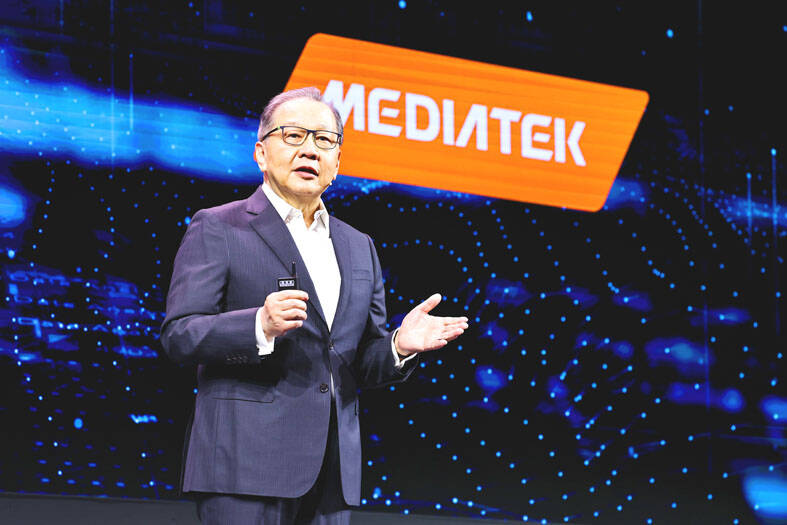
2024.Photo: CNA
That would follow volume production in the fourth quarter this year of the first AI ASIC it has designed for a US cloud service provider, MediaTek chief executive officer Rick Tsai (蔡力行) told an online investors’ conference.
MediaTek did not disclose the customer’s name, but reports said the company is designing a tensor process unit — an AI ASIC — for Google.
MediaTek expects to generate more than US$2 billion from chips used in data centers this year and for revenue to expand substantially next year, primarily driven by accelerating customer demand, Tsai said.
To increase its scale in the global AI ASIC market, MediaTek continues to deepen its engagement with several customers, he said.
On the advanced packaging technology front, MediaTek helps customers develop high-performance ASICs across a broad range of very large chip sizes using the chip-on-wafer-on-substrate (CoWoS) and EMIB-T technologies, leveraging its experience in advanced node design, such as 2-nanometer processes, as well as cutting edge engineering and architecture capabilities, the company said.
CoWoS is an advanced packaging technology developed by Taiwan Semiconductor Manufacturing Co (TSMC, 台積電) and widely used in AI chips production, while EMIB-T, a rival technology developed by Intel Corp, is expected to commence volume production in 2028.
MediaTek said its board of directors yesterday approved a US$5 billion budget to secure supply chain capacity and fuel the company’s strategic expansion from AI ASIC to full-scale systems and platforms.
MediaTek yesterday forecast that revenue this quarter would be flat or expand 15 percent sequentially to between NT$152.2 billion and NT$159.8 billion (US$4.71 billion and US$4.95 billion).
The company expects growth in connectivity and vehicle chips this quarter to offset a mid-single-digit percentage decline in smartphone chip revenue due to increased material costs.
MediaTek said it plans to launch a new flagship smartphone chip made on TSMC’s 2-nanometer technology this quarter to cater to demand for agentic AI features on premium phones.
For the full year, the company said it aims to increase revenue by a high-single-digit percentage in US dollar terms, achieving the high-end of its full year revenue growth target range.
Gross margin this year would be within the current quarter’s guidance range at about 46 percent, it said.
The company yesterday said net profit edged up 0.7 percent to NT$24.34 billion last quarter from NT$24.15 billion in the first quarter.
On an annual basis, net profit last quarter contracted 12.6 percent compared with NT$27.85 billion a year earlier.
Earnings per share last quarter were NT$15.28 versus NT$15.17 in the first quarter and NT$17.5 a year earlier.
Gross margin dropped to 46.2 percent from 46.3 percent in the first quarter and 49.1 percent in the second quarter last year.

Qualcomm Inc, the biggest maker of smartphone processors, plans to increase prices by a percentage in the double digits, a move that is likely to ripple through much of the tech industry. The San Diego-based company sent a letter to customers on Friday informing them of price hikes, according to a copy of the document seen by Bloomberg News. The rise would go into effect for products shipped after Sept. 1, Qualcomm said. The company said it had exhausted its ability to absorb higher costs from suppliers and had made attempts to secure alternative components from new sources. Like the rest of the
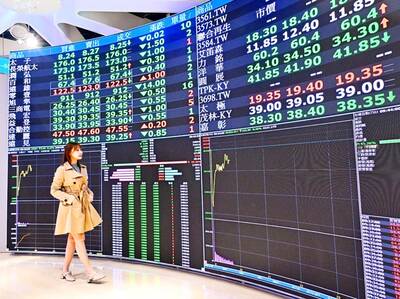
CRASH DIVE: Tech stocks across Asia are taking it in the teeth among war-induced uncertainties, worries about a bubble and more, as the TAIEX plunged precipitously The TAIEX suffered its third-largest point decline on record yesterday as investors continued a global retreat from tech shares amid concerns over the artificial intelligence (AI) boom, plunging 2,030.83 points, or 4.65 percent, to close at 41,603.36. The loss was exacerbated by a sharp selloff in global semiconductor stocks that triggered broad-based risk aversion across Asian markets, CTBC Securities Investment Service Co (中國信託證券投顧) said. The decline was driven mainly by market positioning rather than a deterioration in corporate fundamentals, CTBC said, citing the unwinding of leveraged trades and automated trading. “The selloff reflected panic in global markets, forced deleveraging and cascading program-driven selling
This year's Fortune Global 500 ranking listed Taiwan Semiconductor Manufacturing Co (TSMC, 台積電) among its top 100 companies for the first time. TSMC climbed 44 places to 82nd, with revenue of US$122.26 billion, a report published on Tuesday by New York-based Fortune magazine said. TSMC's entry into the top 100 for the first time underscored how surging demand for advanced chips is reshaping the scale and influence of companies in Asia and around the world, the report said. Besides TSMC, Taiwanese electronics manufacturer Wistron Corp (緯創) climbed 298 places to 198th on this year's list — the largest jump among all companies ranked
RUNNING HOT: The contract chipmaker is planning to both deepen and broaden its capacity, with more facility space and more advanced chips on offer United Microelectronics Corp (UMC, 聯電), the world’s fourth-largest contract chipmaker, plans to invest US$5 billion over the next two to three years to expand silicon photonics and advanced packaging capacity as artificial intelligence (AI)-driven demand accelerates. The company views silicon photonics and advanced packaging as vital businesses to its growth, and expects AI-related revenue to reach about US$300 million this year and surpass US$1 billion in three years, it said yesterday. “We actually feel pretty optimistic about advanced packaging, and that’s why we started facility deployment,” UMC CEO Jason Wang (王石) said at an earnings conference. “The overall [advanced packaging] addressable market


 RSS
RSS