


Nvidia Corp co-founder Jensen Huang (黃仁勳) joined US President Donald Trump on his visit to China as a last-minute addition, thrusting artificial intelligence (AI) and technology into the spotlight before a high-stakes Beijing summit.
Huang is among several US business leaders, including Apple Inc’s Tim Cook and Tesla Inc’s Elon Musk, on Trump’s first overseas trip since waging war in the Middle East — a 36-hour pow-wow with Chinese President Xi Jinping (習近平) that is expected to encompass the war, tariffs and the self-ruled Taiwan.
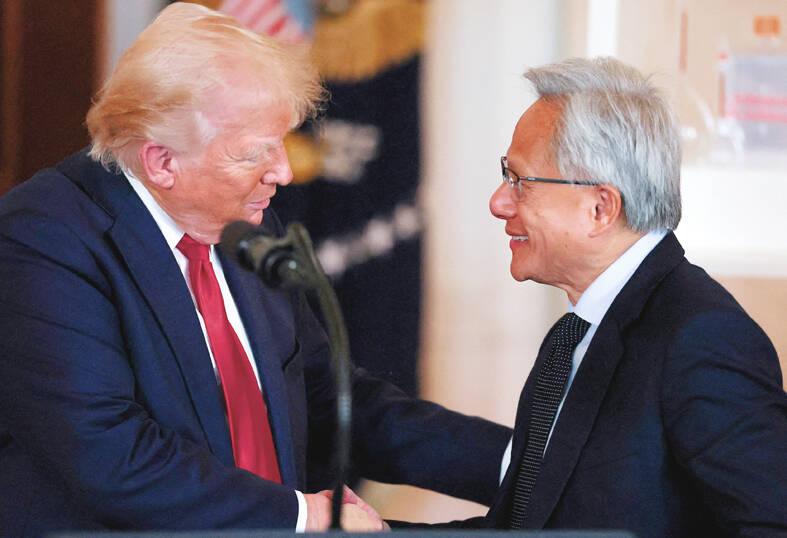
Photo: Reuters
The list of attendees until yesterday had not included Huang, whose company makes the chips at the heart of the AI boom and has been pushing for greater leeway in a market he has identified as a US$50 billion opportunity.
The Nvidia chief executive officer was spotted on the tarmac boarding the presidential plane and Trump later confirmed his attendance in a social media post, saying it was an honor to have Huang and other business leaders as part of the US delegation. Trump will also be joined by Boeing Co’s Kelly Ortberg and Goldman Sachs Group Inc’s David Solomon, among others.
“I will be asking President Xi, a Leader of extraordinary distinction, to ‘open up’ China so that these brilliant people can work their magic, and help bring the People’s Republic to an even higher level!” Trump said in the post. “In fact, I promise, that when we are together, which will be in a matter of hours, I will make that my very first request.”
It’s unclear whether Trump will raise with Xi any concerns that relate specifically to Nvidia, whose shares extended gains to more than 3 percent in after-hours Blue Ocean trading.
The big-ticket item would be seeking Beijing’s approval for Chinese customers to buy Nvidia’s advanced H200 AI chips. Those products, which are used to train and run models like OpenAI’s ChatGPT, have always required Washington’s permission for export to China due to US concerns that the technology could boost the Asian country’s military.
Trump’s team granted H200 licenses several months ago in a major reversal of US policy and huge win for Nvidia’s Huang — but Beijing remains a holdup. While China’s central government has for years complained about US export controls on advanced technology, Beijing also wants to achieve self-sufficiency in semiconductors and boost domestic champions like Huawei Technologies Co (華為). Last year, China rejected imports of less-advanced Nvidia AI chips called H20s.
It’s been a long road on H200 sales, which emerged as a possibility after China’s H20 import block. Nvidia secured Trump’s support for H200 exports in December last year and some initial US licenses in early this year. Then in March, Huang said that Nvidia had received Washington’s permission for shipments to “many customers” in China and was firing up H200 production accordingly. That was also in response to receiving official purchase orders from firms in the Asian country — an indication that Beijing had approved the sales.
But those Chinese companies later informed Nvidia that they could not actually fulfill the purchases, according to a person familiar with the matter. Last month, US Secretary of Commerce Howard Lutnick said that no H200s had been shipped to Chinese firms because the “Chinese central government has not let them, as of yet, buy the chips, because they’re trying to keep their investment focused on their own domestic industry.” It’s unclear how much new inventory Nvidia is now sitting on.
White House spokesman Steven Cheung (張振熙), asked about why Huang was now joining Trump’s trip, said Huang’s schedule changed and “it just happened to work out.” Trump called Huang this morning and asked him to come, and the Nvidia leader flew to Anchorage to meet Air Force One on its planned layover, according to a person familiar with the matter. Cheung said he wasn’t aware of Trump calling Huang before the schedule change.
“Jensen is attending the summit at the invitation of President Trump to support America and the administration’s goals,” Nvidia said in a statement.
The executives joining Trump are all from companies with significant existing China exposure and represent sectors expected to be part of the trip’s commercial agenda, according to another person familiar with the matter.
Shares of contract chipmaker Taiwan Semiconductor Manufacturing Co (TSMC, 台積電) came under pressure yesterday after a report that Apple Inc is looking to shift some orders from the Taiwanese company to Intel Corp. TSMC shares fell NT$55, or 2.4 percent, to close at NT$2,235 on the local main board, Taiwan Stock Exchange data showed. Despite the losses, TSMC is expected to continue to benefit from sound fundamentals, as it maintains a lead over its peers in high-end process development, analysts said. “The selling was a knee-jerk reaction to an Intel-Apple report over the weekend,” Mega International Investment Services Corp (兆豐國際投顧) analyst Alex Huang
Taiwan Semiconductor Manufacturing Co (TSMC, 台積電) is expected to remain Apple Inc’s primary chip manufacturing partner despite reports that Apple could shift some orders to Intel Corp, industry experts said yesterday. The comments came after The Wall Street Journal reported on Friday that Apple and Intel had reached a preliminary agreement following more than a year of negotiations for Intel to manufacture some chips for Apple devices. Taiwan Institute of Economic Research (台灣經濟研究院) economist Arisa Liu (劉佩真) said TSMC’s advanced packaging technologies, including integrated fan-out and chip-on-wafer-on-substrate, remain critical to the performance of Apple’s A-series and M-series chips. She said Intel and Samsung
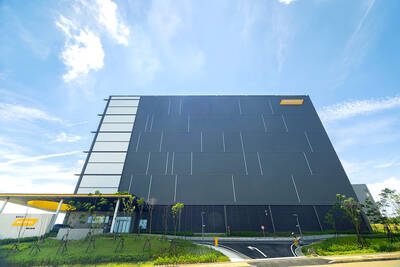
POWER BUILDUP: Powered by Nvidia’s B200 Blackwell chips, the data center would support MediaTek’s computing power demand and business growth, the company said Smartphone chip designer MediaTek Inc (聯發科) yesterday launched a new artificial intelligence (AI) data center with a maximum capacity of 45 megawatts to meet its rising demand for computing power required to develop new advanced chips for AI applications. The company has completed the first-phase computing power buildup at the data center in Miaoli County’s Tongluo Township (銅鑼), providing 15 megawatts of capacity to support its research and development (R&D) capabilities, despite an industrywide shortage of key components, MediaTek said. Supply constraints have plagued a wide range of key components, including memory chips, solid-state drives, power supply units and central
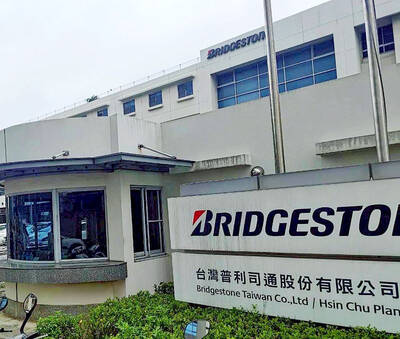
TRANSITION: With the closure, the company would reorganize its Taiwanese unit to a sales and service-focused model, Bridgestone said Bridgestone Corp yesterday announced it would cease manufacturing operations at its tire plant in Hsinchu County’s Hukou Township (湖口), affecting more than 500 workers. Bridgestone Taiwan Co (台灣普利司通) said in a statement that the decision was based on the Tokyo-based tire maker’s adjustments to its global operational strategy and long-term market development considerations. The Taiwanese unit would be reorganized as part of the closure, effective yesterday, and all related production activities would be concluded, the statement said. Under the plan, Bridgestone would continue to deepen its presence in the Taiwanese market, while transitioning to a sales and service-focused business model, it added. The Hsinchu


 RSS
RSS