


Taiwan is open to joining a global liquefied natural gas (LNG) program if one is created, but on the condition that countries provide delivery even in a scenario where there is a conflict with China, an energy department official said yesterday.
While Taiwan’s priority is to have enough LNG at home, the nation is open to exploring potential strategic reserves in other countries such as Japan or South Korea, Energy Administration Deputy Director-General Chen Chung-hsien (陳崇憲) said.
While the LNG market does not have a global reserve for emergencies like that of oil, the concept has been raised a few times — most notably by Japan in 2023. The US and Israeli attacks on Iran has upended the global gas market, triggering a wider conflict that has forced Qatar to close the world’s largest LNG export plant. About one-third of Taiwan’s LNG came from Qatar last year.
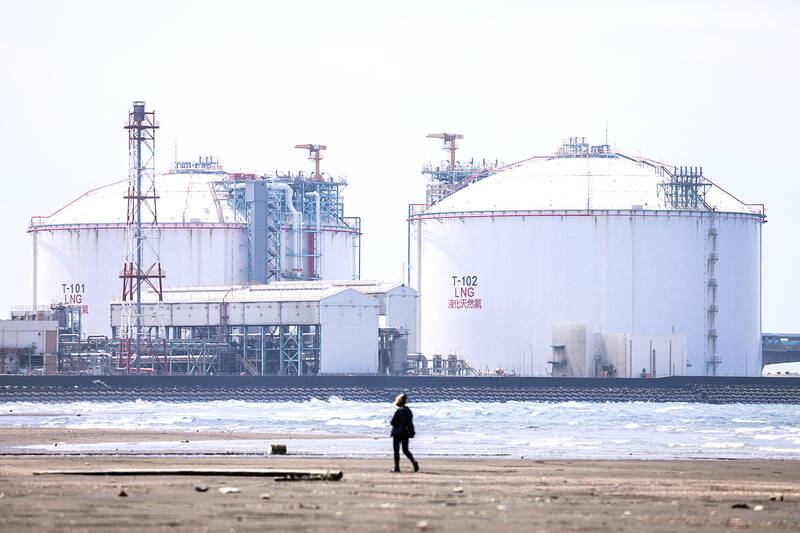
Photo: Cheng I-hwa, AFP
If Taiwan were to set up strategic reserves, “we must make sure those materials can be imported into Taiwan,” even if there are hostilities with China, Chen said.
Taiwan has about 11 days of LNG reserve onshore and plans to extend that to 14 days starting next year, he said. The long term goal would be to expand domestic stockpiles, provided exploration sites could be identified and the right environmental protections are put in place, he added.
Taiwan is making it a priority to shift away from the Middle East for its LNG imports, targeting 25 percent shipments from the US by 2029 from 10 percent today, Chen said, adding that there are also pans to increase purchases from Australia.
Taiwan imported one-third of its LNG from Australia last year.
Global LNG supply has been badly hampered by the war in Iran, with the closure of the Strait of Hormuz cutting the world off from about one-fifth of the total.
Asian LNG imports fell the most in more than three years last month as natural gas deliveries to the region declined 8.6 percent from a year earlier to about 20.6 million tonnes, ship-tracking data compiled by Bloomberg showed. That is the biggest drop since December 2022.
The region has been scrambling to seek alternative sources of energy, with countries including Bangladesh, India and Japan flocking back to coal, while in Vietnam, Vingroup JSC asked the government to allow it to replace an LNG project with renewable energy.

Singapore-based ride-hailing and delivery giant Grab Holdings Ltd has applied for regulatory approval to acquire the Taiwan operations of Germany-based Delivery Hero SE's Foodpanda in a deal valued at about US$600 million. Grab submitted the filing to the Fair Trade Commission on Friday last week, with the transaction subject to regulatory review and approval, the company said in a statement yesterday. Its independent governance structure would help foster a healthy and competitive market in Taiwan if the deal is approved, Grab said. Grab, which is listed on the NASDAQ, said in the filing that US-based Uber Technologies Inc holds about 13 percent of

Taiwan’s food delivery market could undergo a major shift if Singapore-based Grab Holdings Ltd completes its planned acquisition of Delivery Hero SE’s Foodpanda business in Taiwan, industry experts said. Grab on Monday last week announced it would acquire Foodpanda’s Taiwan operations for US$600 million. The deal is expected to be finalized in the second half of this year, with Grab aiming to complete user migration to its platform by the first half of next year. A duopoly between Uber Eats and Foodpanda dominates Taiwan’s delivery market, a structure that has remained intact since the Fair Trade Commission (FTC) blocked Uber Technologies Inc’s

Taiwan Semiconductor Manufacturing Co (TSMC, 台積電) yesterday received government approval to deploy its advanced 3-nanometer (3nm) process at its second fab currently under construction in Japan, the Ministry of Economic Affairs said in a news release. The ministry green-lit the plan for the facility in Kumamoto, which is scheduled to start installing equipment and come online in 2028 with a monthly production capacity of 15,000 12-inch wafers, the ministry said. The Department of Investment Review in June 2024 authorized a US$5.26 billion investment for the facility, slated to manufacture 6- to 12nm chips, significantly less advanced than 3nm process. At a meeting with
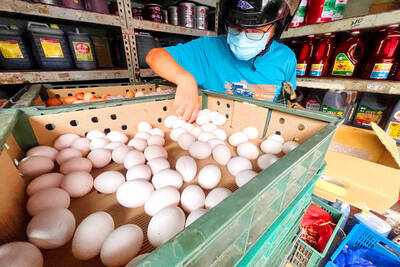
HEIGHTENED CONCERNS: A survey by National Central University showed that consumer concerns are linked to uncertainty caused by the war in Iran Taiwan’s consumer confidence declined this month as escalating tensions in the Middle East weighed on sentiment and heightened concerns over inflation and economic risks, a survey released yesterday by National Central University (NCU) said. The consumer confidence index dropped 4.28 points from the previous month to 62.3, the lowest level in three years and two months, the survey showed. All six sub-indicators dropped, including expectations for prices, household finances, the domestic economic outlook, employment opportunities, stock investment interest and purchases of durable goods. The retreat in sentiment reflects growing uncertainty linked to the ongoing conflict in the Middle East, which has raised


 RSS
RSS