


Taiwan’s economic growth is still expected to be higher than 7 percent this year if the Middle East war ends soon, National Development Council (NDC) Minister Yeh Chun-hsien (葉俊顯) said yesterday, citing the latest GDP growth forecasts by seven institutions.
Four forecast GDP growth above 8 percent, one predicted 7.28 percent, and two projected 6.92 percent and 6.22 percent, Yeh said at a news conference following an Executive Yuan meeting in Taipei.
“Economic growth this year should not differ significantly from the Directorate-General of Budget, Accounting and Statistics’ [DGBAS] forecast of 7.71 percent,” he said.
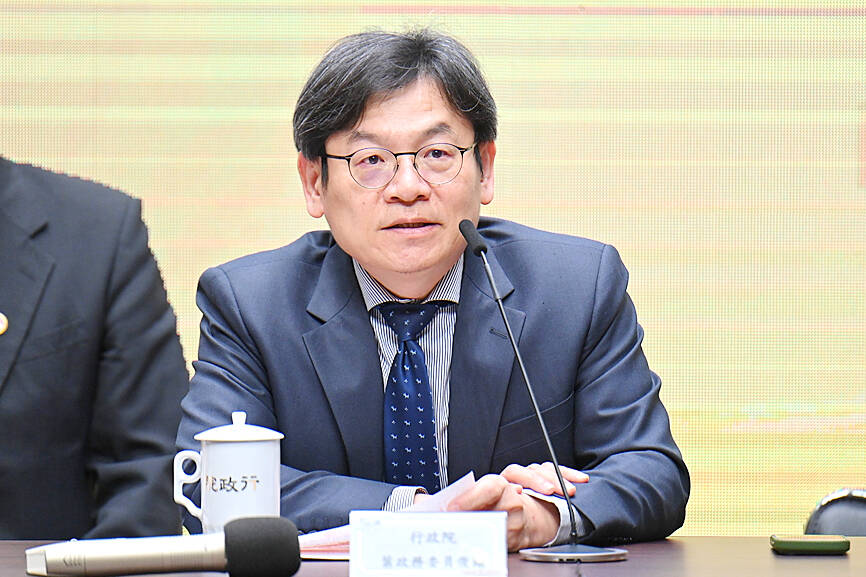
Photo courtesy of the Executive Yuan
The seven institutions include the central bank and Goldman Sachs Group Inc, Yeh added.
They remain relatively optimistic about the economy, mainly because the nation’s export structure has shifted toward the artificial intelligence (AI) industry, and the Middle East war has a relatively limited impact on AI development, he said, adding that it was “unlike the oil wars of the 1980s, when Taiwan’s exports focused more on petrochemical products.”
Regarding inflation outlook, the seven institutions forecast the consumer price index (CPI) could rise between 1.5 percent and 1.91 percent this year, Yeh said.
The central bank predicted CPI would rise 1.8 percent this year.
Headline inflation rose 1.33 percent in the first two months after seasonal adjustments, the DGBAS said last month.
The agency is scheduled to update its CPI data on Wednesday next week.
Based on information collected from the DGBAS and the central bank, inflation is expected to be below 1.5 percent in the first quarter and remain below the 2 percent alert level for the whole year, if the government’s price stabilization mechanism works smoothly, Vice Premier Cheng Li-chiun (鄭麗君) said at the news conference.
The conflict in the Middle East is impacting global energy supplies and market confidence, and exacerbating volatility in financial markets.
From March 2 to Wednesday, Taiwanese stocks fell by about 6.3 percent, lower than the 8.68 percent drop in Japanese stocks and the 12.26 percent decline in South Korean equities, indicating that the nation’s financial markets are relatively stable, Cheng said.
The government would continue to closely monitor the development of the war in the Middle East, and its impact on the domestic economy and inflation, and take subsequent policy adjustments when necessary, Cheng added.

Singapore-based ride-hailing and delivery giant Grab Holdings Ltd has applied for regulatory approval to acquire the Taiwan operations of Germany-based Delivery Hero SE's Foodpanda in a deal valued at about US$600 million. Grab submitted the filing to the Fair Trade Commission on Friday last week, with the transaction subject to regulatory review and approval, the company said in a statement yesterday. Its independent governance structure would help foster a healthy and competitive market in Taiwan if the deal is approved, Grab said. Grab, which is listed on the NASDAQ, said in the filing that US-based Uber Technologies Inc holds about 13 percent of

Taiwan’s food delivery market could undergo a major shift if Singapore-based Grab Holdings Ltd completes its planned acquisition of Delivery Hero SE’s Foodpanda business in Taiwan, industry experts said. Grab on Monday last week announced it would acquire Foodpanda’s Taiwan operations for US$600 million. The deal is expected to be finalized in the second half of this year, with Grab aiming to complete user migration to its platform by the first half of next year. A duopoly between Uber Eats and Foodpanda dominates Taiwan’s delivery market, a structure that has remained intact since the Fair Trade Commission (FTC) blocked Uber Technologies Inc’s

Taiwan Semiconductor Manufacturing Co (TSMC, 台積電) yesterday received government approval to deploy its advanced 3-nanometer (3nm) process at its second fab currently under construction in Japan, the Ministry of Economic Affairs said in a news release. The ministry green-lit the plan for the facility in Kumamoto, which is scheduled to start installing equipment and come online in 2028 with a monthly production capacity of 15,000 12-inch wafers, the ministry said. The Department of Investment Review in June 2024 authorized a US$5.26 billion investment for the facility, slated to manufacture 6- to 12nm chips, significantly less advanced than 3nm process. At a meeting with

HEIGHTENED CONCERNS: A survey by National Central University showed that consumer concerns are linked to uncertainty caused by the war in Iran Taiwan’s consumer confidence declined this month as escalating tensions in the Middle East weighed on sentiment and heightened concerns over inflation and economic risks, a survey released yesterday by National Central University (NCU) said. The consumer confidence index dropped 4.28 points from the previous month to 62.3, the lowest level in three years and two months, the survey showed. All six sub-indicators dropped, including expectations for prices, household finances, the domestic economic outlook, employment opportunities, stock investment interest and purchases of durable goods. The retreat in sentiment reflects growing uncertainty linked to the ongoing conflict in the Middle East, which has raised


 RSS
RSS