


As a boom in online gambling across Africa gathers pace, governments are hiking taxes to contain addiction risks and fill depleted state coffers. In by far the biggest market of South Africa, the industry is pushing back.
Once a niche activity, gambling has exploded across the continent as a result of easily available online betting accounts.
South Africa’s gambling industry regulator, the National Gambling Board, estimates that two-thirds of adults engage in online gambling, a sharp rise from 30 percent in 2017.

Photo: Reuters
The South African government has proposed a national 20 percent tax on online gambling profits, which it says would more than double revenues from the sector to 10 billion rand (US$607 million) annually from 4.8 billion rand currently.
The draft bill would be presented to lawmakers this year and the final tax proposal introduced in February next year, the South African National Treasury said.
Several political parties represented in parliament have expressed support for the tax.
Betting firms are lobbying hard against it, arguing that the tax would not curb problem gambling, but instead push it to unregulated sites, which they say would proliferate without the extra burden of the levies.
Local gambling firm Hollywood Bets, one of the largest in the country, has not publicly commented on the tax proposal, while NYSE-listed Betway said it would speak through the industry body, the South African Bookmakers’ Association.
Distress calls to a national helpline for gambling addicts have surged by more than two-thirds over the past year, South African Responsible Gambling Foundation executive director Sibongile Simelane-Quntana said.
The foundation acts as a national crisis center for problem gamblers and treated more than 4,600 people for addiction last year, up from 2,600 in 2024.
Simelane-Quntana said that most South Africans play out of desperation more than entertainment.
“We’re trying to gamble ourselves to prosperity,” she said.
Reuters spoke with two self-confessed gambling addicts in South Africa, who did not want to be named because of the stigma attached to the issue.
Both said that economic hardship had pushed them to gambling.
Southern African nations Malawi and Zimbabwe introduced similar tax hikes on gambling profits this year.
In Senegal, a gambler who identified himself by his initials, I.A, told Reuters that he relapsed into gambling after a five-year hiatus.
“When people ask me where my money goes, I can’t explain and I have to lie,” he said. “It hurts me. How can I not ... tell the truth?”
The 37-year-old Senegalese man living in the capital, Dakar, started playing in 2017, initially betting 300 CFA francs (US$0.5343) a week on sports bets while working as a cashier at a gambling company.
When he started working as a manager, he said he began stealing from the cash register, losing thousands of francs in bets.
He lost his job, but said he headed off legal action by returning the money.
Three months ago, I.A. started playing again after hearing his neighbor mention a new app for instant bets. In the familiar yo-yo of the struggling addict, he has been downloading and deleting apps again and again.
South African punters wagered a record 1.5 trillion rand in the 2024-2025 financial year, National Gambling Board data showed.
The South African government in paper published in November last year said that the proposed tax would reduce the proliferation of online gambling activity and disincentivize problem gambling.
However, in a formal submission to the treasury, the bookmakers’ association, which represents about one-quarter of the country’s 400 bookmakers, said it would be more effective to crack down on illegal gambling sites.
Currently gambling taxes are set by provincial authorities and average between 6 and 9 percent.
The new national tax would increase total tax rates to up to 29 percent, the Treasury said.
Bookmakers’ association chief executive officer Sean Coleman said that the total tax from a mix of provincial, value-added and national taxes, and the new levy would be 38.5 percent of profits.
The association is presenting a case to the government that its proposal would drive players to illegal sites, as legally registered companies could become more expensive and the winnings less attractive to players.
“That’s going to be a counterproposal from us, is to go and address the illegal market ... and we all reap the benefits,” Coleman said.
Meanwhile, debt-ridden Senegal announced additional gambling taxation in its economic recovery plan last year.
Seydina Mohamed Moustapha Gueye, head of a Senegalese association that organizes support group meetings with betting addicts, doubted that tax would help if “there is no policy in place to support these players who suffer from addiction.”
Lonase, the authority that regulates gambling, did not respond to a request for comment.
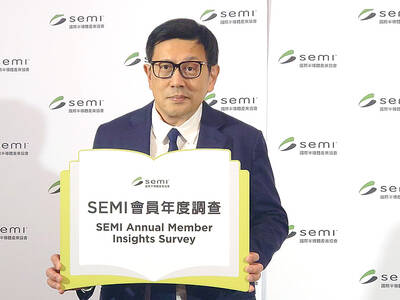
PRICE HIKES: The war in the Middle East would not significantly disrupt supply in the short term, but semiconductor companies are facing price surges for materials Taiwan’s semiconductor companies are not facing imminent supply disruptions of essential chemicals or raw materials due to the war in the Middle East, but surges in material costs loom large, industry association SEMI Taiwan said yesterday. The association’s comments came amid growing concerns that supplies of helium and other key raw materials used in semiconductor production could become a choke point after Qatar shut down its liquefied natural gas (LNG) production and helium output earlier this month due to the conflict. Qatar is the second-largest LNG supplier in the world and accounts for about 33 percent of global helium output. Helium is
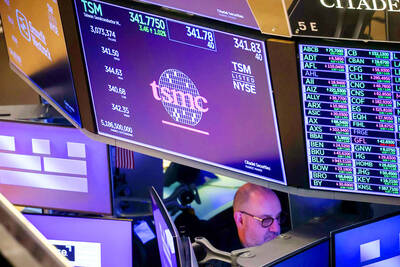
STRONG INTEREST: Analysts have pointed to optimism in TSMC’s growth prospects in the artificial intelligence era as the cause of the rising number of shareholders The number of people holding shares of chipmaker Taiwan Semiconductor Manufacturing Co (TSMC, 台積電) hit a new high last week despite a decline in its stock price, the Taiwan Depository and Clearing Corp (TDCC, 台灣集保) said. The number of TSMC shareholders rose to 2.46 million as of Friday, up 75,536 from a week earlier, TDCC data showed. The stock price fell 1.34 percent during the same week to close at NT$1,840 (US$57.55). The decline in TSMC’s share price resulted from volatility in global tech stocks, driven by rising international crude oil prices as the war against Iran continues. Dealers said
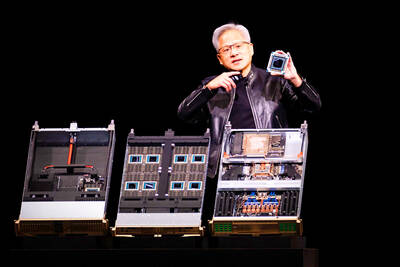
DOMESTIC COMPONENT: Huang identified several Taiwanese partners to be a key part of Nvidia’s Vera Rubin supply chain, including Asustek, Hon Hai and Wistron Nvidia Corp chief executive officer Jensen Huang (黃仁勳), addressing crowds at the company’s biggest annual event, unveiled a variety of new products while predicting that its flagship artificial intelligence (AI) processors would help generate US$1 trillion in sales through next year. During a two-and-a-half-hour keynote address, Huang announced plans to push deeper into central processing units (CPUs) — Intel Corp’s home turf — and introduced semiconductors made with technology acquired from start-up Groq Inc. The company even said it was developing chips for data centers in outer space. At the heart of Huang’s speech was the message that demand for computing power
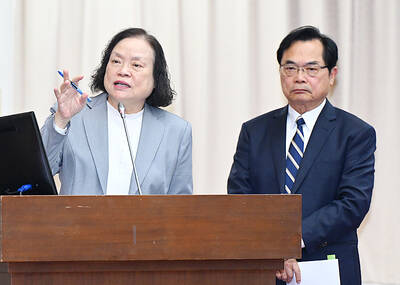
OPTIMISTIC: Inflation still has a chance of remaining below the central bank’s 2 percent alert level, as Taiwan’s economy is resilient with healthy exports, the NDC minister said Taiwan’s inflation could exceed 2 percent this year if oil prices continue to surge amid escalating tensions in the Middle East, prompting the government to reassess its economic outlook, the Directorate-General of Budget, Accounting and Statistics (DGBAS) said yesterday. DGBAS Minister Chen Shu-tzu (陳淑姿) told lawmakers at a meeting of the legislature’s Finance Committee that the agency’s earlier growth forecast of 1.68 percent in the consumer price index (CPI) and 7.71 percent for GDP this year did not account for the ongoing Middle East conflict and would need revision, if tensions persist. The previous forecast assumed an average international crude price of


 RSS
RSS